
Intellectual Property
Hot selling product recommendations
View More




















Cisco Switch Duel: N9K-C9236C - C9300-24UX-E Data Center Beast Meets Enterprise Powerhouse
When you place the Nexus N9K-C9236C next to the Catalyst C9300-24UX-E, you’re looking at two entirely different philosophies of networking. One is built for raw data center throughput, while the other is engineered for enterprise access layers where power, flexibility, and ease of use matter most. Here’s how they stack up where it counts.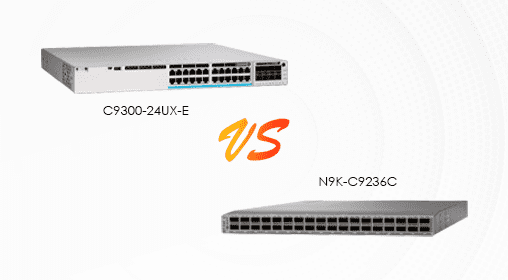
A quick glance at their technical DNA reveals their divergent purposes immediately.
|
Parameter |
N9K-C9236C (Data Center) |
C9300-24UX-E (Enterprise Access) |
|---|---|---|
|
Port Configuration |
36 x 100G QSFP28 ports (flexible as 1/10/25/40/50/100G) |
24 x Multi-Gig RJ45 (100M/1G/2.5G/5G/10G) + 4 x SFP+ uplinks |
|
Switching Capacity |
7.2 Tbps |
640 Gbps (scalable to 1.12 Tbps with stacking) |
|
Power over Ethernet |
Not supported |
Up to 60W per port (UPOE/POE++), 740W total budget |
|
Stacking Technology |
Not stackable (supports Fabric Extenders) |
StackWise-320 (320 Gbps backplane, up to 8 units) |
|
Latency |
Sub-microsecond |
<3 microseconds (cut-through mode) |
|
Buffer Size |
30 MB shared |
16 MB packet buffer |
|
Operating System |
Cisco NX-OS |
Cisco IOS XE |
|
Typical Use Case |
Data center spine/leaf, high-performance computing |
Enterprise wireless access, IoT deployments, smart buildings |
The Nexus 9236C occupies a 2RU chassis with a robust, data-center-optimized design. It’s built for racks where airflow and redundancy are critical, featuring hot-swappable power supplies and fans with N+1 redundancy. Weighing in at 8.3 kg without power supplies, it’s clearly designed for environments where hardware is set once and left to run 24/7.The Catalyst 9300-24UX-E, in contrast, fits into a more compact 1RU form factor. It’s tailored for wiring closets and office environments where noise levels matter—its acoustics are noticeably quieter than the Nexus’s data-center-grade fans, which can hit nearly 70 dBA at full speed. This one’s meant to be deployed where people actually work.
The Nexus 9236C is a performance monster. Its 36 ports can be broken out into a range of speeds, offering incredible flexibility for high-density data center architectures. It supports advanced data center technologies like VXLAN routing, EVPN control planes, and programmable fabric capabilities thanks to the Cloud Scale ASIC. This is the switch you turn to when you need to move massive amounts of data with minimal latency—think financial trading or AI workload clusters.
The Catalyst 9300-24UX-E takes a different approach. Its 24 Multi-Gigabit ports automatically negotiate speeds from 100M all the way up to 10G, making them perfect for mixed environments with legacy and modern devices. The standout feature is its UPOE/POE++ support, delivering up to 60W per port. That means it can power everything from Wi-Fi 6 access points and IP cameras to advanced building automation systems without needing separate power adapters. With StackWise-320, you can connect up to eight switches to act as a single unit, dramatically simplifying management for distributed deployments.
Working with the Nexus 9236C means you’re dealing with Cisco’s NX-OS, an operating system built for data center operators who need granular control over high-performance networking features. It supports automation through Python scripting, Puppet, Chef, and Ansible, but there’s a learning curve if you’re coming from the IOS world. This isn’t a switch you just plug in—it requires careful planning and configuration.
The Catalyst 9300 runs IOS XE, which will be familiar to anyone who’s worked with Cisco enterprise gear. It integrates seamlessly with Cisco DNA Center for software-defined access, making policy deployment and network automation significantly easier for enterprise IT teams. The web-based GUI provides an alternative to the command line for less experienced staff, while features like automated PoE provisioning simplify IoT device onboarding. It’s designed for operational efficiency in environments where IT resources may be stretched thin.
Both platforms are built for reliability, but with different failure scenarios in mind. The Nexus 9236C includes redundant, hot-swappable power supplies and fans as standard practice, reflecting the zero-downtime expectations of data center environments. Its mean time between failures (MTBF) is rated at 399,300 hours, and features like virtual PortChannels (vPC) provide additional resilience against link failures.
The Catalyst 9300 offers power supply redundancy as an option rather than a standard feature, but it provides stability through its stacking architecture. If one unit in a stack fails, the others continue operating, and the failed unit can be replaced with minimal disruption. The StackPower feature allows power supplies to be shared across the stack, providing additional resilience. For enterprise environments where occasional maintenance windows are acceptable, this approach balances cost and reliability effectively.
Trying to declare one switch "better" than the other misses the point—they’re optimized for completely different jobs.
The Nexus 9236C delivers tremendous value for data center and service provider environments where port density, bandwidth, and low latency are non-negotiable. Its flexible port configuration means you’re not locked into a single speed architecture, potentially saving on switch refresh cycles as needs evolve. This is infrastructure designed to handle the exponential growth of data traffic in modern applications.
The Catalyst 9300-24UX-E provides its value through versatility in enterprise access layers. The combination of Multi-Gigabit speeds and high-power PoE eliminates the need for separate power injectors and dedicated switching for different device types. When you factor in the management simplicity of StackWise and DNA Center integration, the total cost of ownership for distributed enterprise deployments becomes compelling.
Choose the Nexus N9K-C9236C if you’re building out data center fabric, supporting high-performance computing workloads, or need the ultimate in port density and throughput for traffic-heavy environments. Its raw performance and data-center-specific features justify its positioning in Cisco’s lineup.
The Catalyst C9300-24UX-E is the clear winner for enterprise access layers where Power over Ethernet, mixed-speed device connectivity, and operational simplicity are priorities. It’s particularly well-suited for modern workspaces, IoT deployments, and wireless networks where powering devices and simplifying management outweigh raw throughput requirements.
Ultimately, the right choice depends entirely on where and how the switch will be used. Both represent competent solutions for their intended domains—just make sure you’re not trying to use a race car to haul lumber or a pickup truck to win the Grand Prix.