
Intellectual Property
Hot selling product recommendations
View More



















Cisco Switch Deep Dive: C9300-48UN-A vs N3K-C3548P-10GX Enterprise Access Meets Data Center Core
When you place the Catalyst C9300-48UN-A next to the Nexus N3K-C3548P-10GX, you're looking at two different engineering philosophies. One is built for the connected, power-hungry enterprise edge; the other is a speed specialist for the data center core. Choosing between them isn't about finding the "better" switch, but about matching the right tool to the environment it was designed to dominate.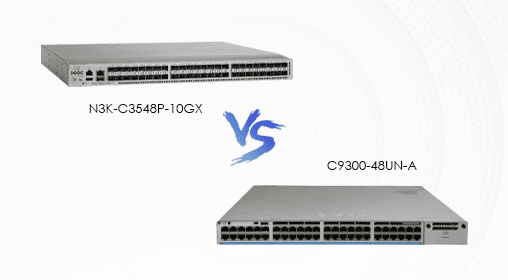
Let's get straight into the numbers that define their capabilities.
|
Core Parameter |
Cisco Catalyst C9300-48UN-A |
Cisco Nexus N3K-C3548P-10GX |
|---|---|---|
|
Port Configuration |
48 x Multi-Gigabit RJ45 (1/2.5/5/10Gbps) UPOE+ & 4 modular uplink slots (10G/25G/40G/100G)
|
48 x fixed 10 Gigabit Ethernet SFP+ ports
|
|
Power over Ethernet |
UPOE+ (90W per port), total budget up to 3,460W
|
Not Supported
|
|
Switching Capacity |
1.44 Tbps
|
960 Gbps
|
|
Forwarding Rate |
1.08 Bpps
|
720 Mpps
|
|
Stacking Technology |
StackWise-480 (480 Gbps backplane, up to 8 units)
|
Not stackable (supports vPC for multi-chassis link aggregation)
|
|
Operating System |
Cisco IOS XE
|
Cisco NX-OS
|
|
Typical Use Case |
High-density PoE+ for IoT, Wi-Fi 7 APs, smart buildings
|
Data center top-of-rack, high-performance computing
|
Physical Presence and Design Philosophy
The C9300-48UN-A sports a 1RU form factor designed for wiring closets where its silent operation is a necessity, not a luxury. Its front panel is dominated by RJ45 ports, ready to power and connect everything from a desk phone to an automated guided vehicle in a smart factory. The design prioritizes serviceability with hot-swappable power supplies and fans, acknowledging that it will be deployed in thousands of locations where uptime is critical.
In contrast, the N3K-C3548P-10GX is all business with its 48 SFP+ cages, signaling a pure focus on fiber connectivity and high-speed data transmission. It's built for data center racks where consistent, front-to-back cooling is paramount. The chassis supports reversible airflow with fan trays that can be configured for either port-side intake or exhaust, a crucial feature for managing thermal dynamics in tightly packed server environments. This is hardware designed to be installed and left to run at full tilt 24/7.
Where They Excel: Features for the Task
The Catalyst's standout feature is its monstrous power budget. Delivering up to 90W of UPOE+ on every port transforms it from a simple network switch into an infrastructure consolidation tool. It can power Wi-Fi 7 access points, advanced security cameras, and building automation systems directly, eliminating the clutter and cost of individual power injectors. With StackWise-480, you can connect up to eight switches to behave as a single logical device, dramatically simplifying management for large, distributed deployments.
The Nexus switch lives for speed and latency. It's built on a cut-through switching architecture to achieve sub-microsecond latency, a non-negotiable requirement for high-frequency trading, AI workload clusters, and storage area networks. Its operating system, NX-OS, is a data-center-hardened platform with features like VXLAN routing and programmable interfaces for automation at scale. This is not a "set and forget" switch; it's a core component for architects building high-performance fabric.
The Human Factor: User Experience
Working with the C9300 means you're in the familiar world of Cisco IOS XE. It integrates seamlessly with Cisco DNA Center for software-defined access, allowing for automated policy deployment and network-wide visibility. For IT teams managing a campus or a large branch office, the GUI and automation tools significantly reduce the day-to-day operational overhead.
The N3K demands a data center operator's mindset. Its NX-OS CLI is powerful and precise, built for engineers who need granular control over high-performance features. Automation is achieved through Python scripting and model-driven programmability, appealing to teams that manage infrastructure as code. The learning curve is steeper, but the payoff is total control in a complex environment.
Stability and Reliability Considerations
Both platforms are built for reliability, but they address different failure scenarios. The Catalyst ensures stability through its stacking architecture. If one unit in a stack fails, the others continue to operate, and the failed unit can be replaced with minimal disruption. The optional power supply redundancy provides additional resilience for critical access layer deployments.
The Nexus takes a more traditional data-center approach to redundancy. It is designed to accommodate a second power supply for true N+1 redundancy, and its fans are hot-swappable. Stability here is about absolute hardware uptime and predictable, microsecond-level performance under massive, sustained load.
The Value Proposition
The C9300-48UN-A's value is in its versatility and total cost of ownership for the enterprise edge. The convergence of data and high-power PoE on a single platform reduces cabling, eliminates power injectors, and simplifies operations. For environments deploying a massive number of IoT devices or next-generation wireless, the long-term savings can justify the investment.
The N3K-C3548P-10GX delivers value through raw, uncompromising throughput. Its price per 10G port and its extreme low latency are the key metrics for data center and financial sector deployments. Here, value is measured by the ability to handle exponentially growing data traffic without becoming a bottleneck.
The Final Verdict
Your choice is clear-cut. If your world is the enterprise access layer—powering devices, connecting users, and managing a scalable, automated network—the Cisco Catalyst C9300-48UN-A is your undisputed champion. It’s the strategic enabler for a hyper-connected workplace.
If your world is the data center core—where every microsecond counts and the network must move mountains of data with flawless precision—the Cisco Nexus N3K-C3548P-10GX is the specialized tool designed for that singular purpose. It’s the engine for high-performance computing and spine-leaf architectures.
Trying to use the C9300 as a data center core switch would be a lesson in frustration, just as attempting to use the N3K to power a campus of IP phones would be an expensive failure. Each is a master of its domain; your job is simply to recognize which domain you're building.