
Intellectual Property
Hot selling product recommendations
View More




















Cisco's Uplink Dilemma: When to Go with 4G's Steadiness or 8X's Muscle
Choosing between the Cisco C9300-NM-4G and the C9300-NM-8X network modules feels a lot like deciding between a reliable work truck and a high-performance transport. Both will get your cargo from point A to point B, but they're engineered for entirely different roads and loads. One is your go-to for connecting essential services and handling day-to-day traffic with unwavering reliability. The other is built for speed, designed to merge massive data streams onto the network highway without becoming a bottleneck. Picking the wrong one can leave you either with insufficient uplink capacity or paying for performance you'll never use.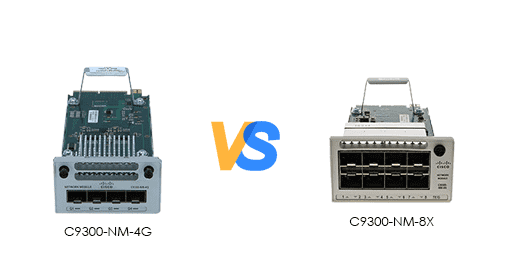
Let's get straight to the hardware specifics that define their capabilities.
|
Feature |
Cisco C9300-NM-4G |
Cisco C9300-NM-8X |
|---|---|---|
|
Port Configuration |
4 x 1 Gigabit Ethernet SFP slots
|
8 x 10 Gigabit SFP+ slots
|
|
Total Uplink Bandwidth |
4 Gbps aggregate
|
80 Gbps aggregate
|
|
Typical Latency |
<3 microseconds per port
|
Information not specified in available search results |
|
Key Differentiator |
Cost-effective Gigabit expansion |
High-density 10G aggregation |
|
Hot-Swap Capable |
Yes
|
Yes
|
|
Typical Power Draw |
~8 Watts
|
Information not specified in available search results |
|
Ideal Use Case |
Branch office fiber links, server access, connecting to legacy gear |
Data center aggregation, high-speed core links, bandwidth-intensive applications |
The Core of the Matter: Port Speed and Philosophy
The numbers in the table tell a clear story. The C9300-NM-4G is built for Gigabit connectivity. Its four SFP slots are perfect for when you need to add a few more fiber links, perhaps to connect to a server with a Gigabit NIC or to establish a dedicated link to a security appliance. It's the module you choose for practicality and cost-efficiency where 10G speeds are overkill. It’s the steadfast workhorse.
The C9300-NM-8X, in contrast, is a performance-oriented module. With eight SFP+ ports, it multiplies your uplink capacity. This is the module you turn to when you're aggregating traffic from multiple other switches or need high-speed links to your network core. It's designed to prevent the uplink from becoming a congestion point in a busy network. It’s the powerhouse.
Physical Design and Integration
Physically, both modules are designed to slide neatly into the modular slot on a Catalyst 9300 series switch, maintaining a clean 1RU form factor. The C9300-NM-4G, with its more modest performance profile, has straightforward thermal requirements. The C9300-NM-8X, packing more ports and higher speed into the same space, may incorporate more advanced thermal management solutions to maintain stability under full load.
Functionality and Daily Operations
In terms of features, both modules support essential enterprise functions like Quality of Service (QoS) and Access Control Lists (ACLs) to prioritize critical traffic and enhance security. The experience of using them, however, differs.
Deploying the C9300-NM-4G is straightforward. It's a plug-and-play solution for expanding connectivity. The simplicity is its virtue. The C9300-NM-8X, by nature of its role in more complex network segments, often comes into play in environments that leverage advanced capabilities like streaming telemetry for network analysis or integration with SD-Access architectures for policy-based automation.
Weighing Value and Stability
When it comes to value, the C9300-NM-4G is the clear winner for budgets focused on Gigabit needs. You're investing in a practical and economical way to add ports. The C9300-NM-8X commands a higher price, justifiable by the raw port density and speed it provides for demanding applications. The value is in avoiding a network bottleneck.Both modules benefit from the underlying stability of the Cisco IOS XE operating system and the robust hardware design of the Catalyst 9300 platform. The hot-swap capability of both modules means you can add or replace them without taking the entire switch offline, a significant plus for network availability.
The Bottom Line: Making the Right Call
So, which one is the correct tool for your network? The answer lies entirely in the question you need to answer.
Choose the Cisco C9300-NM-4G if your primary need is to add a handful of reliable Gigabit fiber connections. It's the ideal, cost-effective choice for connecting to servers, storage, or legacy infrastructure where 10G capability is not required.
Choose the Cisco C9300-NM-8X when you need to future-proof your uplinks. If you're building a network backbone, aggregating traffic from multiple access switches, or supporting bandwidth-intensive applications, the high-density 10G ports are not just a luxury—they are a necessity to ensure smooth data flow.
There's no universal "better," only the right module for the specific job your switch needs to do.