
Intellectual Property
Hot selling product recommendations
View More




















Cisco’s Power Duo: Unpacking the Real Differences Between N9K-C9332C and N9K-C93108TC-EX Switches
Choosing the right spine for your data center network isn't just about specs; it's about finding the perfect fit for your workload's personality. The Cisco Nexus 9000 series offers a range of options, and two standout models—the N9K-C9332C and the N9K-C93108TC-EX—cater to distinctly different roles. Let's break down their core identities beyond the datasheet.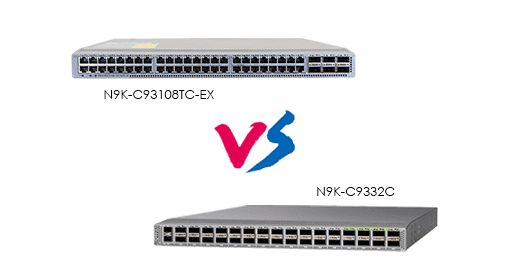
If you're building the backbone of a large-scale cloud or a high-performance computing (HPC) environment, the N9K-C9332C is designed to be the unwavering core. It’s the high-capacity freeway interchange, built for sheer speed and scale. In contrast, the N9K-C93108TC-EX is the ultimate high-density access and leaf switch. Think of it as a massive multi-lane on-ramp, efficiently aggregating traffic from a vast number of servers and funneling it upstream. One is a pure spine, and the other is a spine-and-leaf superstar.
|
Core Parameters |
Cisco N9K-C9332C |
Cisco N9K-C93108TC-EX |
|---|---|---|
|
Form Factor |
1RU
|
1RU
|
|
Fixed Port Configuration |
32 x 40/100G QSFP28 ports + 2 x 1/10G SFP+ ports
|
48 x 1/10G SFP+ ports + 6 x 40/100G QSFP28 ports
|
|
Total Switching Bandwidth |
6.4 Tbps
|
3.6 Tbps (full duplex)
|
|
System Memory |
16 GB
|
24 GB
|
|
SSD Storage |
128 GB
|
64 GB
|
|
Typical Power Consumption |
Information not explicitly found in search results |
~290W
|
Peeling back the layers on performance, the N9K-C9332C is all about raw power for the core. Its 6.4 Tbps backplane bandwidth
Physically, both switches occupy a single rack unit (1RU), but their front panels tell completely different stories. The C9332C presents a clean, focused interface dominated by thirty-two high-speed QSFP28 ports, signaling its purpose as a core interconnect. The C93108TC-EX is a portrait of density, packed with forty-eight SFP+ ports, ideal for a server-dense cabinet, accompanied by six QSFP28 uplinks for robust connectivity to the network spine. You'll find more variation in their internal makeup; the C9332C ships with 16GB of memory and a 128GB SSD, while the C93108TC-EX often comes with 24GB of memory and a 64GB SSD, reflecting their different operating system and application caching needs.
When it comes to features and functionality, both platforms run on Cisco's robust NX-OS and support the Application Centric Infrastructure (ACI) mode for software-defined networking. This is where you get advanced capabilities like VXLAN for network overlays and comprehensive automation tools. The C93108TC-EX, with its high 10G port density, truly shines in implementing micro-segmentation for security within a leaf-spine architecture, allowing for granular policies at the server access layer. The C9332C’s feature set is optimized for high-scale routing and efficient transport of large data flows across the fabric core.
From a usability standpoint, the C93108TC-EX is often the go-to for engineers working in server halls. Its port layout is perfect for a ToR deployment, directly connecting to a wide array of servers with a mix of SFP28 and QSFP28 connectivity options. The C9332C’s user experience is that of a network architect focused on the big picture. Its interface and command structure are geared towards managing high-speed interconnects, traffic engineering, and maintaining the stability of the entire network backbone. For teams deeply integrated into the Cisco ecosystem, the management experience will be familiar, but the operational focus is fundamentally different.
Discussing value isn't just about initial cost; it's about cost-per-port and operational efficiency. The C9332C provides high-density 100G connectivity, making it a cost-effective solution for building a high-capacity spine layer. The C93108TC-EX offers exceptional value in server access scenarios, where the cost per 10G server port is a key metric. Its ability to consolidate traffic and uplink at 100G provides a very efficient aggregation point. The choice hinges on your primary need: are you cost-optimizing for core bandwidth (C9332C) or for server access density (C93108TC-EX)?
In terms of reliability, both switches are built for data-center duty with redundant, hot-swappable power supplies and fans. The C9332C, designed as a core component, likely has its cooling and power architecture optimized for maximum uptime. The C93108TC-EX also boasts a robust build with front-to-back airflow, suitable for a dense server environment. Stability is a hallmark of the Nexus series, but the stability of the C9332C is about being an unshakeable core, while the stability of the C93108TC-EX is about reliably handling a high number of access connections.
So, what’s the final take? The N9K-C9332C is your undisputed champion for the core. Its strengths are raw bandwidth, high-density 100G ports, and a design purpose-built for being the spine of your network. The potential drawback is its lack of lower-speed ports, making it less ideal for direct server connectivity. The N9K-C93108TC-EX is the ultimate access layer specialist. Its superiority lies in its incredible 10G port density, flexible uplinks, and features optimized for ToR deployments. Its limitation is that it's not a core switch; its total throughput is lower, so deploying it as a spine could create a bottleneck. There's no universal winner here. For building a network backbone, the C9332C is the clear choice. For connecting a vast field of servers to that backbone, the C93108TC-EX is practically unmatched. It all comes down to the role you need to fill.