
Intellectual Property
Hot selling product recommendations
View More




















Cisco's Edge Duo: Choosing Between the Versatile C8300 and the Powerful C8500
When you're building the backbone of a modern network, the choice between the Cisco Catalyst C8300-2N2S-6T and the C8500-12X isn't about finding a winner; it's about matching the right architectural philosophy to your specific terrain. One is a versatile all-terrain vehicle, perfect for navigating the complex needs of a branch office. The other is a high-speed transport, designed to move data with raw power for aggregation roles. Picking the wrong one can lead to either a performance bottleneck or a lot of unused, expensive capacity.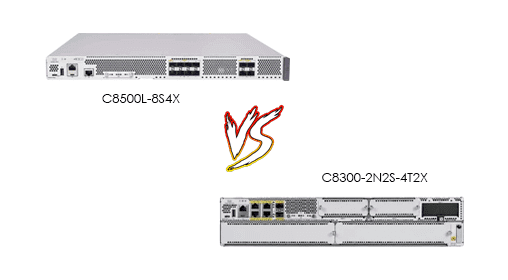
Let's start with the hard numbers, which tell a very clear story about their intended destinations.
|
Feature |
Cisco Catalyst C8300-2N2S-6T |
Cisco Catalyst C8500-12X |
|---|---|---|
|
Form Factor |
2 Rack Units (2RU)
|
Information not fully detailed in search results |
|
Default Port Configuration |
6 x 1 Gigabit Ethernet (RJ45) ports
|
12 x 10 Gigabit SFP+ ports
|
|
Expansion Slots |
2 x Service Module (SM), 2 x Network Interface Module (NIM), 1 x Pluggable Interface Module (PIM)
|
6 x Service Module (SM) slots
|
|
Performance (Throughput) |
SD-WAN IPsec: ~1.75 - 1.9 Gbps; IPv4 Forwarding: Up to ~19.7 Gbps
|
Up to 10 Gbps (with services)
|
|
IPsec VPN Performance |
Up to 5 Gbps (IMIX)
|
Information not specified in available search results |
|
Default Memory (DRAM) |
8 GB (Upgradable to 32 GB)
|
Information not specified in available search results |
|
Power Supplies |
Default Dual (AC/DC/PoE options)
|
Information not specified in available search results |
|
Key Differentiator |
Flexibility and service integration for branches |
High-speed port density for aggregation |
The Core Design Philosophy
The table reveals the fundamental difference. The C8300-2N2S-6T is a modular maestro built for integration. Its strength isn't just in its six built-in Gigabit Ethernet ports, but in its impressive array of expansion slots—two for Service Modules (SMs) and two for Network Interface Modules (NIMs). This design lets you tailor the device extensively. You can add modules for 4G/5G wireless failover, additional PoE+ ports to power devices like phones and cameras, or even enhanced security services. It’s engineered to be the all-in-one heart of a sophisticated branch office, consolidating multiple functions into a single, manageable platform.In the other corner, the C8500-12X appears to be a study in focused performance. With twelve 10G SFP+ ports right out of the gate, it's built for environments where bandwidth is the non-negotiable currency. This kind of configuration is ideal for aggregating traffic from multiple access switches or for high-speed data center connections. While it also offers expansion via six Service Module slots, its primary identity is clear: move large amounts of data, fast.
Living with Each Device
Deploying these two boxes feels different. Setting up the C8300 involves more planning. You need to consider which modules to populate in its various slots to meet the specific needs of the site. This initial complexity, however, pays off in long-term flexibility. As the branch grows or its needs change—perhaps requiring a new type of WAN connection or a new security service—you can often just slot in a new module instead of replacing the entire router. It's a long-term partner for dynamic environments.The C8500-12X, in contrast, feels more like a precision instrument for a known task. If your need is primarily for a high-density 10G aggregation point, the configuration is more straightforward. You're getting a powerful engine designed to handle heavy traffic loads with simplicity. The experience is centered on leveraging its raw port speed and throughput for well-defined, high-bandwidth applications.
Weighing Value, Stability, and the Right Choice
In terms of value, the C8300-2N2S-6T shines if you need a versatile platform that can adapt and grow, potentially saving you from a costly hardware refresh down the line. You're investing in flexibility. The C8500-12X delivers value when your primary, unchanging need is massive throughput. You're paying for pure power and port density.Both platforms run on the robust Cisco IOS XE operating system, which is a hallmark of stability. The C8300 is designed with high availability in mind, shipping with default dual, redundant power supplies. The C8500, as a higher-end platform, would be expected to have correspondingly robust hardware design to ensure reliability for its role in the network.
So, which warrior belongs in your network? The answer lies in the mission.
Choose the Cisco Catalyst C8300-2N2S-6T if your battlefield is a complex branch office. It's the ideal fit when you need a single device that can handle routing, SD-WAN, security, and multiple types of connections (both current and future). Its modularity makes it a resilient and adaptable choice.
Lean towards the Cisco Catalyst C8500-12X when your mission is to build a high-capacity network backbone. It's the right tool for aggregating traffic from other switches or for applications where 10G connectivity is the standard requirement and maximum data throughput is the primary goal.
Ultimately, the better device is the one that is perfectly suited to the task at hand. Carefully mapping your performance needs against your requirement for flexibility will lead you to the correct choice.