
Intellectual Property
Hot selling product recommendations
View More




















Cisco’s Data Center Dilemma: Picking Between the N9K-C9364C and N9K-C93180YC-EX
Walking into a data center, the choice of switch isn't just about specs on a page. It’s about the feel of the network, the pulse of the traffic. On one side, you have the N9K-C9364C, a beast built for the core. On the other, the N9K-C93180YC-EX, a versatile workhorse for the edge. They’re both from the same Cisco Nexus 9000 family, but they live in different worlds. Let’s get into what really sets them apart.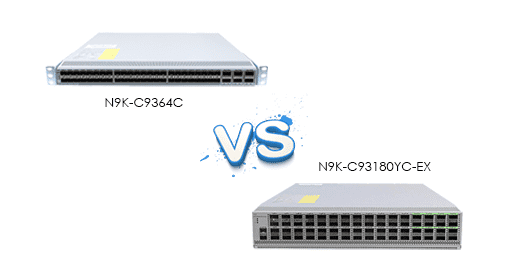
First, the raw numbers. This is where you see their DNA.
|
Core Parameters |
Cisco N9K-C9364C |
Cisco N9K-C93180YC-EX |
|---|---|---|
|
Form Factor |
2RU |
1RU |
|
Fixed Port Configuration |
64 x 40/100G QSFP28 ports |
48 x 1/10/25G SFP28 ports + 6 x 40/100G QSFP28 ports |
|
Total Switching Capacity |
12.8 Tbps |
3.6 Tbps |
|
Forwarding Rate |
~9.5 Bpps |
~2.7 Bpps |
|
Typical Power Draw |
Higher, often 500W+ range |
Lower, typically under 300W |
|
Cooling |
Side-to-side airflow (port-side exhaust) |
Front-to-back airflow |
Looking at that table, the story is pretty clear. The 9364C is about pure, unadulterated power. Its 12.8 Tbps capacity is meant for one thing: being the spine of a large network, handling massive amounts of traffic between other switches without breaking a sweat. The 93180YC-EX is about flexibility and density. Those 48 ports can be 1G, 10G, or 25G, making it a dream for connecting a rack full of servers with mixed speed requirements, while the six 100G uplinks give it a powerful connection to the core.
Performance-wise, it’s a classic case of a heavyweight versus a middleweight. The 9364C is built for raw bandwidth. It’s the central freeway interchange of your network. The 93180YC-EX, with its support for cut-through switching, offers incredibly low latency, which is critical for high-performance computing or financial trading applications where every microsecond counts. You’d choose the first for sheer volume, the second for sheer speed at the server access layer.
The physical feel of these switches is different, too. The 9364C is a substantial 2RU unit. Its face is a grid of sixty-four QSFP28 ports—intimidating and focused. It demands space and proper cooling. The 93180YC-EX is a sleeker 1RU device. Its front panel is a mix of SFP28 and QSFP28 ports, a sign of its multi-role personality. It fits neatly into a standard rack, designed for top-of-rack deployment where real estate is precious.
When we talk features, both run Cisco’s robust NX-OS and support ACI mode. But their strengths diverge. The 9364C excels in high-scale routing protocols and massive VXLAN overlay networks. It’s built for stability and scale at the core. The 93180YC-EX shines in features like granular quality of service (QoS) and advanced security policies right at the access layer. Its ability to handle a mix of port speeds on the fly is a major operational advantage.
For the engineer actually using these boxes, the experience varies. Deploying a 9364C is a strategic event. It’s about planning the core network architecture. The configuration is focused on high-speed interconnects. The 93180YC-EX is a hands-on tool. Engineers love it for its flexibility in the server rack. Need to connect a 10G NAS, a 25G server, and have a 100G uplink? It’s a one-stop shop, simplifying cable management and configuration.
Value is a tricky thing. The 9364C’s value is in its core capacity. If you need that level of throughput, it’s cost-effective on a per-100G-port basis. It’s a strategic investment. The 93180YC-EX delivers value through versatility and operational simplicity. Its cost per connected server can be very attractive, especially in environments with diverse hardware. It’s a tactical tool that saves time and hassle.
Stability is non-negotiable for both, but it manifests differently. The 9364C is engineered for 24/7 operation as the network’s heart. Its redundancy and cooling are designed for constant, heavy load. The 93180YC-EX is equally stable, but its stability is tested in a different way—handling frequent adds, moves, and changes at the access layer without flinching.
So, what’s the final word?
The N9K-C9364C's strengths are its immense bandwidth and its purpose-built design for the spine role. The downside? It’s overkill for anything else. It’s a specialist tool with a high power footprint. You wouldn’t use it to connect servers directly.
The N9K-C93180YC-EX's advantages are its port flexibility, compact size, and lower power consumption. It’s a jack-of-many-trades. The compromise is its lower overall throughput; it’s not meant to be the core of a large network. It’s the master of the access layer.
There’s no winner here, only the right tool for the job. If you’re building the backbone of a cloud, the 9364C is your answer. If you’re wiring up a modern, high-density server rack, the 93180YC-EX is incredibly hard to beat. The choice ultimately maps directly to the role you need to fill in your data center story.