
Intellectual Property
Hot selling product recommendations
View More




















Cisco's Crossroads: Choosing Between the Nexus N9K-C9232C and the Catalyst WS-C4500X-32SFP+
When you're building the backbone of a network, the choice between a switch from Cisco's Nexus line and one from the Catalyst family is more than just a comparison of specs—it's a decision about the network's very personality. The N9K-C9232C and the WS-C4500X-32SFP+ sit in a similar performance class but are engineered for different worlds. One is a data center speed specialist, and the other is a resilient enterprise workhorse. Let's get into the details that matter.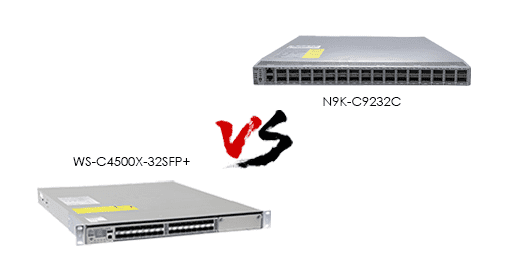
First, the raw numbers tell a clear story about their design priorities.
|
Core Parameters |
Cisco Nexus N9K-C9232C |
Cisco Catalyst WS-C4500X-32SFP+ |
|---|---|---|
|
Product Family / Use Case |
Nexus Series / Data Center |
Catalyst Series / Enterprise Core/Aggregation |
|
Fixed Port Configuration |
32 x 40/100G QSFP28 |
32 x 1/10G SFP+ (with optional 8 x 10G Ethernet or 2 x 40G expansion) |
|
Switching Capacity |
6.4 Tbps |
800 Gbps |
|
Forwarding Rate |
~4.8 Bpps |
~400 Mpps |
|
Typical Latency |
Ultra-low, cut-through switching |
Higher, store-and-forward switching |
|
Architecture |
Centrally shared memory |
Port-specific buffers |
Looking at this, the N9K-C9232C is in a different league regarding raw throughput. It's built for the data center spine, where handling massive east-west traffic between servers and other switches is the primary job. The WS-C4500X-32SFP+, with its more modest capacity, is designed for the enterprise wiring closet or network core, focusing on aggregating traffic from access switches and providing robust, feature-rich connectivity for users and services.
Performance-wise, the difference is fundamental. The Nexus switch is all about speed and low latency, using cut-through switching to minimize delay for high-performance computing and storage networks. The Catalyst switch prioritizes reliability and deep packet inspection, using store-and-forward switching to ensure data integrity, which is critical for business applications but adds a tiny bit of latency.
Physically, they share a similar 1RU footprint, but their front panels reveal their purpose. The N9K-C9232C is a study in focus: 32 identical high-density QSFP28 ports for a clean, high-speed interconnect. The WS-C4500X-32SFP+ offers more flexibility, with its 32 SFP+ ports and room for expansion modules to add copper ports or higher-speed uplinks, adapting to the varied needs of a campus network.
Feature sets diverge sharply. The Nexus switch runs Cisco's NX-OS, optimized for automation, programmability (with features like VXLAN for network overlays), and stability in large-scale data center environments. The Catalyst runs the classic Cisco IOS XE, a battle-tested operating system packed with advanced routing, security, and application visibility features essential for managing a complex enterprise network.
For the network engineer, the experience is defined by the environment. Working with the N9K-C9232C feels like tuning a race car—it's about optimizing for sheer speed and efficiency within the controlled climate of a data center. Managing the WS-C4500X-32SFP+ is like driving a supremely capable off-road vehicle; it's about leveraging a vast set of features (like advanced QoS and security policies) to handle the unpredictable terrain of user traffic and ensure unwavering uptime.
Value is contextual. The N9K-C9232C's value is its unparalleled 100G port density for the data center core. The WS-C4500X-32SFP+ delivers value through its versatility, expansion options, and the comprehensive feature set of IOS XE, making it a long-term strategic platform for the enterprise network core.
Stability is paramount for both, but it's achieved differently. The Nexus switch is engineered for predictable, high-volume data center traffic patterns. The Catalyst switch is built to be resilient against the erratic and bursty nature of enterprise user traffic, with robust buffers to prevent packet loss during congestion.
So, what's the final call?
The N9K-C9232C's strengths are its raw bandwidth, low latency, and data-center-optimized operating system. Its main drawback is its lack of port variety; it's a specialist that can be overkill for a general enterprise network.
The WS-C4500X-32SFP+'s advantages are its operational flexibility, the rich feature set of IOS XE, and its proven stability in demanding enterprise environments. The compromise is its lower overall throughput; it is not designed for the internal traffic flows of a modern data center.
There's no winner, only the right tool. If your world is the data center and your currency is speed, the N9K-C9232C is the clear choice. If your domain is the enterprise campus and your mission is reliable, feature-rich connectivity, the WS-C4500X-32SFP+ remains an incredibly solid foundation. The choice maps directly to the architectural blueprint of your network.