
Intellectual Property
Hot selling product recommendations
View More




















Cisco's C9200L-24P-4G-E vs. C9200-24T-A Switch Showdown
Hey there! So you're trying to decide between these two Cisco Catalyst 9200 switches? It's a classic dilemma. On the surface, they might seem similar, but the devil's in the details, and that's where your network's needs really come into play. Let's break them down in a way that's a bit more conversational than a boring spec sheet.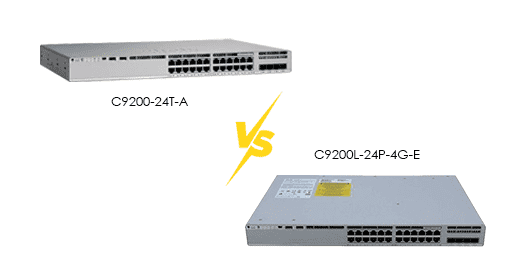
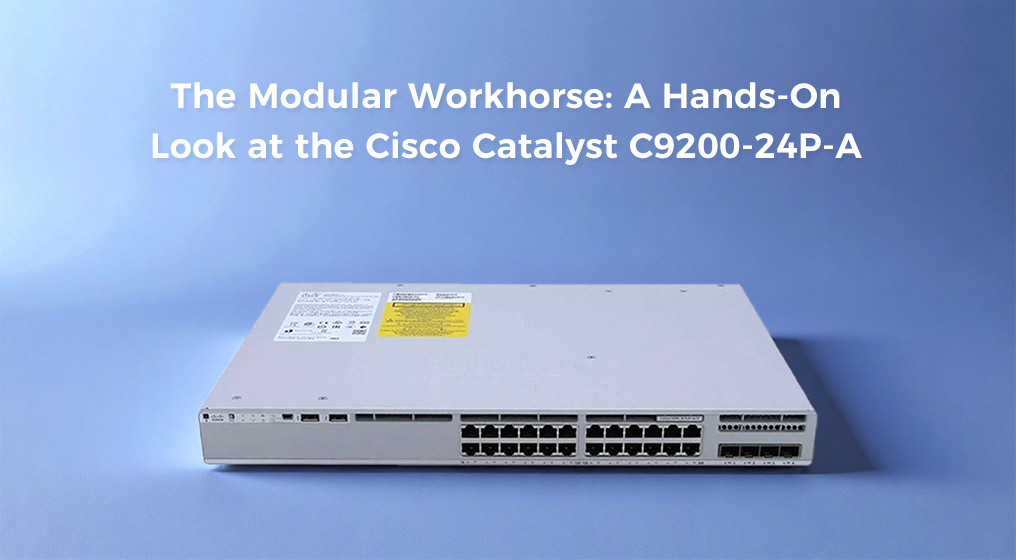
First things first, the most glaring difference hits you right in the ports. The C9200L-24P-4G-E is the power player—literally. All 24 of its Gigabit Ethernet ports are full PoE+ ports. This is a massive deal if you're running a bunch of devices that need power over the network cable, like wireless access points, IP security cameras, or VoIP phones. It's got a hefty power budget to keep them all humming. The other model, the C9200-24T-A, sticks to data. Its 24 ports are standard Gigabit Ethernet, meaning they handle your network traffic but won't power your devices. This fundamental distinction really sets them on different paths.
Here’s a quick look under the hood to see how their core parameters stack up. This table lays out the raw numbers.
|
Feature |
Cisco C9200L-24P-4G-E |
Cisco C9200-24T-A |
|---|---|---|
|
Total 1G Copper Ports |
24
|
24
|
|
PoE Capability |
24 x PoE+ Ports
|
Non-PoE (Data Only) |
|
Default Power Supply |
PWR-C5-600WAC (for PoE)
|
PWR-C6-125WAC (for switch operation)
|
|
Uplink Ports |
4 x 1G SFP
|
Information not specific in search results |
|
Switching Capacity |
56 Gbps
|
104 Gbps
|
|
Packet Forwarding Rate |
41.66 Mpps
|
Information not specific in search results |
|
Typical Power Consumption |
370W (with PoE load)
|
Lower (data-only operation) |
|
Dimensions (HxWxD) |
440 x 445 x 288 mm
|
Information not specific in search results |
Based on the specs, their personalities are pretty clear. The C9200L-24P-4G-E is your go-to workhorse for a "powered" edge. Imagine an office floor, a school classroom, or a hospital wing packed with devices that need both data and power. This switch cleans up the mess by eliminating the need for a separate power adapter for every single device. It's designed for environments where convenience and centralized power management are key. The trade-off is that all that power conversion generates more heat, so it might have more active cooling, leading to a bit more noise.
On the flip side, the C9200-24T-A is the lean, data-focused machine. It's perfect for a wiring closet where your main job is to aggregate data traffic from other switches or to connect non-PoE devices like desktop computers, printers, and servers. Because it's not dealing with the complexities of power delivery, it can be more energy-efficient and potentially quieter in operation. Its higher switching capacity, as mentioned in one source, also suggests it might be built for pure data-crunching performance.
When we talk about stability, both are enterprise-grade Cisco switches, so they're built to be reliable. The PoE switch, however, has a more demanding job. Powering devices adds another layer of complexity and a point of potential failure, though Cisco's design is robust. The non-PoE model's simplicity might give it a slight edge in pure, raw uptime for data-only tasks.
As for value, it's not about which is cheaper, but which gives you more for yourmoney. If you need PoE, the C9200L-24P-4G-E is unquestionably the better value. Paying extra for separate power injectors and dealing with that cable spaghetti is a nightmare. But if you have zero need for power on your ports, then spending on the PoE model is a waste of budget. The C9200-24T-A would be the smarter, more cost-effective choice in that scenario.
So, which one is for you? It boils down to a simple question: do your devices need to be powered? If the answer is yes, the C9200L-24P-4G-E is your clear winner. If you're just moving data, the streamlined C9200-24T-A will serve you well and might even be the more elegant solution. Hope this real-talk breakdown helps you make the call