
Intellectual Property
Hot selling product recommendations
View More




















Cisco's C6800-SUP6T: The Heartbeat of Your Network Chassis
If you're running a Cisco Catalyst 6800 series chassis, you know it's not just a piece of hardware—it's the backbone of your entire network. And what makes it tick? That would be the supervisor engine, specifically the C6800-SUP6T. Think of it as the brain of the entire operation. This module doesn't handle the data packets directly (that's what the line cards are for), but it tells them exactly how and where to send traffic. It runs the show, managing the entire system's control plane, ensuring all the components work together seamlessly, and providing the intelligence for advanced features. It's what transforms a powerful chassis into a smart, functioning network powerhouse.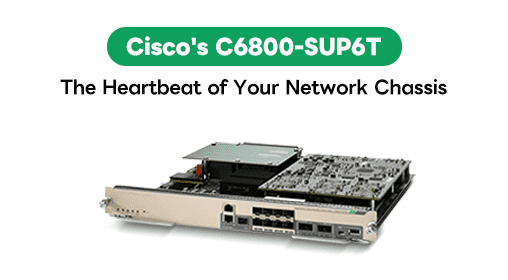
This supervisor engine is built for performance. It's designed to deliver a solid 440 Gbps per slot, ensuring that your network doesn't become a bottleneck. Right on the front panel, you get a handy set of built-in ports to connect to high-speed links without needing additional modules: eight 10 Gigabit Ethernet ports and two 40 Gigabit Ethernet ports for those hefty uplinks. Here’s a quick look at its core specs:
|
Feature |
Specification |
|---|---|
|
Forwarding Performance |
440 Gbps per slot
|
|
Built-in Ports |
8 x 10 Gigabit Ethernet (SFP+), 2 x 40 Gigabit Ethernet (QSFP+)
|
|
Communication Mode |
Full-Duplex & Half-Duplex
|
|
Management Port Speed |
10/100/1000 Mbps
|
Physically, the C6800-SUP6T is a half-width module that slides into the dedicated supervisor slot of your chassis. The front is where the action is, housing those eight 10GbE and two 40GbE ports, along with the essential management interfaces like the console port and status LEDs. It’s crafted with redundancy in mind—serious installations typically run two of these in a chassis. If the active supervisor has a hiccup, the standby takes over without dropping a session, which is absolutely critical for maintaining uptime in a data center environment.
What really makes it valuable are the features it unlocks. We're talking full support for advanced routing protocols, network virtualization technologies like MPLS and VXLAN, and deep programmability with APIs. It also handles Cisco’s TrustSec security for segmenting traffic and provides detailed analytics about what's happening on your network. This isn't just a simple controller; it's what gives the Catalyst 6800 its enterprise-grade muscle.
From a user's perspective—especially if you're a network engineer—working with a system powered by the SUP6T is about reliability and familiarity. The CLI is pure Cisco, so if you've worked with other Catalyst switches, you'll feel right at home. The high availability features are a lifesaver. The stateful switchover means that if the active supervisor has an issue, the backup takes over so smoothly that most applications won't even notice. And because it's part of the Cisco ecosystem, it integrates easily with management tools like DNA Center. That’s a big plus for automation and day-to-day operations.
Now, is it a good value? The C6800-SUP6T isn't something you buy alone; you're investing in the whole Catalyst 6800 platform. For the price, you're getting a reliable, high-performance supervisor from a vendor with a solid reputation. Its true value shines in environments that need high availability, advanced features, and tight security. If you're building a large, critical network where downtime is not an option, the redundancy and features justify the cost. However, for a small business or a simple setup that doesn't need such advanced capabilities, the overall solution might be more than what's necessary.
So, what's the real-world take? People who use it appreciate its proven reliability. It's based on a mature platform, so most of the bugs have been ironed out, giving you stable performance for 24/7 operations. The high availability with stateful failover is rock solid. On the flip side, the Catalyst 6800 series isn't the newest kid on the block. While perfectly capable, it may not match the raw throughput or energy efficiency of some newer platforms. Also, the overall solution cost can be high, especially for smaller deployments where such advanced capabilities might be underutilized. It's a workhorse that delivers where it counts: reliability, features, and seamless failover for complex networks that can't afford surprises