
Intellectual Property
Hot selling product recommendations
View More




















Cisco's Branch Battle: Modern C8200L-1N-4T vs. Proven ISR4331
Picking between Cisco's C8200L-1N-4T and the ISR4331 isn’t just about specs—it’s a choice between two different philosophies. The C8200L screams "future-ready," built for a cloud-first world where SD-WAN and security are baked in from the ground up. The ISR4331? It’s the seasoned veteran, a workhorse that’s been holding down branches for years with proven reliability. Let’s break down where each one shines, and where it might leave you wanting more.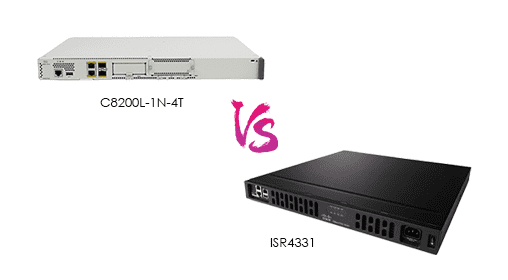
First, the raw numbers. A side-by-side look at their core specs tells you exactly who they’re built for.
|
Parameter |
C8200L-1N-4T |
ISR4331/K9 |
|---|---|---|
|
Form Factor |
Modular |
Non-modular (Fixed ports) |
|
WAN Ports |
4x 1GigE RJ45 |
1x GE/SFP, 1x GE, 1x SFP |
|
Expansion Slots |
1 NIM slot |
2 NIM slots, 1 SM slot |
|
SD-WAN Throughput |
500 Mbps |
Not explicitly rated for modern SD-WAN |
|
System Memory (DRAM) |
Up to 32 GB |
Default 4 GB (Max 16 GB) |
|
Flash Storage |
Not specified in sources |
Default 4 GB (Max 16 GB) |
|
USB Ports |
Not specified in sources |
1x Type-A USB port |
|
Key Feature Focus |
SD-WAN, SASE, Cloud Management |
Multi-service routing (voice, data, video) |
Just glancing at that table, the C8200L is playing a different game. It’s built for bandwidth and software-defined everything, while the ISR4331 focuses on versatile connectivity and hardware expansion.
When you look at them, the C8200L feels like the sleek, modern tool. Its modular design means you can pop in a NIM for 5G failover or extra ports without a full chassis overhaul. It’s built for scalability. The ISR4331 has a more traditional, industrial feel—sturdy, fixed ports, and those extra NIM slots let you customize with older or specialized modules. It’s the kind of box you install and forget for years, but it’s not as nimble for sudden tech shifts.
Feature-wise, the gap widens. The C8200L is born for SD-WAN and SASE (Secure Access Service Edge). It integrates natively with Cisco Catalyst Center and is designed for branches that live in the cloud, with security policies centralized and automated. The ISR4331 takes a broader, more traditional approach. It’s a multi-services platform handling everything from voice and video to IoT, with strong VPN support and a mature IOS feature set. It’s fantastic for environments with mixed legacy and modern needs, but it wasn’t built from the ground up for a cloud-centric world.
For user experience, the C8200L feels like managing a cloud service if your team is comfortable with SD-WAN managers and API-driven automation. Setup is more about software configuration than hardware tweaking. The ISR4331 is Cisco’s classic IOS XE command-line interface—deeply powerful, but it demands expertise. Network engineers who love granular control will feel right at home; those wanting a more GUI-driven, set-and-forget experience might find it dated.
Now, value. The C8200L isn’t the cheaper option, but its cost is in long-term readiness. You’re investing in a platform that can handle SD-WAN, cloud security, and higher bandwidth demands without needing replacement in a few years. The ISR4331 often represents a lower upfront cost for solid, proven performance in traditional network designs. It’s the smarter budget choice if your needs are stable and you don’t foresee a rapid shift to cloud-native architectures.
Stability? Both are Cisco, so both are reliable. The ISR4331 has years of field proof in countless deployments. It’s a known quantity. The C8200L benefits from newer hardware and a more modern architecture, but it lacks the same long-term track record. For mission-critical environments allergic to unexpected bugs, the ISR4331’s maturity can be comforting.
The Bottom Line:
Choose the C8200L-1N-4T if your branch is cloud-dependent, prioritizes SD-WAN/ SASE, and you need a scalable platform for future growth. It’s the clear pick for avoiding a rip-and-replace upgrade down the line.
Choose the ISR4331 if you need a versatile, proven workhorse for mixed services (like voice and video), have a stable network design, and value the lower initial investment and deep CLI control.
Both are capable devices, but they excel in different eras. The C8200L is for building the next decade’s network; the ISR4331 is for perfecting the last decade’s.