
Intellectual Property
Hot selling product recommendations
View More




















Cisco's Access Layer Evolution C9200-48T-A vs WS-C4500X-40X-ES : Stackable C9200 vs. Classic Chassis C4500X
Picking between Cisco's Catalyst C9200-48T-A and the older WS-C4500X-40X-ES isn’t just about raw specs—it’s a choice between modern stackable architecture and proven chassis-like reliability. The C9200 represents the current generation of access-layer switches, built for flexibility and software-defined networking, while the C4500X hails from an era where robust, standalone performance was king. If you’re designing a new network or upgrading an existing one, understanding their differences can save you from future headaches .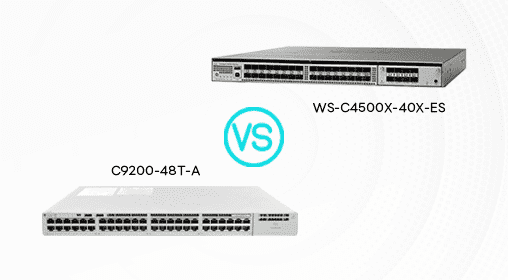
Let’s start with the hardware guts. The C9200-48T-A offers 48 gigabit Ethernet ports with modular uplinks, supporting stacking bandwidth up to 160 Gbps. It’s powered by a UADP 2.0 Mini ASIC and runs the modern IOS XE operating system. In contrast, the WS-C4500X-40X-ES provides 40 gigabit ports plus 4 fixed 10G SFP+ uplinks, with a switching capacity of 176 Gbps. While the C4500X has a slight edge in pure backplane bandwidth, the C9200’s stacking capability allows multiple units to operate as a single logical switch, which dramatically simplifies management and increases resiliency in multi-switch deployments .
|
Feature |
C9200-48T-A |
WS-C4500X-40X-ES |
|---|---|---|
|
Port Configuration |
48 x 1G RJ45 + modular uplinks |
40 x 1G RJ45 + 4 x 10G SFP+ fixed |
|
Switching Capacity |
160 Gbps (stacking: up to 160 Gbps per unit) |
176 Gbps |
|
Forwarding Rate |
130.95 Mpps |
130.95 Mpps |
|
Power Supply |
Dual FRU power supplies (redundant) |
Dual hot-swappable power supplies |
|
Software OS |
Cisco IOS XE |
Cisco IOS |
|
Stacking Technology |
StackWise-160 |
Not stackable (standalone) |
Physically, the C9200-48T-A is a compact, standalone switch measuring 44x445x391mm, designed for mounting in standard racks. Its modular uplink slots let you choose between 1G, 10G, or even 25G/40G modules depending on your needs. The C4500X feels more industrial—it’s built with a rugged metal chassis and includes fixed 10G uplinks on the front. It’s a workhorse, but what you see is what you get; there’s no flexibility to change uplink ports down the road. Both are well-built, but the C9200 offers more future-proofing thanks to its modular design .
When it comes to features, the C9200 pulls ahead with its support for full IOS XE capabilities, including SD-Access, advanced security with TrustSec, and programmable APIs. It’s designed for intent-based networking and automation. The C4500X supports classic Layer 3 routing, QoS, and security features, but it lacks the software-defined capabilities and centralised management options that modern networks increasingly rely on. If you’re running a traditional network without plans for automation, the C4500X will do the job. But if you want to leverage Cisco DNA Center or cloud management, the C9200 is the clear winner .
From a user experience perspective, the C9200 is noticeably easier to manage—especially in stacks. With StackWise, you configure and monitor multiple switches as one entity. The C4500X is managed individually, which can become tedious in larger deployments. Both offer CLI and web interfaces, but the C9200’s integration with Cisco DNA Center provides a more intuitive, policy-driven approach to network management. That said, if you’re more comfortable with traditional IOS commands, the C4500X will feel familiar .
In terms of value, the C9200 offers better long-term ROI. Its stacking capability reduces operational overhead, and its software-defined features help adapt to changing business needs. The C4500X is a solid performer, but as an older platform, it lacks the innovation and support for newer technologies. For growing organisations, the C9200’s flexibility and modern feature set justify its position in the market.
So, which one should you choose?
Go with the C9200-48T-A if:
You’re building a new network or upgrading with an eye toward automation and scalability.
You want to use stacking to simplify management and improve redundancy.
Your roadmap includes software-defined access or cloud-based management.
Consider the WS-C4500X-40X-ES if:
You need a reliable, standalone access or distribution layer switch for a static environment.
You’re already familiar with the platform and don’t require advanced SDN features.
Your budget constraints are significant and you’re okay with an older but stable architecture.
In the end, the C9200 represents the future. It’s more flexible, more manageable, and better aligned with where enterprise networking is headed. The C4500X had a great run, but for new deployments, the C9200 is the smarter choice .