
Intellectual Property
Hot selling product recommendations
View More




















Cisco's 9300 Series Face-Off:C9300-24U-E vs C9300L-24T-4G-A The Powerhouse Meets the Agile Performer
Choosing between two switches from the same series can be surprisingly tricky. The Cisco Catalyst C9300-24U-E and the C9300L-24T-4G-A are a perfect example. They share the same DNA but are engineered for distinctly different battles. One is a high-power heavyweight, while the other is a streamlined agile performer. The right choice doesn't just affect your network's speed; it impacts everything from power delivery to future expansion. Let's break down their personalities beyond the spec sheet.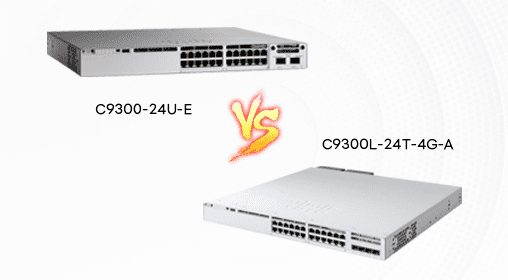
At first glance, their core specs tell a clear story about their intended roles. The C9300-24U-E is built around power delivery, while the C9300L-24T-4G-A focuses on core routing functionality.
|
Core Parameter |
Cisco Catalyst C9300-24U-E |
Cisco Catalyst C9300L-24T-4G-A |
|---|---|---|
|
Port Configuration |
24 x 1G UPOE (60W/port)
|
24 x Gigabit Ethernet Data ports
|
|
PoE Budget |
Up to 830W
|
Non-PoE
|
|
Uplinks |
Modular slots for flexible uplink modules
|
4 x fixed 1G SFP uplinks
|
|
Switching Capacity |
208 Gbps
|
Information not specified in search results |
|
Forwarding Rate |
154.76 Mpps
|
Information not specified in search results |
|
Default Power Supply |
1100W AC
|
Information not specified in search results |
|
Software License Tier |
Network Essentials (perpetual)
|
Network Advantage (perpetual)
|
|
Stacking Technology |
StackWise-480 (480 Gbps)
|
Stackable
|
The physical presence of these switches hints at their internal capabilities. The C9300-24U-E feels like a solid, robust piece of enterprise hardware with a weight of around 7.5 kg. It's designed for resilience, often featuring dual, hot-swappable power supplies and fan trays that can be replaced without shutting down the unit, which is crucial for environments where every second of downtime costs money. The C9300L series takes a more streamlined approach. It's designed to be compact and is part of a more cost-optimized lineup, making it less imposing in the rack.
When it comes to features, the difference in their licenses is a major divider. The C9300L-24T-4G-A comes with the Network Advantage license out of the gate. This unlocks advanced Layer 3 routing protocols like OSPF and EIGRP, sophisticated security policies, and enhanced redundancy features. The C9300-24U-E, in its base form, ships with the Network Essentials license, which covers robust Layer 2 and basic Layer 3 functionality like static routing and RIP. However, its superpower lies in its UPOE (Universal Power over Ethernet). The ability to deliver up to 60 watts per port is a game-changer for powering devices like high-end Wi-Fi 6 access points, IP cameras, and even building automation systems directly from the switch, simplifying cabling and power infrastructure.
The day-to-day experience for a network manager varies significantly between the two. Deploying the C9300-24U-E is about building a high-capacity power and data backbone. Its programmability and integration with Cisco DNA Center make it a star player for automated, software-defined networks. For the user on the ground, it means their high-power devices just work, without the need for a separate power adapter. Managing the C9300L-24T-4G-A is a different experience. Its fixed configuration and lack of PoE make it simpler to set up initially. The immediate availability of the Network Advantage features is a huge plus for networks requiring complex routing from day one, without needing a license upgrade.
In terms of stability, both platforms are built on the proven Cisco IOS XE operating system and are known for their reliability. The C9300-24U-E, with its robust power and cooling design, is engineered for mission-critical environments demanding high availability. The C9300L series also offers solid stability, with features like dual-partitioned storage for fail-safe operations, making it a dependable workhorse for core connectivity tasks.
So, which one gives you more bang for your buck? The C9300-24U-E's value is in its power and flexibility. You are investing in a future-proofed PoE infrastructure that can eliminate the need for electrical work for new devices. The C9300L-24T-4G-A’s value proposition is its advanced routing capability. You get top-tier Layer 3 features accessible immediately, which could otherwise require a costly license upgrade on other models.
Here’s the real breakdown of strengths and weaknesses.
The Cisco Catalyst C9300-24U-E is the power maestro. Its biggest advantage is the massive PoE budget and UPOE support, making it incredibly versatile for modern IoT and mobile deployments. Its modular uplinks offer flexibility for future network growth. The main drawback is that to unlock its full potential, particularly for advanced routing and security features comparable to the 'A' license, you would need to invest in a DNA Advantage subscription upgrade, which adds to the total cost.
The Cisco Catalyst C9300L-24T-4G-A is the routing specialist. Its unbeatable advantage is the inclusion of the Network Advantage license, providing advanced routing and security features right away. Its fixed configuration can lead to a simpler, potentially lower-cost initial setup. The trade-offs are significant: the complete lack of PoE support limits the types of devices you can connect, and the fixed uplinks offer no flexibility for expansion beyond its four 1G SFP ports.
The final decision is actually quite clear. If your network is filled with devices that need power—from phones and access points to digital signage and specialized equipment—the Cisco Catalyst C9300-24U-E is your only logical choice. It’s the foundation for a powered, connected environment.
However, if your primary need is for a high-performance, wired data backbone that requires complex routing between subnets, and powering devices isn't a concern, the Cisco Catalyst C9300L-24T-4G-A delivers superior advanced features from the start. It’s all about the intelligence in the data path, not the power on the line.