
Intellectual Property
Hot selling product recommendations
View More




















When it's time to build or upgrade your data center's network spine, two names from Cisco's Nexus 9000 series consistently pop up: the N9K-C9364C-GX and the N9K-C93180YC-FX. They're both powerhouses, but they're built for different races. One is a speed demon for the network core, while the other is a versatile workhorse for server connectivity. Let's break down their specs, feel out their differences, and see which one might be the right fit for your infrastructure.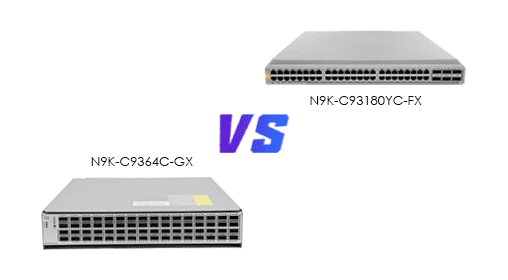
First things first, the raw numbers. This table lays out their core architectural differences.
|
Core Parameter |
N9K-C9364C-GX |
N9K-C93180YC-FX |
|---|---|---|
|
Switching Capacity |
6.4 Tbps
|
3.6 Tbps
|
|
Forwarding Rate |
4.8 Billion Packets Per Second (Bpps)
|
1.2 - 2.67 Bpps
|
|
Port Configuration |
64 x 40/100G QSFP28
|
48 x 10/25G SFP28 + 6 x 40/100G QSFP28
|
|
Latency |
~1.2 microseconds
|
<1 microsecond (cut-through mode)
|
|
MAC Address Table |
1,000,000 entries
|
512,000 entries
|
|
Form Factor (RU) |
1 RU
|
1 RU
|
Looking at this, the N9K-C9364C-GX is clearly the density king. With 64 dedicated high-speed ports, it's engineered to be a spine or core switch, a central hub designed to handle massive amounts of traffic flying between different parts of your network. Its job is to be a high-capacity, reliable backbone.
The N9K-C93180YC-FX, on the other hand, has a more hybrid personality. Its 48 slower ports combined with 6 high-speed uplinks make it a perfect Top-of-Rack (ToR) switch. It's designed to connect a rack full of servers to the rest of the network, aggregating their traffic and sending it upstream via the 100G links.
Both switches occupy a single rack unit (1U), so they're similar in their physical footprint. However, their design intentions are reflected in their layouts. The C9364C-GX presents a face full of 64 identical QSFP28 ports, a clear signal of its purpose for high-speed interconnects. The C93180YC-FX has a more varied front panel, accommodating a mix of SFP28 and QSFP28 ports, offering flexibility for diverse device connections within a rack.They both feature redundant, hot-swappable power supplies and cooling fans, which is standard for hardware expected to run 24/7. The C93180YC-FX, for instance, typically comes with dual 500W power supplies, totaling 1000W. This shared focus on redundancy is crucial for the stability demanded in data center environments.
This is where the choice becomes clear based on your role in the network.The N9K-C9364C-GX is your go-to for building the network's foundation. Its immense switching capacity and high 100G port density make it ideal for roles like an ACI spine switch or a core data center switch, where the priority is moving huge volumes of data between other switches with high reliability.The N9K-C93180YC-FX shines at the edge of the network, right inside the server rack. It's built for environments where you need to connect many servers at 25G speeds and have efficient uplinks to the core. Its claim to fame is ultra-low latency (sub-microsecond), which makes it a fantastic choice for AI/ML clusters, high-performance computing (HPC), and financial trading applications where every nanosecond counts. It also has strong features for network automation and supports technologies like RDMA over Converged Ethernet (RoCEv2), which is critical for GPU workloads in AI.
From an operational standpoint, both run on Cisco's NX-OS, so the management interface will be familiar to network engineers. The real difference in "user experience" comes from where you place them.
Deploying the C9364C-GX is about building highway on-ramps. The experience is centered on high-throughput reliability and ensuring the core doesn't become a bottleneck. For the C93180YC-FX, the experience is about high-density server connectivity and achieving the lowest possible latency for performance-sensitive applications.
When it comes to value, it's not about which is cheaper, but which gives you more for your specific needs. The C9364C-GX offers raw port density and bandwidth for the core. If you need to connect many 100G links, its cost-per-port at that speed is likely more attractive. The C93180YC-FX provides versatility and low-latency performance at the rack level. Its value is in connecting many servers efficiently and future-proofing your rack for high-speed workloads.
Choose the Cisco Nexus N9K-C9364C-GX if your mission is to build or upgrade the core backbone of your data center. It's the right call when you need maximum high-speed port density and switching capacity to link multiple parts of your network together.
Choose the Cisco Nexus N9K-C93180YC-FX if you're focusing on the server rack. It's the superior option for connecting a high density of servers with 25G connectivity, especially for latency-sensitive applications like AI, HPC, or big data analytics, where its sub-microsecond speed and RoCE support provide a tangible performance benefit.