
Intellectual Property
Hot selling product recommendations
View More




















When you first encounter the Cisco Nexus N9K-C9372TX-E, its substantial build immediately conveys a sense of purpose. This isn't lightweight equipment; it's built for serious work. The switch features a non-modular design with a thoughtful arrangement of ports—forty-eight 10Gbps BASE-T ports alongside six 40Gbps QSFP+ ports, all accessible from the front. Its dimensions (444 x 395 x 71 mm) and weight (approximately 10.25 kg) make it standard for rack-mounted installation, though the solid construction is evident when handling it. The physical layout is practical, emphasizing functionality over flashy design, which is exactly what you'd expect from hardware destined for a data center environment .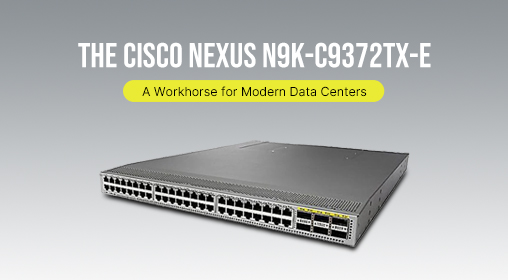
This switch is engineered for the core of modern network infrastructure. It operates as a Layer 3 device, making it ideal for roles such as a spine or top-of-rack (ToR) switch in data centers, or as a powerful aggregation switch in large enterprise networks. The "E" in its model number signifies the enhanced feature set, supporting advanced data center technologies like VXLAN, which is crucial for creating network overlays in virtualized or cloud environments. Its design focuses on handling high-density 10GbE server access while using the 40GbE ports for high-speed uplinks, effectively managing traffic flow between servers and the network core .
Performance is where this switch truly makes its case. The figures speak to its capacity: a 1.44 Tbps backplane bandwidth ensures that data can move across the switch fabric without bottlenecks. The packet forwarding rate of 1150 million packets per second (mpps) means it can process an immense volume of data with minimal latency, a critical factor for performance-sensitive applications. The store-and-forward switching mechanism provides reliability, ensuring packets are error-checked before being forwarded. A MAC address table of 96,000 entries allows it to efficiently manage a vast number of connected devices, while support for up to 4094 VLANs offers the flexibility needed for complex network segmentation .
|
Parameter |
Specification |
|---|---|
|
Product Type |
10 Gigabit Ethernet Switch, Data Center Switch |
|
Application Layer |
Layer 3 |
|
Switching Bandwidth |
1.44 Tbps |
|
Forwarding Rate |
1150 Mpps |
|
MAC Address Table Size |
96K |
|
VLAN Support |
4094 VLANs |
|
Port Configuration |
48 x 10G BASE-T (RJ-45) + 6 x 40G QSFP+ |
|
Power Supply |
AC 100-240V; HVAC 200-277V; DC -48--60V |
|
Typical Power Consumption |
374.5 W |
|
Dimensions (H x W x D) |
444 x 395 x 71 mm |
|
Weight |
10.25 kg |
|
Operating Temperature |
0 to 40 °C |
From an operational standpoint, the N9K-C9372TX-E is fully managed, offering deep control through the Cisco NX-OS operating system. This software provides robust management capabilities, including support for Netconf for API-driven automation, comprehensive QoS policies for traffic prioritization, and BGP-EVPN for efficient control plane learning in VXLAN environments. The ability to manage the switch programmatically is a significant advantage for teams embracing infrastructure-as-code practices, allowing for consistent, repeatable configurations that reduce human error .
For those who deploy and manage this hardware, the experience is a mix of rock-solid reliability and a demanding learning curve. Once properly configured, the switch operates with the steadfastness you expect from Cisco's Nexus line. The initial setup and mastery of NX-OS, however, can be challenging for network teams accustomed to other systems. The command-line interface is powerful but has its own nuances. The fixed port configuration is a double-edged sword; it simplifies the physical setup but means you can't adapt the port types later if your needs change. You're committing to a specific mix of copper and fiber connectivity from the start .
Evaluating its value proposition, the N9K-C9372TX-E sits in a interesting position. It's not a budget option. Its value comes from the combination of high port density, proven performance, and the extensive feature set of NX-OS, particularly for organizations already invested in the Cisco ecosystem. For a data center that requires its specific port arrangement and will leverage advanced features like VXLAN, the investment can be justified by the reliability and capabilities it brings. However, for simpler deployments or where budget is a primary constraint, competing options might offer a more accessible entry point, albeit potentially with trade-offs in features or brand integration .
In conclusion, the Cisco Nexus N9K-C9372TX-E is a capable and robust switch that excels in the environment it was designed for: the demanding data center. Its strengths are its high throughput, proven stability, and advanced software features. The trade-offs involve its fixed port configuration, the complexity of its operating system, and a higher power draw compared to some modern alternatives. Choosing it comes down to a clear-eyed assessment of whether your network demands the specific performance and features it offers, and whether your team has the expertise to manage it effectively.