
Intellectual Property
Hot selling product recommendations
View More




















That Solid Workhorse in Your Server Rack: A Real Look at the Cisco Nexus N3K-C3064PQ-10GX
Ever peek into a data center rack and see those switches that just look… dependable? The Cisco Nexus N3K-C3064PQ-10GX is one of those. It’s not the newest, flashiest model on the block, but it’s the kind of hardware that forms the unshakable foundation of a network. If you need a ton of 10G connections and a clear path to 40G without the drama, this box has been a go-to choice for years.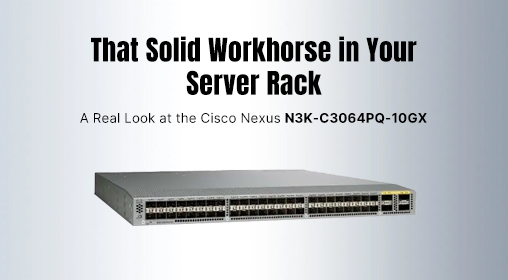
Let's get straight to the heart of the matter: what this thing can handle. It’s built for density, offering a serious number of ports in a single rack unit (1U). You get 48 SFP+ ports for 10 Gigabit Ethernet, giving you the flexibility to use either copper Twinax cables or optical SFP+ modules. Then, for your high-speed uplinks, it has 4 QSFP+ ports, each capable of handling a single 40 Gigabit link or being split out into four independent 10 Gigabit connections. That’s a potential total of 64 ports, which is pretty impressive for a 1U form factor .
|
Feature |
Specification |
|---|---|
|
Port Configuration |
48 x 10G SFP+ + 4 x 40G QSFP+ |
|
Total Switching Capacity |
1.28 Tbps |
|
Forwarding Rate |
950 Million Packets Per Second (Mpps) |
|
Latency |
Low-latency (line-rate on all ports) |
|
Layer Support |
Layer 2 and Layer 3 |
|
Form Factor |
1 Rack Unit (1RU) |
|
Power Supply |
Dual, hot-swappable (AC or DC options) |
On the outside, it’s classic Cisco enterprise gear—a sturdy, metal 1U chassis designed for a 19-inch rack. All the SFP+ ports are lined up neatly, with the QSFP+ uplinks typically on the right side. It’s a clean, utilitarian design that prioritizes function over flair. A key thing to note is that this model often ships without power supplies or fan trays, so you’ll need to order those separately to match your data center’s power and cooling setup . The unit supports both standard and reverse airflow fan modules, which is a lifesaver for dealing with specific hot aisle/cold aisle configurations .
Where this switch truly proves its worth is in its features and real-world performance. It runs on Cisco's robust NX-OS operating system, which supports a comprehensive suite of Layer 3 routing protocols like OSPF and BGP . For modern data center needs, it includes technologies like VXLAN for building network overlays and virtual PortChannel (vPC) for multi-chassis link aggregation, which eliminates spanning-tree protocol bottlenecks and provides truly resilient connectivity . The support for Data Center Bridging (DCB) protocols also makes it suitable for lossless storage network convergence .
So, what’s it actually like to use one? The overwhelming feedback from users is about its rock-solid stability. Once it’s configured, it just runs. The programmability features, including Python scripting, are a bonus for teams looking to automate configurations . However, there are a couple of real-world quirks. As a performance-focused switch, its fans can get audible under load—this isn't gear for a quiet office closet . Also, since this is a mature product, you're often buying refurbished or remaining new-old stock. This means no manufacturer warranty, though reputable resellers usually provide their own coverage . Some users have even reported receiving units with slightly bent chassis, though they noted the hardware remained fully functional, a testament to its build quality .
When it comes to value, the 3064PQ presents a compelling case. Its initial cost can be significantly lower than newer models, offering enterprise-grade features at a more accessible point. The real value is in its high port density and proven reliability. You’re investing in a tool that will handle your traffic without fuss for years. Just remember to factor in the potential lack of a direct warranty and the ongoing power consumption, which might be higher than the latest generation of switches .
In short, the Cisco Nexus 3064PQ-10GX is like a trusted, high-precision tool. It might not have the latest digital readout, but it fits perfectly, never slips, and gets the job done with unwavering consistency. For network engineers who need dense, reliable 10G connectivity with a clear path to 40G, it remains a seriously capable workhorse.