
Intellectual Property
Hot selling product recommendations
View More




















Cisco Nexus Face-Off: Unpacking the N3K-C3172TQ-XL and N3K-C3172PQ-10GE
Choosing between the Cisco Nexus 3172TQ-XL and the 3172PQ-10GE is more than just comparing specs—it's about picking the right engine for your data center. Both are 1RU top-of-rack switches from the same respected family, but they're engineered for different environments. One is your go-to for straightforward, easy-to-deploy server connectivity, while the other is a precision instrument for performance-critical applications. Let's break down what sets them apart to help you make an informed choice.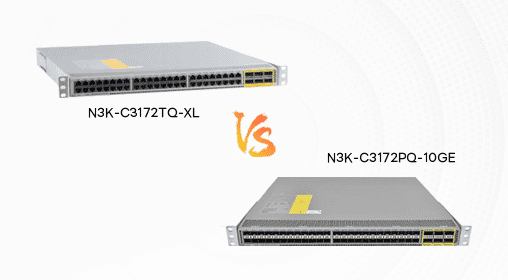
At first glance, their core specs seem similar. Both offer a hefty 1.44 Tbps switching capacity and a forwarding rate of 1080 Mpps, meaning they can handle line-rate traffic on all ports without breaking a sweat. They both come with 48 fixed 10G ports and 6 QSFP+ uplink ports that can be used as 40G or broken out into 4x10G connections, giving you a maximum of 72x10G ports. The fundamental difference lies in the type of those 48 main ports, which dictates everything from cost and cabling to performance.
|
Feature |
N3K-C3172TQ-XL |
N3K-C3172PQ-10GE |
|---|---|---|
|
Port Configuration |
48x 10G BASE-T (RJ-45 Copper) + 6x 40G QSFP+ |
48x 10G SFP+ (Fiber) + 6x 40G QSFP+ |
|
Switching Capacity |
1.44 Tbps |
1.44 Tbps |
|
Forwarding Rate |
1080 Mpps |
1080 Mpps |
|
Latency |
< 1.2 microseconds
|
< 0.8 microseconds
|
|
Typical Power Draw |
Lower (approx. 95W idle)
|
Higher (approx. 110W idle)
|
|
Internal Storage (bootflash) |
16 GB SSD (XL model)
|
16 GB
|
|
Key Differentiator |
Ease of deployment with copper cabling |
Ultra-low latency and optimized for performance
|
Physically, both units share a similar 1RU footprint, but a closer look at the front panel reveals their personalities. The TQ-XL is all about practicality, featuring 48 familiar RJ-45 ports. This design simplifies connections to servers with built-in 10G NICs, using standard Cat6/6a cables. The PQ-10GE, in contrast, presents a panel of 48 SFP+ cages. This interface is for fiber optic cables or direct-attach copper (DAC) cables, giving it a more specialized feel geared towards data center spine-leaf connections and storage networking.
When you dig into their operational strengths, the gap widens. The N3K-C3172PQ-10GE is built for speed and efficiency. Its key advantage is a significantly lower latency of <0.8μs, making it a favorite for high-frequency trading, high-performance computing, and any environment where every microsecond counts. Its advanced buffer management also results in a packet loss rate about 40% lower than the TQ-XL's during traffic bursts, which is crucial for loss-sensitive applications. While both support VXLAN, the PQ model shows better hardware acceleration with less performance degradation.
The N3K-C3172TQ-XL fights back with sheer convenience and lower total cost of ownership. Its 10G Base-T RJ-45 ports can leverage existing copper cabling infrastructure, drastically reducing deployment time and complexity—by up to 35% by some estimates. You avoid the additional cost and management of SFP+ transceivers for short-reach connections. For IT teams more familiar with copper, the diagnostic tools on the TQ-XL can make troubleshooting faster and simpler.
From a user experience perspective, the choice often comes down to your team's expertise and the specific application. If your priority is getting a dense 10G server access layer up and running quickly with minimal cabling hassle, the TQ-XL feels like a gift. It just works. However, if you're building the core of a low-latency fabric for a financial application or a virtualized data center, the raw performance and buffer intelligence of the PQ-10GE will give you more confidence. It's worth noting that the PQ's richer CLI commands might require a slightly steeper learning curve for administrators.
In terms of value, the TQ-XL typically has a lower initial cost, especially when you factor in the savings from not needing SFP+ modules for every port. The PQ-10GE, while often more expensive upfront, delivers superior value in scenarios where its low latency and high throughput stability directly impact business outcomes, like financial trading, leading to a faster return on investment in those specific environments.
So, which one should you choose? Here’s a quick rundown of their pros and cons.
The N3K-C3172TQ-XL is your best bet if:
Rapid Deployment is Key: You need to connect many servers quickly and want to use cost-effective, familiar copper cabling.
Cost is a Primary Concern: You want to minimize both initial hardware costs (possibly avoiding SFP+ modules) and cabling expenses.
Ease of Use Matters: Your team appreciates straightforward diagnostics and management.
The N3K-C3172PQ-10GE is the superior choice when:
Performance is Non-Negotiable: Your applications demand the absolute lowest latency and highest throughput stability, such as in high-frequency trading or HPC clusters.
You're Building for the Future: The clearer path for future upgrades and longer software support cycle (7+ years of major version support vs. the TQ-XL's 5 years) is important for your long-term strategy.
Fiber Infrastructure is in Place: Your data center is already set up for a fiber-rich spine-leaf architecture.
In the end, the TQ-XL is the pragmatic workhorse for general server access, while the PQ-10GE is the high-performance engine for mission-critical, data-intensive workloads. Your network's specific demands will make the right choice clear.