
Intellectual Property
Hot selling product recommendations
View More




















Cisco Nexus 93180YC-EX: The Spine of Modern Data Centers
When you first lay eyes on the Cisco Nexus 93180YC-EX, its design immediately signals a purpose-built tool for dense data center environments. This isn’t a flashy piece of consumer gear; it’s a workhorse engineered for performance and flexibility. The compact 1RU form factor houses a surprising density of ports, with 48 fixed 10/25G SFP28 ports and 6 additional 40/100G QSFP28 uplinks, allowing for significant connectivity in a minimal rack footprint. The chassis is designed for practical deployment, supporting both front-to-back and rear-to-front airflow configurations, which is critical for integrating into existing hot-aisle or cold-aisle layouts without redesigning your entire cooling strategy. The build quality feels robust, with clearly labeled ports and redundant, hot-swappable power supplies and fans—features that become invaluable during late-night maintenance windows.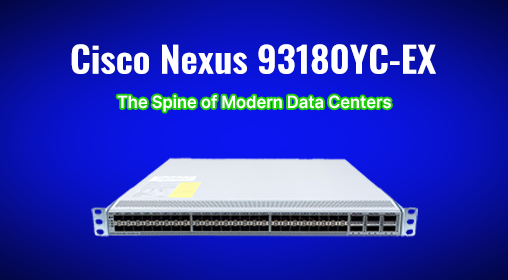
Diving into the core specifications reveals where this switch truly flexes its muscles. It delivers a system bandwidth of 2.56 Tbps and a packet forwarding rate of 2.8 billion packets per second (bpps), ensuring that traffic flows smoothly even under heavy loads. The heart of the operation is a capable quad-core processor paired with 16GB of memory, providing the necessary horsepower for complex routing decisions and network virtualization tasks. A 40MB packet buffer helps manage microbursts and temporary congestion, which is essential for maintaining low latency in storage or high-performance computing clusters.
|
Core Parameter |
Specification |
|---|---|
|
Form Factor |
1 Rack Unit (1RU) |
|
Port Configuration |
48 x 10/25G SFP28, 6 x 40/100G QSFP28 |
|
System Bandwidth |
2.56 Tbps |
|
Forwarding Rate |
2.8 bpps |
|
Processor & Memory |
Quad-core, 16GB |
|
Buffer Memory |
40 MB |
|
Power Consumption |
Typical: ~210W; Maximum: ~537W
|
Where the 93180YC-EX really stands out is in its functional versatility. It operates seamlessly in two distinct modes: the traditional Cisco NX-OS mode, offering granular control for network purists, and the Application Centric Infrastructure (ACI) mode, which enables policy-based automation for software-defined networks. This dual-personality is a significant advantage for organizations transitioning to more automated infrastructure. The support for VXLAN is crucial for building scalable, overlay networks, while features like QoS and ACLs provide the fine-grained control needed for multi-tenant environments. The inclusion of streaming telemetry is a modern touch, offering real-time visibility into network performance that goes far beyond what traditional SNMP polling can achieve.
From an operational standpoint, this switch is designed to make life easier for network teams. The ability to mount it with ports facing either the front or rear of the rack is a simple but brilliant feature that can dramatically simplify cable management in tight spaces. The consistent and reliable NX-OS operating system reduces the learning curve and operational risk. However, the sheer number of high-speed ports in a 1U chassis means heat and power management require attention; ensuring adequate cooling is non-negotiable. The typical power draw is around 210 watts, but it can peak near 537 watts under full load, so power infrastructure needs to be planned accordingly.
When evaluating its value, the 93180YC-EX positions itself as a high-density aggregator. The cost per 10/25G port is competitive, especially when considering the flexibility of the six high-speed uplinks that can be used for 40G or 100G connectivity. Its value shines in environments that need to maximize port density without sacrificing the ability to run modern protocols or transition to an automated network model. The trade-off, as with many fixed-configuration switches, is the lack of expandability; you are buying a specific port configuration upfront.
In terms of reliability, the architecture is built for the long haul. The hot-swappable components are the first line of defense, allowing for maintenance and replacements without taking the entire switch offline. The NX-OS software is a mature, battle-tested platform known for its stability in enterprise and cloud data centers. This combination of hardware redundancy and proven software results in a platform that network engineers can trust for critical workloads.
No product is perfect, and the 93180YC-EX has its considerations. Its primary strength is also a potential limitation: it’s a fixed-configuration switch. You cannot add new line cards down the road. While it’s a powerhouse for top-of-rack (ToR) or middle-of-row (MoR) deployments, its non-modular nature means future needs might require a forklift upgrade rather than a simple card swap. Additionally, the initial investment, while justifiable for its feature set, is higher than that of less capable access-layer switches.
All things considered, the Cisco Nexus 93180YC-EX is a remarkably well-rounded platform. It excels in scenarios demanding high-density 25G server connectivity with robust uplink capacity, all packaged in a space-efficient design. It’s an ideal choice for modernizing data center access layers, supporting everything from virtualized workloads and all-flash storage arrays to building blocks for AI/ML clusters. For organizations that need to pack maximum connectivity and modern features into a single rack unit, the 93180YC-EX delivers a compelling and powerful solution.