
Intellectual Property
Hot selling product recommendations
View More




















The Cisco Nexus 9232C isn't just another switch; it's a compact powerhouse designed for the core of modern data centers. Sitting within the broader Nexus 9000 series, this model carves out a specific niche with its balance of high density and form factor. Let's peel back the layers and see what makes it tick, how it stacks up, and who it's really for, all without getting lost in marketing speak.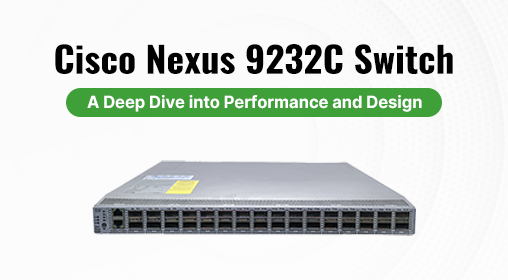
At its heart, the 9232C is a 1RU (1 Rack Unit) spine switch, which is a fancy way of saying it's designed to be a central traffic director in a high-performance network. Its most striking feature is the array of 32 fixed 40/100 Gigabit Ethernet QSFP28 ports. This means you can configure each port for either 40G or 100G speeds, offering tremendous flexibility for connecting to servers, storage, or other switches. Two additional 1/10G SFP+ ports are included for management, giving you a handy out-of-band connection for those critical configuration tasks.
When you look at the core numbers, the 9232C makes a strong case for itself. It delivers a system bandwidth of 6.4 Tbps—that's Terabits per second—ensuring that even with all ports running at full tilt, data has a massive highway to travel on without congestion. The forwarding rate, which is a measure of how many data packets it can process per second, is a staggering 4.4 billion packets per second (bpps). This kind of performance is crucial for applications like high-frequency trading or large-scale AI model training where every microsecond of delay counts.
|
Core Parameter |
Specification |
|---|---|
|
Form Factor |
1 Rack Unit (1RU)
|
|
Port Configuration |
32 x 40/100G QSFP28, 2 x 1/10G SFP+
|
|
System Bandwidth |
6.4 Tbps
|
|
Forwarding Rate |
4.4 bpps
|
|
Buffer Memory |
40 MB
|
|
Typical Power |
~296W (AC)
|
Beyond the raw specs, the 9232C is packed with enterprise-grade features. A standout is the support for MACsec encryption on the last 8 ports. This provides hardware-based, line-rate security, meaning you can encrypt data flowing between switches without taking a performance hit—a must-have for multi-tenant environments or for meeting strict compliance regulations. It also supports advanced congestion management technologies like Priority Flow Control (PFC) and Explicit Congestion Notification (ECN), which are essential for creating a "lossless" fabric required by technologies like RoCEv2 (RDMA over Converged Ethernet). This allows for remote direct memory access, drastically reducing latency for storage and HPC clusters.
From an operational standpoint, the 9232C runs on Cisco's NX-OS, a robust and stable operating system that network administrators are often already familiar with. This familiarity reduces the learning curve and operational risk. The switch can operate in two distinct modes: the traditional NX-OS mode for those who prefer granular control, and the Application Centric Infrastructure (ACI) mode. ACI is a software-defined networking (SDN) solution that automates network provisioning and management based on application policies, a huge benefit for large-scale, dynamic cloud environments. The inclusion of streaming telemetry is a modern touch, allowing for real-time monitoring of the network's state rather than relying on clunky, polled SNMP data, which leads to faster troubleshooting and better visibility.
So, how does it feel to use this switch? The physical experience is defined by its compact 1RU design. This is a major advantage in space-constrained data centers, allowing you to pack a lot of 100G capability into a very small footprint. However, this density comes with a consideration: thermals. High-performance kit in a small space generates heat. The switch employs hot-swappable, redundant fans to manage this, but it underscores the need for a well-designed cooling system in your server room. You'll hear it when it's working hard.
When evaluating its value, the 9232C isn't an entry-level product. Its value proposition lies in its port density per rack unit. For organizations that need to maximize 100G port count in a limited space, the calculus often leans in its favor despite a higher initial outlay compared to less dense options. The energy efficiency of the modern CloudScale ASICs helps keep long-term operational costs (OPEX) in check, which is a critical part of the total cost of ownership equation.
In terms of stability and reliability, the architecture is built for mission-critical workloads. Features like hot-swappable power supplies and fans mean components can be replaced without powering down the entire switch, maximizing uptime. The NX-OS software is mature and has been proven in countless production environments over the years, contributing to a generally solid and predictable operational experience.
Of course, no product is perfect. The primary strength of the 9232C is also its main limitation for some: it's a fixed-configuration switch. If your needs change, you can't add new port types or densities with line cards as you could with a modular chassis like the Nexus 9508. You're essentially buying the port configuration upfront. Furthermore, while it supports a wide range of speeds from 10G to 100G via breakout cables, it's important to note that some models in the 9000 series explicitly do not support branch cables, so verifying compatibility for specific cabling plans is essential.
All things considered, the Cisco Nexus 9232C is a highly specialized tool. It shines brightest in environments where its specific combination of high-density 100G connectivity, compact size, and advanced data center features aligns perfectly with the need. It's a compelling choice for building out spine layers in leaf-spine architectures, supporting AI/ML workloads with RoCE, or acting as a high-performance aggregation point. For organizations where space is at a premium and throughput is non-negotiable, the 9232C stands as a formidable and well-engineered solution.