
Intellectual Property
Hot selling product recommendations
View More




















Cisco Nexus 7000 vs. 7700: A Technical Deep Dive for Data Center Professionals
When evaluating the Cisco Nexus 7000 Series N7K-C7018 against the Nexus 7700 Series N77-C7718, you are comparing two foundational 18-slot chassis designed for mission-critical data center environments. While they share a similar physical scale, they represent distinct generations of technology, each with unique advantages for different operational philosophies and future roadmaps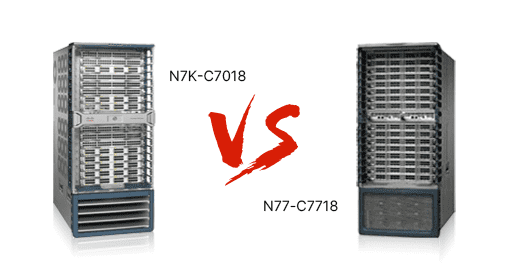
The following table provides a high-level overview of their core differences for a quick comparison.
|
Feature |
Nexus 7000 (N7K-C7018) |
Nexus 7700 (N77-C7718) |
|---|---|---|
|
Core Architecture |
Mature, crossbar fabric |
Next-generation, higher-bandwidth fabric |
|
Performance Profile |
Robust for predictable, aggregated traffic |
Designed for low-latency, high-density 40G/100G |
|
Physical Design |
Standard cooling, classic modular design |
Advanced modular cooling, tool-less maintenance features |
|
Key Differentiator |
Proven reliability and stability |
Forward-looking scalability and operational efficiency |
The most significant difference lies in their internal architecture, which dictates performance and scalability. The N7K-C7018 is built on a mature, time-tested crossbar fabric. It offers reliable and robust performance, making it an excellent choice for stable enterprise core networks or data center aggregation layers where traffic patterns are predictable and high port density for 10G connections is a priority. Its strength is in its proven stability over many years of deployment
In contrast, the N77-C7718 incorporates a more advanced fabric design. This next-generation architecture delivers higher per-slot bandwidth and significantly lower latency. This makes the chassis inherently suitable for dynamic, virtualized environments and latency-sensitive applications like high-performance computing or financial trading. It is engineered to natively support high-density 40G and 100G interfaces, providing a clear path for network evolution without a complete forklift upgrade
A side-by-side physical comparison reveals evolution in design philosophy. While both are 18-slot chassis, the N77-C7718 often features more advanced, modular cooling systems with redundant, hot-swappable fans. This design offers better thermal management for the higher power loads associated with modern line cards. Tool-less maintenance features are also more prominent, helping to reduce operational downtime during hardware component swaps
When it comes to expansion, the difference in fabric modules is critical. The N77-C7718's fabric modules provide a non-blocking, scalable backplane that allows each slot to utilize the full capacity of high-speed line cards. The N7K-C7018, while highly capable, uses an older fabric technology that can partition bandwidth, potentially creating a bottleneck when deploying the highest-density modules available today. This architectural advantage makes the N77-C7718 better suited for modern spine-leaf topologies
Both platforms run Cisco's robust NX-OS operating system, but the functional scope differs. The N7K-C7018 provides solid support for essential features like Virtual Device Contexts (VDCs). However, its integration with modern automation tools and software-defined networking (SDN) frameworks like Cisco ACI can be more limited or require additional configuration. For network engineers familiar with the classic Cisco CLI, it offers a stable and predictable management experience
The N77-C7718 is designed for the era of automation and network programmability. It offers deeper and more granular integration with ACI and features open APIs that facilitate management with tools like Ansible and Python scripts. This translates to a more intuitive user experience for teams looking to implement automated workflows, real-time monitoring, and predictive analytics, thereby simplifying daily operations and troubleshooting
The choice between these platforms is often a balance between initial investment and long-term value and capabilities.
Cisco Nexus N7K-C7018: The Proven Workhorse
Pros: Lower initial acquisition cost; ideal for networks dominated by 10G infrastructure with predictable traffic patterns; exceptional stability and reliability.
Cons: Higher power consumption per gigabit of throughput; limited scalability for future high-speed demands may necessitate an earlier-than-expected chassis replacement.
Ideal For: Enterprise core layers, campus aggregation, and data centers with a stable, well-understood workload that does not require extreme low latency or rapid scaling.
Cisco Nexus N77-C7718: The Future-Proofed Performer
Pros: Superior energy efficiency reduces operational expenditures; scalable fabric protects your investment by readily accommodating 40G/100G and future technologies; advanced features support SDN and automation.
Cons: Higher upfront capital expenditure.
Ideal For: Greenfield data center deployments, cloud infrastructure, high-performance computing clusters, and any environment where scalability, low latency, and operational automation are critical to the business.
The N7K-C7018 remains a powerful and dependable solution for specific, stable environments where initial cost is a primary concern. However, for new deployments aiming for longevity, scalability, and alignment with contemporary data center trends, the N77-C7718's advanced architecture provides a more forward-looking and operationally efficient foundation. Your decision should be guided by a clear assessment of your network's growth trajectory and the criticality of performance and automation to your operations.