
Intellectual Property
Hot selling product recommendations
View More




















Cisco N9K-SUP-A: The Brain Behind Scalable Data Center Networks
When you slide a Cisco N9K-SUP-A supervisor module into a Nexus 9000 series chassis, you are essentially installing the operational cortex of a high-performance data center switch. This component is far more than a simple processing engine; it acts as the central command center for one of the industry's most flexible switching platforms, capable of adapting to everything from hyperscale cloud deployments to latency-sensitive financial trading networks. The module integrates with Cisco's NX-OS software to deliver reliability and automation at a scale that modern data centers demand.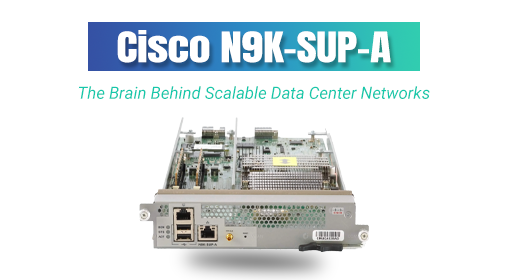
Physically, the N9K-SUP-A is built for seamless integration into the modular Nexus 9000 series chassis. Its design prioritizes serviceability, with clearly marked status indicators and robust heat dissipation mechanisms to maintain stability under continuous operation. The front panel provides essential management ports and LED indicators that give administrators an immediate visual health check of the module. Constructed with enterprise-grade components, the hardware is engineered for 24/7 operation in diverse environmental conditions, from tightly controlled data centers to edge computing sites.
Under the hood, this supervisor engine is optimized for high-throughput scenarios. It supports a system switching capacity of up to 25.6 Tbps, allowing it to handle immense data flows without becoming a bottleneck. The architecture ensures that control plane functions remain responsive even when the data plane is saturated with traffic. A key advantage is its support for flexible operational modes—it can run in traditional NX-OS mode for conventional data centers or in Application-Centric Infrastructure (ACI) mode for software-defined networking environments. This allows organizations to adopt automated policy-based management without a forklift upgrade.
|
Parameter |
Specification |
|---|---|
|
Max System Capacity |
25.6 Tbps
|
|
Supported Port Speeds |
1G to 400G
|
|
Redundancy Support |
Dual supervisor module high availability
|
|
Operational Modes |
NX-OS & ACI mode
|
|
Key Technologies |
VXLAN, EVPN, RoCE, Priority Flow Control (PFC)
|
The functional scope of the N9K-SUP-A extends well beyond basic switching. It serves as the foundation for software-defined networking innovations, enabling features like VXLAN for network virtualization and EVPN for efficient layer 2 and 3 overlay networks. The module also supports advanced congestion management mechanisms, including Explicit Congestion Notification (ECN) and Weighted Random Early Detection (WRED), which help maintain performance for sensitive applications like high-frequency trading or AI workload clustering. Security is ingrained through features like granular access control lists and integration with Cisco's TrustSec technology, providing micro-segmentation capabilities to isolate workloads in multi-tenant environments.
From an operational perspective, the N9K-SUP-A is designed for ease of management. Network administrators appreciate the intuitive CLI and the ability to automate repetitive tasks through Python scripting and APIs. The module's stability is a significant advantage—once configured, it can operate for extended periods with minimal intervention. However, the initial setup, especially for ACI mode, requires a solid understanding of Cisco's ecosystem. The learning curve can be steep for teams unfamiliar with intent-based networking concepts, but the long-term benefits in automation and policy consistency are substantial.
When evaluating its value proposition, the N9K-SUP-A stands out for its scalability. By consolidating multiple network functions into a single platform, it reduces the need for additional hardware, saving rack space, power, and cooling costs. The investment in its advanced ASIC technology future-proofs the network, ensuring it can handle not only current workloads but also emerging demands from AI, machine learning, and IoT applications. For organizations where network uptime and performance directly impact business continuity, the module's reliability offers compelling long-term value, helping to avoid costly outages and performance degradation.
Of course, no technology is without trade-offs. The advanced capabilities of the N9K-SUP-A come with a significant initial investment, and fully leveraging its potential often requires a team with specialized skills. The licensing structure for advanced features like ACI can add complexity to budget planning. Additionally, the module's deep feature set means that initial configuration for complex scenarios can be time-consuming, demanding careful planning to ensure all components interact as intended.
In essence, the Cisco N9K-SUP-A is a high-performance supervisor engine engineered for the core of modern data centers. It excels in environments where scalability, flexibility, and advanced feature sets are non-negotiable. While its complexity and cost warrant careful consideration, its ability to streamline operations, support automated networking, and deliver carrier-grade stability makes it a strategic choice for organizations building the data center infrastructure of the future.