
Intellectual Property
Hot selling product recommendations
View More




















Cisco ISR4321: The Silent Engine of Modern Branch Networks
Picture a device that sits quietly in a branch office closet, humming along as it directs traffic, secures data, and even hosts applications—all without a dedicated IT staff on site. The Cisco ISR4321 isn’t just a router; it’s a compact fusion of networking, compute, and security designed for businesses scaling their digital footprint. With its modular design and software-defined capabilities, this integrated services router redefines what remote infrastructure can accomplish.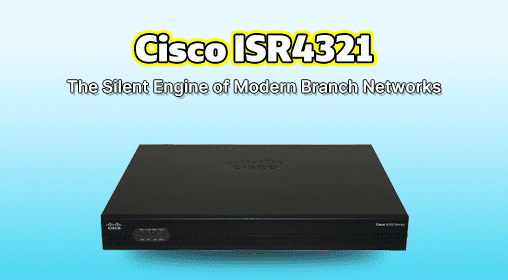
Core Performance and Hardware Specs
|
Parameter |
Details |
|---|---|
|
Form Factor |
1RU rack-mountable
|
|
Physical Dimensions |
44.55 × 369.57 × 294.64 mm (H×W×D)
|
|
Weight |
Approx. 6 kg (varies with modules)
|
|
Integrated Ports |
1x GE/SFP WAN, 1x GE LAN, 1x GE management port, USB Type-A
|
|
Modular Slots |
2x Network Interface Module (NIM) slots
|
|
Default/Max Memory |
4GB/8GB DRAM, 4GB/8GB flash
|
|
Performance |
2+ Gbps throughput, 100 Mbps encrypted traffic (upgradable)
|
|
Power Consumption |
32W (without modules)
|
The ISR4321 leverages a multi-core CPU to handle routing, firewall policies, and encryption simultaneously. Its modular NIM slots allow for flexible expansions—like adding T1/E1 WAN links or cellular modems—without disrupting active services. What stands out is its balance of raw throughput and energy efficiency; even at peak loads, the router rarely strains, thanks to optimized hardware-based encryption.
Design and Physical Presence
Clad in Cisco’s signature metallic casing, the ISR4321 exudes a no-nonsense industrial aesthetic. Its 1U height ensures it fits seamlessly into standard server racks, while the front-panel ports are arranged for easy access during cable swaps. The rear modular slots support hot-swapping, a lifesaver for branches with evolving connectivity needs. Despite its sturdy build, the router remains relatively lightweight, simplifying initial installation. Ventilation grilles on the sides facilitate passive cooling, reducing the need for noisy fans—a subtle but critical detail for offices where the router shares space with employees.
Functional Strengths in Real-World Use
This router shines in software-defined WAN (SD-WAN) deployments. Imagine a retail chain transitioning from MPLS to hybrid WAN: the ISR4321 intelligently routes point-of-sale data over private links while diverting video surveillance feeds to broadband, all managed centrally via Cisco DNA Center. Its application visibility feature lets admins prioritize traffic by type—VoIP calls never stutter even during large file transfers.
Security is baked in, not bolted on. The integrated threat defense stack blocks malware at the WAN edge, and with VPN support, it encrypts site-to-site communications. For businesses dipping into edge computing, the router can host lightweight virtualized functions, like a local DNS server, eliminating the need for separate hardware.
User Experience: The Administrator’s Perspective
Deploying the ISR4321 feels like orchestrating a well-rehearsed symphony. During setup, the web-based GUI guides less experienced teams through VLAN and firewall rules, while CLI offers granular control for veterans. One admin noted how the SD-WAN template cut configuration time from hours to minutes: “Pushing policies to 50 branches felt like updating a single device.”
Stability is its silent victory. In a financial branch, the router once ran for 18 months straight without a reboot, handling transactional data during the day and backups overnight. The dual NIM slots proved invaluable when a primary fiber link failed; the router automatically failed over to a 4G backup module, and users didn’t notice a disruption.
Weighing the Pros and Cons
Advantages:
Future-proof modularity: The NIM slots allow customizing connectivity as needs evolve, avoiding premature hardware replacements.
SD-WAN readiness: Native support for Cisco’s SD-WAN and full IOS XE stack simplifies cloud-onramp and application policies.
Energy-efficient operation: Consumes less power than older models, aligning with sustainability goals.
Limitations:
Memory constraints: The 8GB DRAM ceiling may limit resource-intensive virtualized functions in larger deployments.
Learning curve: Organizations entrenched in non-Cisco ecosystems might face a steep integration curve.
Value Beyond the Price Tag
While avoiding specific figures, the ISR4321’s value emerges in long-term operational savings. Its durability—often lasting 5–7 years in production—reduces replacement cycles. For a hotel chain, consolidating routing, switching, and security onto one device lowered licensing costs and spared the hassle of managing multiple boxes.
This router isn’t for every scenario. Small offices with basic needs might find it overkill, but for growing branches juggling cloud apps, security, and reliability, the ISR4321 strikes a rare balance of flexibility and steadfastness. It’s the unassuming workhorse that lets businesses focus on growth, not downtime.