The Workhorse That Almost Was: A Real-World Look at the Cisco ISR 4431/K9
If you have spent any time managing enterprise networks over the last decade, the Cisco
ISR 4431/K9 likely rings a bell. It wasn't just another box on the rack; for many IT directors, it was the backbone of branch office connectivity during a critical transition period in networking. While Cisco has officially moved this model to "End-of-Sale" status as of late 2023, understanding its DNA helps explain why so many organizations are still running it today and why its reputation remains solid among network engineers who value stability over flashiness.
At its core, the
ISR 4431 was designed to be the heavy lifter of the 4000 series, sitting comfortably above the 4331 and 4321 models. Its primary job was to aggregate multiple services—routing, security, voice, and even some edge computing tasks—into a single chassis. Unlike modern cloud-native appliances that rely heavily on subscription overlays for basic functionality, the 4431 was built as a self-contained powerhouse. It was the go-to solution for mid-to-large enterprises needing to consolidate hardware footprints in remote locations without sacrificing throughput. When you needed to run complex QoS policies for VoIP, terminate IPsec VPN tunnels for hundreds of remote workers, and still have headroom for application visibility, this was the device you called on.
Before diving into the user experience or physical feel, it is crucial to understand exactly what powers this machine. The numbers tell a story of a unit built for serious expansion and modular flexibility. Here is the breakdown of what you are actually getting under the hood:
| Parameter |
Specification Detail |
| Model |
Cisco ISR 4431/K9 |
| Form Factor |
1 Rack Unit (1U) |
| Fixed Ports |
4 x 10/100/1000 Mbps Gigabit Ethernet (RJ-45) |
| Expansion Slots |
3 x NIM (Network Interface Module) slots, 1 x ISC (Internal Service Card) slot |
| Default Memory |
4 GB Control Plane DRAM, 2 GB Data Plane DRAM |
| Default Flash |
8 GB |
| Throughput |
Base ~500 Mbps, Upgradeable to ~1 Gbps (depending on license) |
| USB Ports |
2 x USB 2.0 (Type A) |
| Console Port |
RJ-45 |
| Power Supply |
Integrated AC or DC options (redundant PS available in some configs) |
| OS |
Cisco IOS XE |
| Status |
End-of-Sale (Support until 2028) |
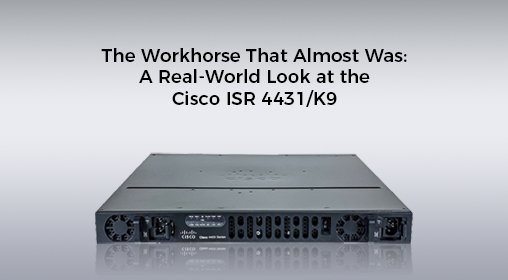
Visually, the
ISR 4431 commands respect in a server room. It is a dense, 1U rack-mountable unit, but don't let the height fool you; it is significantly deeper and heavier than your average 1U switch. The chassis is constructed from rugged metal, designed to dissipate heat efficiently through a mix of passive vents and active cooling fans that, while reliable, can generate a noticeable hum in a quiet office closet. The front panel is a study in functional minimalism: a console port, a USB slot for storage or boot media, and a row of status LEDs that blink with reassuring rhythm. The rear is where the complexity lives, housing the fixed GE ports and the blanking plates for the NIM and ISC slots. It feels industrial, like a piece of machinery rather than consumer electronics, signaling that it is meant to be installed and left alone for years.
The user experience with the ISR 4431 is distinctly "Cisco." If you are coming from a consumer-grade mesh system, the learning curve is a vertical wall. Configuration is done primarily through the IOS XE command-line interface, which offers granular control over every packet but demands expertise. There is no hand-holding wizard that magically sets up your network in five minutes. However, for seasoned network admins, this is a feature, not a bug. The ability to script configurations, automate deployments via DNA Center (in later software versions), and troubleshoot with detailed debug outputs provides a level of control that is hard to match. Once configured, the device is remarkably stable. It's the kind of hardware you configure, save the running config, and then forget about until the next scheduled maintenance window. The integration of security features directly into the routing engine means you aren't juggling separate firewalls for basic zone policies, simplifying the overall architecture.
When evaluating the pros and cons, the picture is nuanced. On the positive side, the modularity is unmatched in its class. The ability to mix and match interface types means the router can adapt to changing site requirements without replacing the whole unit. The performance-to-price ratio on the secondary market is currently excellent; since it is end-of-sale, available stock often comes at a fraction of its original cost, making it a bargain for businesses that need enterprise-grade reliability without the premium price tag of the newest Catalyst 8000 series. Furthermore, its support lifecycle extends until 2028, meaning security patches and TAC support are still very much available.
However, there are drawbacks to consider. Power consumption is higher than modern silicon-based alternatives, and the fan noise can be intrusive in non-data-center environments. The initial licensing model for advanced features like SD-WAN or comprehensive security suites can be complex and costly if you are buying new licenses today. Additionally, while 1 Gbps throughput is sufficient for many, it becomes a bottleneck for sites with multi-gig internet connections or heavy local breakout requirements. The physical size and weight also mean it requires a sturdy rack and adequate cooling, which might be a constraint in smaller telco closets.
In terms of value, the ISR 4431 occupies an interesting niche today. It is no longer the cutting-edge choice for a greenfield deployment aiming for maximum future-proofing, where the newer Catalyst 8000V or edge platforms would take precedence. But for extending the life of an existing infrastructure, upgrading a bottlenecked older router, or setting up a robust temporary site, it offers incredible bang for the buck. You get enterprise-class redundancy, deep packet inspection capabilities, and a proven track record of uptime. It represents a specific era of networking where hardware capability was king, and while the industry shifts toward software-defined everything, the tangible reliability of the ISR 4431 remains a compelling argument for keeping it in the mix.
Ultimately, the
ISR 4431/K9 is a testament to modular engineering. It may not have the sleek, silent operation of the latest fanless designs, nor does it boast the AI-driven analytics of the newest platforms out of the box. But for the network administrator who needs a versatile, powerful, and dependable workhorse that can handle a diverse mix of legacy and modern protocols, it remains a highly competent choice. Its continued presence in global networks suggests that sometimes, the best technology isn't the newest one, but the one that simply gets the job done, day after day, without complaint.