
Intellectual Property
Hot selling product recommendations
View More




















Cisco FPR1010-NGFW-K9: Big Security in a Small Package
When you need serious network protection but don’t have a data center’s worth of space, the Cisco FPR1010-NGFW-K9 makes a strong case for itself. This compact powerhouse fits neatly on a desktop, measuring just 46.2 mm in height, 199.4 mm in width, and 205 mm in depth, and weighs about 1.36 kg. Its unassuming exterior, finished in Cisco’s typical sleek, dark casing, houses a capable security appliance that feels robust and purpose-built for environments where every bit of real estate counts. Designed for small to medium-sized businesses or branch offices, it tackles the critical challenge of providing enterprise-grade security without demanding a dedicated server room. The device features eight Fast Ethernet ports, all RJ-45, offering ample connectivity for a typical office network setup. Its physical design is straightforward and practical, emphasizing function over flashy aesthetics. You won’t find blinking lights for the sake of it; the indicators are clear and functional, focusing on status and activity. The build quality inspires confidence—it feels like a piece of professional equipment designed for long-term, reliable operation.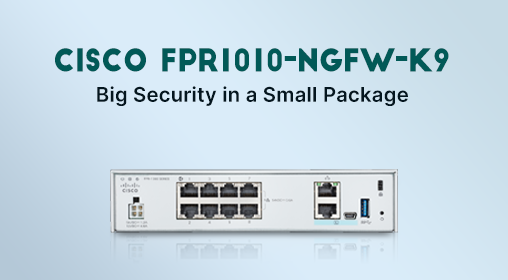
Under the hood, the FPR1010 is built for performance that meets modern demands. It delivers a solid firewall throughput of up to 2 Gbps, ensuring that your basic network traffic flows smoothly without bottlenecks. When you activate its advanced threat inspection capabilities, the system can handle around 650 Mbps for Next-Generation Intrusion Prevention System (NGIPS) and threat inspection, with TLS/SSL decryption reaching up to 150 Mbps. This level of performance is well-suited for businesses needing to inspect encrypted traffic without bringing their network to a crawl. The heart of its operation is the Cisco Threat Defense (FTD) software, which unifies firewall policies, intrusion prevention, malware detection, and URL filtering into a single, manageable system. This integration simplifies what would traditionally be a complex setup involving multiple point solutions. For administrators, a significant advantage is the ability to manage the entire security posture—from access rules to deep packet inspection—through a centralized console, making it easier to maintain a strong security stance without a massive IT team.
|
Feature Category |
Specification / Performance |
|---|---|
|
Firewall Throughput |
Up to 2 Gbps
|
|
Threat Inspection Throughput |
NGFW: ~650 Mbps; Next-Gen IPS: ~650 Mbps
|
|
TLS/SSL Decryption Throughput |
Up to 150 Mbps
|
|
Network Ports |
8 x Fast Ethernet (RJ-45)
|
|
Form Factor |
Desktop
|
|
Dimensions (H x W x D) |
46.2 x 199.4 x 205 mm
|
|
Weight |
Approximately 1.36 kg
|
For the people who manage it day-to-day, the experience is largely positive. The initial setup is relatively streamlined thanks to integrated management tools, which is a blessing for time-strapped IT managers. The centralized system for configuring and monitoring firewalls, VPNs, and intrusion prevention rules reduces the chance of human error and saves valuable time. However, some users note that fully leveraging all the advanced features, especially those involving deep SSL inspection and granular application control, can have a noticeable impact on performance. This is a common trade-off in the cybersecurity world, but it means administrators need to thoughtfully balance the level of inspection with the available bandwidth. The device’s quiet, fanless operation is another major plus in an office setting, eliminating the distracting hum that some competing units can produce. From a reliability standpoint, it has a reputation for stability once correctly configured, which is often the highest priority for businesses that can’t afford unexpected downtime.
When it comes to value, the FPR1010-NGFW-K9 sits in a compelling spot. It bundles critical security functions—stateful firewall, intrusion prevention system (IPS), advanced malware protection, and URL filtering—into a single, compact appliance. This convergence eliminates the need and cost of purchasing and managing separate devices for each function, leading to savings not just on the initial purchase but also on long-term power, cooling, and hardware maintenance. The inclusion of Cisco’s Talos threat intelligence, which provides global threat data to proactively block emerging attacks, adds significant value that is hard to quantify but crucial for modern defense. Of course, it’s not without its drawbacks. The 8-port Fast Ethernet connectivity might feel limiting for organizations with a growing number of Gigabit Ethernet needs, and the performance figures clearly indicate that it’s optimized for networks of a specific size. Pushing it beyond its intended capacity, particularly with all security features activated on a high-traffic network, will reveal its limits. Furthermore, the licensing model for ongoing subscriptions like threat intelligence updates can represent a recurring cost that must be factored into the total cost of ownership.
In the final analysis, the Cisco FPR1010-NGFW-K9 is a highly effective solution for its target market. It delivers the core of Cisco’s security technology in a practical, space-efficient form factor. Its strengths lie in consolidated security management, robust threat inspection for its class, and quiet, reliable operation. The trade-offs involve being mindful of its performance boundaries and the inherent licensing structure. For a small business or a remote branch needing to implement a powerful, unified security strategy without a complex infrastructure, this device represents a smart, balanced investment in network protection.