
Intellectual Property
Hot selling product recommendations
View More




















Cisco FPR-2140: The Silent Guardian of Network Security
When you first unbox the Cisco FPR-2140, the immediate impression is one of understated solidity. This isn’t a flashy piece of hardware—it’s a workhorse designed for environments where reliability trumps aesthetics. As a next-generation firewall, the FPR-2140 sits at the edge of corporate networks or data centers, acting as a gatekeeper against cyber threats while managing traffic flow with precision. Its role extends beyond traditional firewalls; it integrates intrusion prevention, malware analysis, and application visibility into a single platform. For organizations balancing performance and security, this device becomes the silent orchestrator of network integrity, scrutinizing every packet without slowing down critical operations.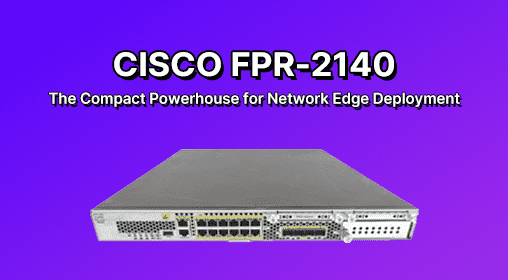
The FPR-2140’s physical design emphasizes practicality. The chassis is built for standard 1U rack mounting, with a brushed metal exterior that dissipates heat efficiently. On the front panel, you’ll find twelve Gigabit Ethernet ports alongside four SFP+ slots for fiber optics, all neatly aligned to simplify cable management. The top-left corner houses a dedicated management port, a small but crucial detail for administrators who need secure access without disrupting data interfaces. Despite the high port density, the layout avoids clutter—a thoughtful touch for technicians working in cramped server rooms. The device operates with a low hum, relying on passive cooling and minimal fan noise, making it suitable for office-adjacent deployments.
Under the hood, the FPR-2140 is engineered for demanding workloads. It runs Cisco’s Firepower Threat Defense (FTD) software, which combines ASA firewall capabilities with advanced services like NGIPS and AMP. The hardware leverages a multi-core CPU architecture and dedicated encryption engines to handle throughput up to 20 Gbps, depending on configuration. What stands out is its flexibility: it supports modular expansion, allowing networks to scale security policies alongside growing traffic. Below is a breakdown of its core specifications:
|
Parameter |
Specification |
|---|---|
|
Firewall Throughput |
Up to 20 Gbps (with services enabled) |
|
IPS Capacity |
~15 Gbps (varies by threat complexity) |
|
Port Configuration |
12×1G Ethernet, 4×10G SFP+ |
|
Form Factor |
1U Rack-Mountable |
|
Software Platform |
Cisco FTD (Firepower Threat Defense) |
|
High Availability |
Active/Standby Failover Support |
Functionally, the FPR-2140 excels in unified threat management. It can inspect encrypted traffic, block zero-day exploits using reputation-based filters, and correlate threats across network layers. The built-in FDM (Firepower Device Manager) offers a centralized GUI for policy adjustments, though advanced users might prefer the CLI for granular control. However, its reliance on Cisco’s ecosystem can be a double-edged sword. While integration with other Security Fabric products is seamless, customizing features outside Cisco’s framework requires expertise. For example, setting up failover between two FPR-2140 units involves configuring port-channels and heartbeat links—a process that’s smooth for seasoned engineers but daunting for newcomers.
Users of the FPR-2140 often highlight its stability. One network engineer noted that after initial configuration, the device ran for years without unexpected downtime. The learning curve is manageable for those familiar with Cisco’s environment, though the interface’s depth can overwhelm occasional administrators. Some admins wish for more intuitive logging or faster firmware updates, but overall, the consensus is that it’s a "set-and-forget" solution for core security duties. The absence of licensing surprises—common in subscription-based models—also earns praise.
When evaluating its pros and cons, the advantages include robust build quality, comprehensive threat protection, and seamless failover capabilities. The drawbacks revolve around complexity: initial setup requires careful planning, and troubleshooting deep-seated issues often demands Cisco TAC support. Yet, for organizations prioritizing long-term value over low upfront cost, the FPR-2140 delivers. It avoids the premium price of newer models while handling modern threats effectively, making it a prudent investment for enterprises with established Cisco infrastructure.
In summary, the FPR-2140 embodies Cisco’s emphasis on endurance over novelty. It might lack the buzz of cloud-native firewalls, but for those who need a resilient, all-in-one security partner, it remains a steadfast choice.