
Intellectual Property
Hot selling product recommendations
View More




















Cisco FPR-2130: The Resilient Enforcer for Modern Network Security
When you deploy the Cisco FPR-2130 into a network rack, its purpose becomes clear: it’s designed to serve as a unified security gateway for mid-to-large enterprises. This Next-Generation Firewall (NGFW) consolidates multiple security functions—stateful firewall inspection, intrusion prevention, VPN connectivity, and advanced threat detection—into a single 1U appliance. It’s typically deployed at the internet edge or data center perimeter, where it scrutinizes traffic in real-time to block malicious activity while allowing legitimate business operations to flow uninterrupted. For organizations balancing performance with security, the FPR-2130 acts as a vigilant guard, ensuring that both inbound and outbound data exchanges remain secure without introducing debilitating latency.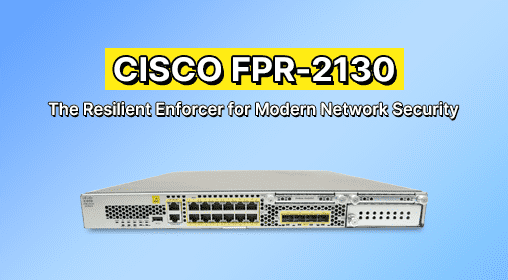
Under the hood, the appliance leverages a dual multicore CPU architecture that dedicates specific cores to firewall tasks, cryptographic operations, and deep packet inspection. This specialized processing enables it to maintain throughput up to 10 Gbps for stateful firewall inspections and about 5.4 Gbps when advanced threat features like IPS are enabled. It can handle up to 2 million concurrent connections and process 40,000 new connections per second, making it suitable for environments with significant user loads or sudden traffic surges. The system also supports IPsec VPN throughput of roughly 1.9 Gbps and can maintain up to 7,500 VPN peers, which is essential for securing remote branch office links or mobile worker access. Below is a summary of its core parameters:
|
Parameter |
Specification |
|---|---|
|
Firewall Throughput (Stateful) |
Up to 10 Gbps |
|
Throughput (with IPS/AVC) |
~5.4 Gbps |
|
Concurrent Connections |
2 million |
|
New Connections per Second |
40,000 |
|
IPsec VPN Throughput |
~1.9 Gbps |
|
Maximum VPN Peers |
7,500 |
|
Integrated Ports |
12×1G RJ-45, 4×10G SFP+ |
|
Expandable Ports (via Module) |
Up to 24 total Ethernet ports |
|
Power Supply |
250W AC or -48V DC options |
|
Rack Units |
1U |
Physically, the FPR-2130 embodies a rugged, practical design. The chassis is built for standard 19-inch racks, with a brushed metal exterior that aids heat dissipation. Its front panel neatly arranges twelve Gigabit Ethernet RJ-45 ports and four SFP+ cages for fiber optics, all clearly labeled to simplify cable management. A dedicated management port and a console port are positioned for out-of-band administration, while a hot-swappable fan module and redundant power supply options enhance operational resilience. The unit operates quietly under normal loads—around 56 dBA—making it suitable for office-adjacent server rooms, though noise can increase to 77 dBA during peak processing.
Functionally, the FPR-2130 runs Cisco’s Firepower Threat Defense (FTD) software, which integrates ASA firewall capabilities with advanced services. It enforces granular application-level policies (AVC), blocks intrusions using signature-based and anomaly-based detection (IPS), and filters threats through Cisco’s Talos intelligence feed. The system also supports encrypted traffic analysis (up to 760 Mbps for TLS inspection) and segments networks using virtual security contexts (up to 30). High availability is achieved through active/active or active/standby clustering, and centralized management is available via Cisco Security Manager or cloud-based Defense Orchestrator. However, the learning curve for these advanced features can be steep for teams new to Cisco’s ecosystem, and troubleshooting complex policies sometimes requires support from Cisco’s TAC.
Users of the FPR-2130 often highlight its reliability in day-to-day operations. One network administrator noted that after the initial setup—which is straightforward for those familiar with Cisco’s CLI—the device runs for years without unexpected downtime. The web-based Adaptive Security Device Manager (ASDM) provides an intuitive interface for routine tasks, though power users may prefer the command line for fine-tuning. On the downside, some mention that the interface for correlating logs across multiple features can feel cluttered, and licensing costs for full threat intelligence updates can add up over time. Nevertheless, the overall experience is of a set-and-forget appliance that consistently blocks threats while keeping network performance stable.
When evaluating its pros and cons, the advantages include a robust build quality, seamless integration of multiple security functions, and scalable performance for mid-range deployments. The drawbacks involve the complexity of initial configuration for advanced features and the recurring costs for subscription services. Yet, for organizations invested in Cisco’s security fabric, the FPR-2130 delivers strong value by consolidating security tools into one platform, reducing the need for multiple point solutions. It may not be the cheapest option upfront, but its durability and comprehensive protection make it a cost-effective long-term investment for securing critical network boundaries.
In summary, the FPR-2130 stands as a testament to Cisco’s focus on unifying performance with layered security. It might not have the hype of cloud-only solutions, but for those who need a physical, all-in-one enforcement point, it remains a dependable workhorse that earns its keep through relentless vigilance.