
Intellectual Property
Hot selling product recommendations
View More




















Cisco Catalyst C9300-48UN-A: The Engine of Modern Enterprise Networks
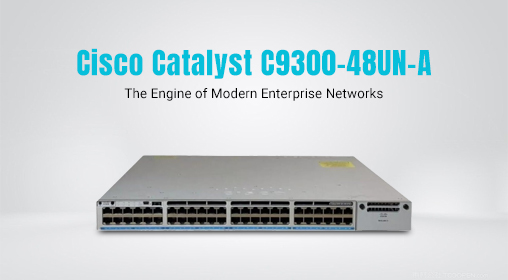
Let’s cut straight to the specs—here’s what’s under the hood:
|
Key Specification |
Details |
|---|---|
|
Port Configuration |
48 x Multigigabit Ethernet (100M/1G/2.5G/5G) |
|
Uplink Options |
Modular (supports 1G/10G/25G/40G via add-on modules) |
|
Switching Capacity |
256 Gbps |
|
Packet Forwarding Rate |
190.48 Mpps |
|
Power over Ethernet |
Cisco UPOE (up to 60W per port) |
|
Stacking Technology |
StackWise-480 (up to 480 Gbps bandwidth) |
|
Security Features |
MACsec encryption, Cisco TrustSec, SD-Access integration |
Now, onto what this actually means for your network. The C9300-48UN-A isn't just a switch; it's the central nervous system for a modern, agile business. Think of it as the silent workhorse that connects everything—from your legacy office printers to a fleet of new Wi-Fi 6 access points—without breaking a sweat. Its 48 multigigabit ports are the real star, automatically negotiating the best speed for each connected device. This means you can upgrade your wireless infrastructure to the latest standard without the nightmare of rewiring your entire building.
Performance is where it truly flexes its muscles. That 256 Gbps switching capacity handles traffic spikes during company-wide video calls or large data transfers without a hint of congestion. For IT managers, the modular uplinks are a gift. Need to connect to a high-speed data center or build a resilient spine-leaf architecture? Just slot in the appropriate 10G, 25G, or 40G module. It’s this kind of flexibility that future-proofs your investment.
Build quality is unmistakably enterprise-grade. The unit feels solid, with a dark, minimalist chassis that looks professional in any rack. The cleverly designed airflow keeps it cool and remarkably quiet, which is a small but appreciated detail for anyone working near the server closet.
But hardware is only half the story. The magic lies in features like Cisco UPOE, which can deliver enough power through an Ethernet cable to run a thin client or a high-end video conferencing system. On the security front, it’s a fortress. Built-in encryption (MACsec) protects data flowing between switches, while integration with Cisco DNA Center lets you segment network access at a granular level. Imagine instantly isolating a potentially compromised device with a few clicks instead of a weekend-long emergency project.
Users who’ve deployed it often talk about the initial “aha” moment. “Once we got it stacked and integrated with DNA Center, managing our branch networks became centralized and almost effortless,” one network engineer shared. The learning curve for the full software suite is real, but the payoff in automated policy enforcement and visibility is substantial.
Is it the right choice for everyone? Let’s be honest: for a small office with basic needs, it might be over-engineered. The initial investment is significant, and critical components like the high-speed uplink modules are sold separately. However, for a growing organization where network reliability, security, and scalability are non-negotiable, the value is clear. It eliminates costly rip-and-replace upgrades down the line. When you factor in reduced downtime, centralized management, and the power to support next-generation applications, the total cost of ownership begins to look very competitive. It’s a strategic tool, not just an expense.