
Intellectual Property
Hot selling product recommendations
View More




















Cisco Catalyst C9200-48P-A: The Silent Engine of Modern Networks
Walking into a server room, the first thing you notice about the Cisco Catalyst C9200-48P-A is its unassuming presence. Housed in a sleek, single-rack-unit (1RU) chassis, this switch sports a minimalist design with a matte black finish that resists fingerprints and scratches. Its front panel is dominated by 48 PoE+ Ethernet ports, neatly aligned in four rows, with an additional modular uplink slot for flexibility. The built-in status LEDs glow softly, indicating power, link activity, and PoE status without overwhelming the senses. Weighing around 5 kg, it feels substantial yet manageable, hinting at the robust engineering inside.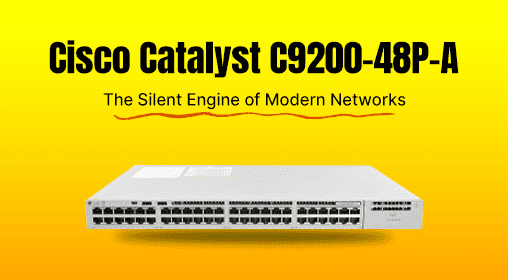
This device is built to be the backbone of mid-sized enterprise networks. It’s commonly deployed as an access layer switch in offices, schools, or campuses, where it powers everything from VoIP phones and wireless access points to IoT sensors and security cameras. The integrated Power over Ethernet Plus (PoE+) capability means it can deliver up to 30W per port to connected devices, eliminating the need for separate power adapters and simplifying cable management. For IT teams, this translates to a unified infrastructure that supports voice, video, and data traffic without retrofitting existing electrical systems.
When it comes to performance, the C9200-48P-A is designed to handle high-density traffic with ease. Its specs reflect a focus on reliability and speed:
|
Parameter |
Specification |
|---|---|
|
Backplane Bandwidth |
176 Gbps
|
|
Packet Forwarding Rate |
361.9 Mpps
|
|
PoE Budget |
Up to 1440W (supports full 48-port PoE+)
|
|
Uplink Options |
Modular slots (support 1G/10G/25G/40G)
|
|
Switching Method |
Store-and-forward with hardware-based CEF
|
|
VLAN Support |
4096 VLAN IDs
|
The secret to its agility lies in Cisco’s UADP 2.0 Mini ASIC, which enables line-rate Layer 3 switching while handling advanced features like QoS and ACLs without breaking a sweat. The stackable design allows multiple units to operate as a single logical switch, with a stacking bandwidth of up to 160 Gbps ensuring seamless interconnects.
Functionally, the C9200-48P-A is a chameleon. It supports Cisco’s intent-based networking framework, allowing administrators to automate policies across the network via DNA Center. Security features include MACsec encryption for data confidentiality, role-based access control, and integration with Cisco Identity Services Engine (ISE) for dynamic policy enforcement. The switch also boasts "cold patching" – the ability to install software updates without rebooting, a godsend for maintaining uptime in 24/7 environments.
From an user experience perspective, the initial setup can be done through a web UI or CLI, with Cisco’s Plug-and-Play service simplifying deployments across multiple sites. Network administrators appreciate the intuitive troubleshooting tools, such as embedded packet capture and streaming telemetry, which provide real-time insights into network health. The redundant, hot-swappable power supplies and fans ensure that even if a component fails, the switch hums along without disruption. One trade-off, however, is the learning curve for DNA Center automation, which might require training for teams accustomed to traditional CLI management.
In terms of value, the C9200-48P-A sits in a sweet spot between entry-level switches and premium models like the Catalyst 9300 series. While its initial cost is higher than non-PoE or basic Layer 2 switches, the long-term savings come from reduced power infrastructure costs, energy-efficient operation (some models are ENERGY STAR certified), and scalability that postpones the need for future upgrades. For organizations planning to expand their IoT footprint or adopt higher-power devices like pan-tilt-zoom cameras, the PoE+ investment pays dividends in flexibility.
The Balanced Verdict
Pros:
Future-proof PoE+ capacity: Powers 48 devices seamlessly, from APs to advanced sensors..
Resilient design: Redundant power and cooling, with a mean time between failures (MTBF) exceeding 500,000 hours.
Software-defined readiness: Fits into Cisco’s SD-Access ecosystem for automated network management.
Cons:
Complex licensing: DNA Advantage and Premier tiers may confuse smaller teams.
Acoustic footprint: The fans, while redundant, can generate up to 45 dB under load – noticeable in quiet offices.
Module dependency: High-speed uplinks require separate network module purchases.
The Cisco Catalyst C9200-48P-A isn’t a flashy superstar; it’s the reliable workhorse that keeps networks running silently in the background. For IT leaders weighing scalability against complexity, it offers a pragmatic path to modernizing network edges without over-engineering.