
Intellectual Property
Hot selling product recommendations
View More




















Cisco Catalyst 9300X vs. 9300L: A Practical Comparison for Network Architects
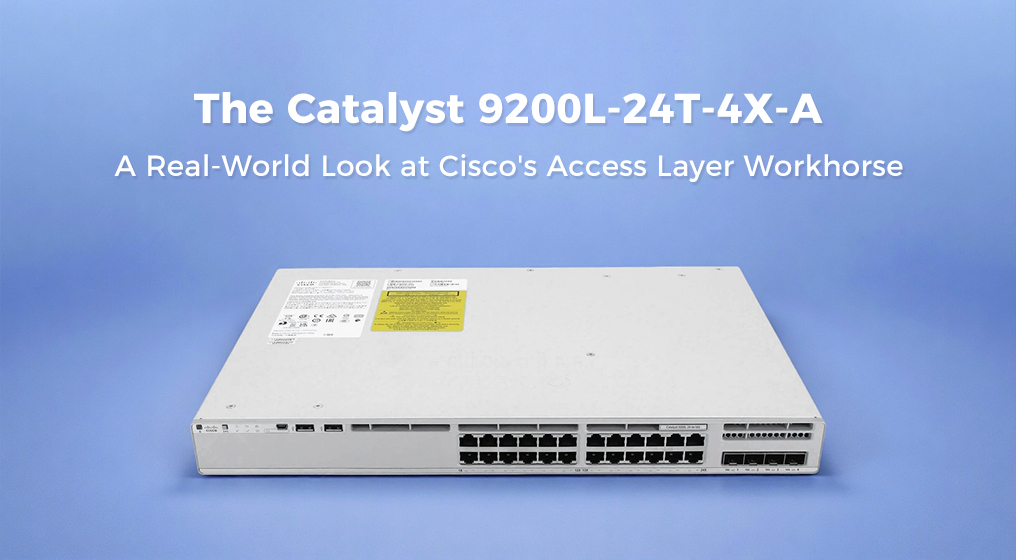
Choosing between the Cisco Catalyst C9300X-24HX-E and the C9300L-24T-4X-A is less about finding a "better" switch and more about matching the right tool to the specific demands of your network environment. One is a high-performance engine built for the most demanding applications, while the other is a reliable and cost-effective workhorse for standard enterprise access layers. Let's break down their core differences.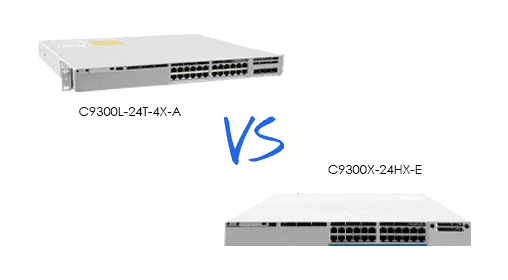
The Core Parameters at a Glance
|
Feature |
Cisco Catalyst C9300X-24HX-E |
Cisco Catalyst C9300L-24T-4X-A |
|---|---|---|
|
Port Configuration |
24 x 1G/10G/25G Multi-Gigabit ports with modular uplink slots
|
24 x 1G RJ45 data ports + 4 x fixed 10G SFP+ uplink ports
|
|
Switching Capacity |
480 Gbps - 1 Tbps (with stacking)
|
128 Gbps
|
|
Stacking Bandwidth |
Up to 1.6 Tbps with StackWise-1T/1.6T
|
320 Gbps with StackWise-320
|
|
PoE Capability |
Supports UPOE+ (up to 90W per port)
|
Data-only (No PoE)
|
|
Network License |
Network Advantage
|
Network Advantage
|
|
Key Differentiator |
High-density 25G, 100G-ready uplinks, hardware-based IPsec encryption
|
Fixed configuration, cost-optimized for 1G access layer with 10G uplinks
|
Performance and Hardware: Power vs. Pragmatism
The performance gap between these two switches is substantial, reflecting their distinct target environments. The C9300X-24HX-E is a performance powerhouse. Its 24 Multi-Gigabit ports can operate at 1G, 10G, or 25G speeds, providing immense flexibility for connecting high-end Wi-Fi 6/6E access points, high-performance workstations, and servers. Its modular uplink slots can support 100G connections, making it suitable for data center edges or high-throughput aggregation points. Under the hood, it features a more powerful ASIC (UADP 2.0sec) that even supports hardware-based IPsec encryption at line rates.In contrast, the C9300L-24T-4X-A is built for reliability and simplicity in the classic enterprise access layer. Its 24 standard Gigabit Ethernet ports are perfect for connecting desktop phones, computers, and printers. The four fixed 10G SFP+ uplink ports provide ample bandwidth for trunking back to the network core without the complexity or cost of additional modules. Its hardware is optimized for this specific role, offering a lower entry point while maintaining the robust Layer 3 features enabled by its Network Advantage license.
Functionality and Ecosystem: Future-Proofing vs. Streamlined Operations
Both switches run Cisco IOS-XE and support advanced capabilities like SD-Access, but the C9300X is designed for a more complex ecosystem. It is a foundational element for intent-based networking, with deep integration for Cisco DNA Center for automation and advanced security features like Encrypted Traffic Analytics (ETA). Its ability to host containerized applications directly on the switch opens up possibilities for running services like a virtual firewall at the network edge.
The C9300L delivers a comprehensive Layer 3 feature set thanks to its Network Advantage license, including protocols like OSPF and BGP. However, it focuses on delivering these core switching and routing functions exceptionally well for its segment, without the added complexity of application hosting or 100G IPsec. It’s a "right-sized" solution for networks that need advanced routing but not the absolute cutting-edge capabilities required for AI workloads or secure cloud gateways.
Stability and Design: Robust Chassis and Clean Layout
From a physical standpoint, the C9300X series often features a more robust chassis design to accommodate the higher heat dissipation needs of its powerful components and optional high-wattage power supplies for PoE. The modular uplink slots are a key part of its design, allowing for future upgrades.
The C9300L, with its fixed port layout, presents a cleaner and more straight forward physical design. This fixed configuration enhances its reliability by eliminating potential points of failure associated with modular components. Its design is optimized for standard office environments, with a focus on operational simplicity and a smaller physical footprint.
Making the Right Choice for Your Network
So, which one is for you? The Cisco Catalyst C9300X-24HX-E is the clear choice if your network is facing bandwidth-intensive futures. It's ideal for upgrading campus backbones, supporting high-density AI/ML workloads, securing cloud connections with high-speed encryption, or deploying a massive number of UPOE+ devices. You're investing in a platform that will not become obsolete for many years.
Choose the Cisco Catalyst C9300L-24T-4X-A when your primary need is a highly reliable, high-functioning access layer switch for a typical enterprise branch or office. It delivers excellent value for connecting standard Gigabit devices, provides the necessary 10G uplinks, and includes full Layer 3 routing capabilities without the premium cost associated with higher-density Multi-Gigabit and 100G features. It’s the pragmatic workhorse that gets the job done efficiently and reliably.