
Intellectual Property
Hot selling product recommendations
View More




















Cisco C9800-L-C-K9: The Brain Behind Your Wireless World
Let’s talk about the Cisco C9800-L-C-K9, a piece of networking hardware that truly gets the job done without much fuss. Imagine the central nervous system for a company's wireless network—this controller is exactly that. It’s the brain that manages all your Cisco access points, making sure they work together seamlessly to provide a stable and secure Wi-Fi experience for everyone, from the front desk to the boardroom. Built on Cisco's intent-based networking philosophy, it brings together the robustness of IOS XE software with advanced radio frequency management, aiming to deliver a wireless environment that just works, day in and day out .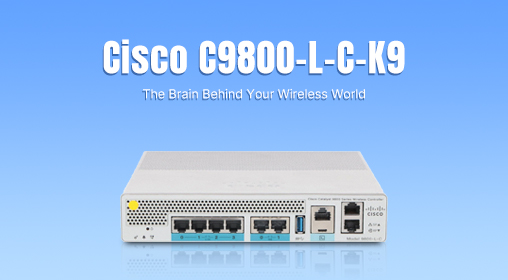
When you first get your hands on the C9800-L-C-K9, you notice its compact and practical design. It’s a standard 1RU unit, meaning it takes up just one slot in a server rack, which is great for saving space. The build feels solid without being overly heavy. On the front, you're greeted by a clean layout of ports, which we'll get into in a moment. It’s a device that looks professional and ready for business without any flashy gimmicks. The core of what makes this controller tick is its performance. It’s designed to handle the demands of modern businesses, supporting the latest Wi-Fi standards to ensure fast and reliable connections for a multitude of devices. Administrators have multiple ways to talk to it, whether through a web browser via HTTP/HTTPS for a graphical interface, or through command-line standards like Telnet and SSH for those who prefer typing out commands . It supports a range of network management protocols, including various versions of SNMP, making it easy to integrate into existing monitoring systems .
Here’s a quick look at its key technical specifications :
|
Parameter |
Specification |
|---|---|
|
Dimensions (H x W x D) |
215.9 x 230.1 x 40.2 mm |
|
Weight |
1.79 kg |
|
Power Consumption |
84.5 W |
|
Management Interfaces |
HTTP/HTTPS, Telnet, SSH, Serial Console |
|
Network Ports |
4 x 2.5G/1G + 2 x 10G copper ports, or 4 x 2.5G/1G copper + 2 x 10G SFP+ fiber ports |
|
Other Ports |
RJ-45 console, Micro-USB console, USB 3.0, RJ-45 management, RJ-45 redundant port |
|
Managed AP Capacity |
Information suggests support for a certain number of access points, relevant for sizing the network. |
The feature set is where the C9800-L really aims to justify its place in your network. A standout for many IT teams is the promise of seamless software updates . This means you can apply critical patches and new features with minimal risk of disrupting the network, a huge plus for maintaining business continuity. It’s built with high availability in mind, offering features like redundant power options to keep things running even if one path fails. Security isn't an afterthought, either; it’s woven into its core, helping to protect the network from threats and ensuring that data transmissions stay private.
From a user experience perspective, particularly for the network administrator, the feedback is generally positive. The web interface is logically structured, making it relatively straightforward to configure new access points, set up different wireless networks (SSIDs), and monitor the health of the system. The consistency of using Cisco IOS XE is a big benefit for teams already familiar with the Cisco environment, as it reduces the learning curve. For end-users, the goal is an invisible experience—they just get a fast, reliable connection that doesn't drop as they move around the office. The controller's advanced RF management works constantly in the background to make this happen, automatically adjusting channel and power settings to avoid interference.
Evaluating its value involves looking beyond just the initial cost. The C9800-L-C-K9 is an investment in network stability and reduced operational overhead. While there are less expensive options on the market, the reliability, extensive feature set, and deep integration with the broader Cisco ecosystem can lead to significant savings in time and trouble over the years. It’s the kind of device that, when it works as intended, you simply don't have to think about very often, which is the highest compliment for enterprise gear. The inclusion of powerful 10G uplink ports also ensures it won't become a bottleneck as your network traffic grows .
Of course, no product is perfect. The primary advantages of the C9800-L are also its main drawbacks for some scenarios. Being a Cisco product, it fits most naturally within an all-Cisco infrastructure. While it can manage various APs, you'll get the most value by using it with Cisco access points, which might not be ideal for a mixed-vendor environment. The initial investment and any potential licensing for advanced features can be a consideration for smaller businesses or tight budgets. Some administrators might also find the sheer depth of configuration options a bit daunting at first, though this complexity is what allows for fine-tuned control.
In summary, the Cisco Catalyst 9800-L-C-K9 Wireless Controller stands out as a robust, feature-rich solution for businesses that depend on their wireless network. Its strengths in seamless updates, strong security, and high availability make it a solid choice for ensuring a dependable Wi-Fi experience. The decision to adopt it will largely hinge on your existing infrastructure, specific performance needs, and how you weigh the initial investment against long-term operational benefits and network stability .