
Intellectual Property
Hot selling product recommendations
View More




















Cisco C9500-40X-A: The Core Workhorse for Modern Enterprise Networks
When you first encounter the Cisco C9500-40X-A, its presence in the rack makes it immediately clear this isn't an ordinary access layer switch. This is a piece of hardware built for a specific purpose: to be the reliable, high-capacity backbone of a demanding network. The design is all business—a solid 1RU chassis that feels dense and purposeful. It houses 40 fixed 10G SFP+ ports, providing a substantial amount of connectivity in a relatively compact form factor. The build quality is what you'd expect from a core-tier device, with robust construction and a layout that prioritizes functionality over flair. The inclusion of hot-swappable, redundant power supplies and fans is a clear signal that this hardware is designed for environments where uptime is non-negotiable. While it might not be the most flashy piece of equipment, its professional aesthetic communicates stability and readiness for heavy lifting.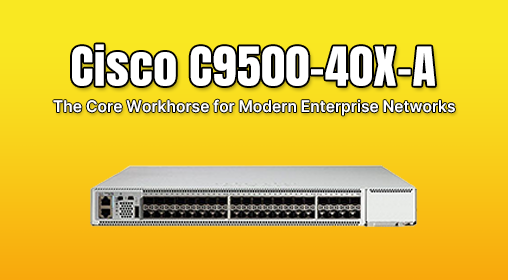
Under the hood, the performance specs are where the C9500-40X-A truly establishes its position. It's powered by a quad-core, 2.4 GHz x86 CPU and is equipped with 16 GB of DDR4 memory, providing ample processing power for complex routing decisions and network management tasks. The system delivers a switching capacity of up to 960 Gbps and a forwarding rate of 720 million packets per second (Mpps). This level of performance ensures that data flows smoothly even under significant load, making it suitable for aggregating traffic from multiple access switches or handling data-intensive applications. A look at the core parameters gives a clearer picture of its capabilities.
|
Core Parameter |
Specification |
|---|---|
|
Form Factor |
1 Rack Unit (1RU) |
|
Port Configuration |
40 x 10G SFP+ |
|
System Switching Capacity |
960 Gbps |
|
Forwarding Rate |
720 Mpps |
|
Processor & Memory |
Quad-core 2.4 GHz, 16 GB DRAM |
|
Flash Storage |
16 GB |
|
Maximum Power Consumption |
850W (max) |
|
Mean Time Between Failures (MTBF) |
180,640 hours |
Where this switch really flexes its muscles is in its feature set. It runs on Cisco's IOS XE operating system, which is a modern, robust platform that supports full programmability, automation, and advanced security features. A key capability is its support for Cisco's Software-Defined Access (SD-Access), which automates network policies and simplifies management in large, complex environments. For security, it offers MACsec (Media Access Control Security) encryption on its ports, providing hardware-based, line-rate security to protect data as it moves across the network. The StackWise Virtual technology is another standout, allowing two physical switches to operate as a single, logical entity, which greatly enhances redundancy and simplifies network management.
From an operational perspective, the C9500-40X-A is built for engineers who need reliability and control. The familiar IOS XE CLI is a comfortable environment for those experienced with Cisco systems, though its depth can present a learning curve for newcomers. The ability to integrate with Cisco DNA Center brings a layer of automation and graphical management that can significantly streamline operations for large-scale deployments. The hardware redundancy features are not just checkboxes; they are critical for maintaining operations. The peace of mind that comes from knowing you can replace a failed power supply or fan without dropping the entire switch is invaluable in a core network device.
When evaluating its value, the conversation shifts from mere cost to total cost of ownership. This switch represents a significant investment, positioning it squarely for enterprise core, data center aggregation, or large campus backbone roles. Its value becomes apparent in scenarios where its high port density, advanced feature set, and proven reliability can be fully leveraged. The long-term operational savings from automation and reduced downtime can balance the initial investment over its extended lifecycle, which is typically longer than that of access-layer switches.
No product is perfect, and the C9500-40X-A has its considerations. Its primary strength is also its main limitation: it's a fixed-configuration switch. You are committing to a specific port configuration (40 x 10G) upfront, with no option to add different port types via expansion modules later. While it delivers strong performance for its class, it's important to note that some of the performance figures, such as the 720 Mpps forwarding rate, are "up to" values and real-world performance can be influenced by the specific features enabled, like deep packet inspection or complex ACLs.
In the final analysis, the Cisco Catalyst C9500-40X-A is a formidable and highly capable switch engineered for a specific mission. It excels as a compact, powerful, and feature-rich core for enterprise networks that require high-density 10G connectivity, robust security, and operational automation. It's an ideal solution for organizations looking to build a solid, future-ready network foundation that can handle the demands of modern applications and cloud connectivity. For the right environment, it's not just a switch, but a strategic asset that delivers dependable performance day in and day out.