
Intellectual Property
Hot selling product recommendations
View More




















Cisco C9300X-12Y-A: The Engine Behind Modern Enterprise Networks
When you first lay eyes on the Cisco C9300X-12Y-A, its design tells you immediately that it’s built for serious work. The sleek metal chassis, measuring 44 × 445 × 445 mm and weighing 7.27 kg, is both compact and robust, fitting neatly into standard server racks while promising durability. The front panel is all business: twelve 25G SFP28 ports stand ready for high-speed fiber connections, accompanied by management ports and stacking interfaces that hint at its expandable nature. This isn’t just a switch; it’s the central nervous system for data-intensive environments, engineered to handle the relentless flow of information without breaking a sweat.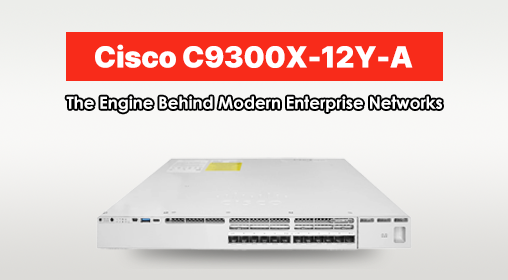
At its core, this switch is designed to serve as the backbone of modern enterprise networks. Think of it as the silent conductor orchestrating traffic in data centers, large campus networks, or cloud infrastructure. Its job is simple yet critical: ensuring that massive volumes of data—whether from virtualized servers, high-definition video streams, or real-time applications—move swiftly and reliably. For businesses that depend on uninterrupted connectivity, the C9300X-12Y-A acts as a force multiplier, eliminating bottlenecks and paving the way for seamless digital operations.
What truly sets this switch apart is its raw performance. With a backplane bandwidth of 208 Gbps and a packet forwarding rate of 154.76 Mpps, it’s built to tackle heavy loads without breaking a sweat. But the numbers only tell part of the story. Its stacking capability allows multiple units to operate as a single logical device, creating a unified management plane and a resilient infrastructure that grows alongside your needs. The inclusion of advanced features like granular access controls, robust VLAN support, and energy-efficient power management transforms it from a mere data passer into an intelligent network asset.
|
Core Parameter |
Specification |
|---|---|
|
Port Configuration |
12 × 25G SFP28 fiber ports |
|
Backplane Bandwidth |
208 Gbps |
|
Packet Forwarding Rate |
154.76 Mpps |
|
Switching Capacity |
1000 Gbps (2000 Gbps when stacked) |
|
Power Supply |
715W AC, with redundant PSU support |
|
Dimensions |
44 × 445 × 445 mm |
|
Weight |
7.27 kg |
|
MTBF (Mean Time Between Failures) |
Approximately 314,790 hours |
For network administrators, the C9300X-12Y-A brings a mix of relief and slight complexity. On one hand, its reliability is palpable—the high mean time between failures (over 300,000 hours) means fewer unexpected outages, and features like hot-swappable power supplies and fans ensure maintenance doesn’t turn into downtime. The learning curve for leveraging its full potential, especially around programmability and automation through Cisco DNA Center, can be steep for teams new to the ecosystem. Yet, once mastered, it offers a level of control and visibility that feels almost futuristic.
Where this switch truly shines is in its balance of power and practicality. While the upfront investment may be higher than some alternatives, it repays that cost through longevity, reduced operational headaches, and scalability. The ability to stack switches and manage them as one unit slashes future expansion costs, while the energy-efficient design keeps electricity bills in check. For growing organizations, this isn’t just a purchase—it’s a long-term investment in a network that won’t need replacing every few years.
No device is perfect, of course. The strengths of the C9300X-12Y-A—its advanced features, deep programmability—also double as its hurdles. Teams accustomed to simpler setups might find the initial configuration daunting, and maximizing value often requires pairing it with Cisco’s DNA Center, which adds to the total cost of ownership. Some users have also noted that the documentation can be dense, leaning heavily toward experienced engineers. Still, for those who need top-tier performance, unwavering reliability, and a platform that can evolve, these trade-offs are more than justified.In the end, the Cisco C9300X-12Y-A isn’t for everyone. It’s for those who see their network as a strategic asset, not just a utility. If your goal is to build an infrastructure that’s as resilient as it is fast, this switch delivers in ways that simpler gear simply can’t match.