
Intellectual Property
Hot selling product recommendations
View More




















Cisco C9300-48U-E: The Reliable Engine of the Modern Campus Network
If you've ever been tasked with wiring up a busy office floor, a university building, or a hospital wing, you know the switch at the access layer isn't just a box—it's the foundation. The Cisco Catalyst C9300-48U-E feels exactly like that: a no-nonsense, utterly dependable foundation. Pulling it out of the box, its heft is immediately apparent. This is a 1U rack unit built with a solid, industrial-grade steel chassis. The front is a clean grid of 48 RJ-45 ports, each with a subtle LED that blinks a reassuring green during normal operation. To the right, you'll find the flexibility: four dedicated 1G SFP slots and four 10G SFP+ uplink ports, ready to connect to your core. It's not flashy, but the design communicates durability. The side vents and rear fan trays are engineered for silent, consistent airflow, meaning you can install it in a wiring closet and forget it's there—which is the highest compliment for this kind of hardware.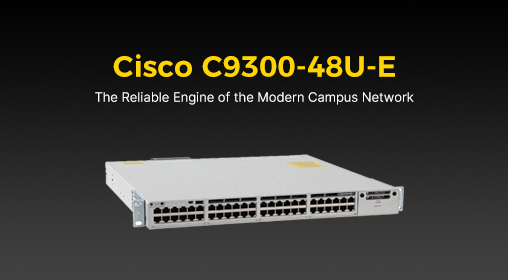
So, what's it for? Think of the C9300-48U-E as the universal workhorse for connecting everything that isn't a server. Its primary playground is the enterprise access layer. We're talking about connecting desktops, IP phones, printers, wireless access points, and a growing army of IoT sensors. Those 48 Gigabit Ethernet ports with Power over Ethernet (PoE+) are the star of the show. They can deliver up to 30 watts per port, which is more than enough to power modern Wi-Fi 6 access points, video phones, and security cameras without needing a separate power injector jungle. This makes it a perfect fit for smart buildings, classrooms, and healthcare facilities where clean, centralized power is a must.
Under the hood, it's powered by Cisco's trusted UADP ASIC. It won't break terabit-scale speed records like its data-center cousins, but for campus traffic, it's more than capable. The architecture is non-blocking, ensuring that traffic from a busy video conference on port 5 doesn't interfere with a large file transfer on port 45. It runs the full-featured Cisco IOS XE operating system, which is a big deal. This isn't a stripped-down OS; it's the same software that runs on much larger routers, bringing advanced routing, security, and programmability right to the edge of your network.
Here’s a quick look at what makes it tick:
|
Parameter |
Specification for C9300-48U-E |
|---|---|
|
Fixed Ports |
48 x 10/100/1000BASE-T RJ-45 (PoE+) |
|
Fixed Uplinks |
4 x 1G SFP + 4 x 10G SFP+ |
|
Switching Capacity |
208 Gbps |
|
Forwarding Rate |
154 Mpps |
|
Maximum PoE Budget |
740W (with 1100W AC power supply) |
|
Stacking Technology |
StackWise-480 (up to 8 units, 480 Gbps ring) |
|
Operating System |
Cisco IOS XE (with DNA Essentials/Advantage tiers) |
|
Security Features |
Hardware Trust Anchor, MACsec, Encrypted Traffic Analytics |
The experience of managing one of these is a tale of two modes. For the network veteran, the command-line interface (CLI) is instantly familiar and powerfully granular. You can tweak everything. For teams moving toward automation, the support for APIs, Python scripting, and integration with Cisco DNA Center is a game-changer. I've seen an admin use a simple script to provision 20 new phones across different VLANs in minutes, a task that would have taken an hour manually. The stackability is another huge win. You can link up to eight switches together logically to act as one, simplifying management and creating redundant uplinks. Rebooting one member of the stack doesn't take the whole network segment down.
Let's talk about value. The C9300-48U-E sits in a sweet spot. It's significantly more capable than basic unmanaged switches, offering the reliability, security, and features that businesses need. Yet, it doesn't carry the extreme cost of the highest-tier modular chassis. You're paying for that robust IOS XE software, the reliable hardware, and Cisco's ecosystem. Over a 5-7 year lifecycle, its stability often means lower total cost of ownership than cheaper alternatives that might fail or need early replacement. The PoE capabilities alone can save thousands in electrical wiring costs for new deployments.
Of course, nothing is perfect.
Where it shines:
Rock-Solid Reliability: These switches are known for running for years without a hiccup. The build quality and mature software see to that.
Powerful PoE: A 740W budget means you can fully utilize most ports for PoE devices without overloading it, future-proofing for more power-hungry devices.
Software Depth: IOS XE is a powerhouse. Features like application visibility, advanced QoS, and integrated security are built-in, waiting to be enabled.
Investment Protection: The stackability and software upgrade paths mean the network can grow without ripping and replacing hardware.
Where it gives pause:
The Licensing Conversation: To unlock the full potential (like advanced security or SD-Access), you need a DNA subscription. This is an ongoing cost that some organizations find complex.
Fan Noise: In a very quiet office environment, the fans can be noticeable during boot-up or under heavy PoE load. It's best suited for a dedicated comms room.
Not a Speed Demon: The 10G uplinks are sufficient for most access-layer duties today, but as desktop connections move to 2.5G/5G, this model's fixed 1G copper ports could become a bottleneck for some high-end use cases.
In the end, the Cisco Catalyst C9300-48U-E is the definition of a workhorse. It doesn't chase the latest buzzwords on the spec sheet; instead, it delivers proven, manageable, and secure connectivity for the heart of your business. You choose it not for a single flashy feature, but for the confidence that the foundation of your network won't let you down.