
Intellectual Property
Hot selling product recommendations
View More




















Cisco C9300-48U-E vs. WS-C3750X-48PF-S : A Tale of Two Networking Eras
Choosing between the Cisco Catalyst C9300-48U-E and the WS-C3750X-48PF-S is less about comparing two switches and more about deciding what kind of network you want to build. One is a modern, software-defined architecture designed for the next decade; the other is a time-tested workhorse from an era of robust hardware and straightforward operations. Here’s a detailed breakdown of how they differ in practice.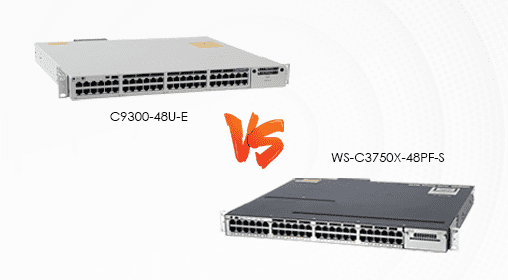
At its core, the C9300-48U-E is built for modern data-intensive environments. With a x86 CPU, 8GB of RAM, and 16GB of flash memory, it can natively host containers and third-party applications, something the 3750X’s 256MB RAM and 64MB flash architecture simply cannot approach. The performance gap is stark: the C9300 offers a switching capacity of up to 256 Gbps and a stacking bandwidth of 480 Gbps with StackWise-480, while the 3750X maxes out at 160 Gbps and relies on the older StackWise Plus technology with significantly lower throughput.
For Power over Ethernet, the C9300 supports Universal PoE (UPOE), delivering up to 60W per port and a total budget of up to 740W. This is essential for powering high-demand devices like next-gen Wi-Fi 6/6E access points, advanced PTZ cameras, and building management systems. The 3750X provides standard PoE+ with a typical budget of up to 435W usable power, which is adequate for IP phones and basic cameras but falls short for power-hungry IoT ecosystems.
|
Core Parameter |
C9300-48U-E |
WS-C3750X-48PF-S |
|---|---|---|
|
CPU/Architecture |
x86-based with UADP 2.0 ASIC |
Traditional Switch ASIC |
|
System Memory |
8 GB DRAM, 16 GB Flash
|
256 MB DRAM, 64 MB Flash
|
|
Switching Capacity |
256 Gbps
|
160 Gbps
|
|
Stacking Bandwidth |
480 Gbps (StackWise-480)
|
64 Gbps (StackWise Plus) |
|
PoE Budget |
Up to 740W (UPOE)
|
~435W Usable (PoE+)
|
|
Forwarding Rate |
190.48 Mpps
|
101.2 Mpps
|
|
MAC Address Table |
32,000 entries
|
4,000 entries
|
The C9300 sports a more compact and streamlined chassis, measuring 1.73" (H) x 17.5" (W) x 17.5" (D) and weighing around 17 lbs. Its 1U form factor and cleaner aesthetics fit well in modern data centers and wiring closets. The 3750X is a bulkier unit, measuring 1.75" (H) x 17.5" (W) x 18" (D) and weighing a heftier 16.7 lbs, reflecting its legacy design with a more industrial build. A key physical difference is the C9300’s integrated uplink options, which natively support high-speed modules like 4x10G SFP+ or 2x40G QSFP+, whereas the 3750X relies on separate, modular uplink cards.
This is where the two switches truly diverge. The C9300 runs on Cisco IOS XE, the same operating system used in the Catalyst 9000 series and beyond. This provides a foundation for SD-Access, DNA Center automation, Encrypted Traffic Analytics (ETA), and IoT convergence. It’s built for an intent-based networking world where security policies are dynamic and management is centralized.
The 3750X runs the classic Cisco IOS with a solid set of Layer 3 features for its time, including routing protocols like OSPF, and security features like ACLs and 802.1X. However, it lacks any modern SDN capabilities, advanced threat detection, or programmability through APIs. It’s a reliable standalone switch, not a participant in a larger automated network fabric.
Managing a 3750X is a journey back in time for network engineers who are masters of the Command Line Interface (CLI). It’s effective and precise, but every configuration is manual. Scaling a stack of 3750X switches means configuring each member individually.
The C9300 can still be managed via CLI, but its real value is unlocked through Cisco DNA Center. This provides a graphical interface for centralized management, policy-based automation, and deep analytics. For teams managing large or distributed networks, the reduction in manual configuration and troubleshooting time is a significant productivity boost.
Both platforms are known for their reliability, but they achieve it differently. The 3750X boasts a proven track record with an MTBF (Mean Time Between Failures) of 139,913 hours. It’s a stable, predictable workhorse.
The C9300 is engineered for modern high-availability needs. With features like StackPower (allowing power sharing between stacked units) and non-stop forwarding with stateful switchover (NSF/SSO), it can handle individual hardware failures with minimal to no impact on network traffic. Its architecture is designed for always-on operations.
The 3750X, especially on the secondary market, presents a lower initial purchase price. It’s a compelling option for isolated networks with static needs and tight budgets.The C9300’s value is in its Total Cost of Ownership (TCO) over time. Its energy-efficient design with EnergyWise technology reduces operational power costs. More importantly, the automation capabilities can drastically reduce the time and expertise required for network provisioning and changes, leading to significant operational savings. For a growing business, this future-proofing is a critical investment.
Choose the WS-C3750X-48PF-S if:
Your network is static, with well-defined and unchanging requirements.
Your budget is severely constrained, and the initial purchase price is the primary deciding factor.
Your team is highly proficient with Cisco IOS CLI and prefers a traditional, hands-on management approach.
You only need to power standard PoE devices like IP phones and basic cameras.
Invest in the C9300-48U-E if:
You are building a network that needs to support IoT, cloud-integration, and advanced wireless for the next 5-8 years.
Automation, centralized management, and robust security are priorities for your operational efficiency.
You need to power high-wattage devices like next-generation APs or building automation equipment.
Your network is expected to grow, and you want a scalable, flexible architecture that simplifies expansion.
The C9300-48U-E isn’t just a switch; it’s a platform for the future. The 3750X is a reliable piece of history. Your choice ultimately depends on whether you're building a network for tomorrow or maintaining one from yesterday.