
Intellectual Property
Hot selling product recommendations
View More




















Cisco C9300-48P-E vs. WS-C3750X-48P-S : The Ultimate 48-Port PoE+ Switch Comparison
Choosing between the Cisco C9300-48P-E and the WS-C3750X-48P-S is like deciding between a cutting-edge smart device and a reliable workhorse. While both are 48-port PoE+ Layer 3 switches, they cater to vastly different network eras and requirements. Let’s break down how they stack up.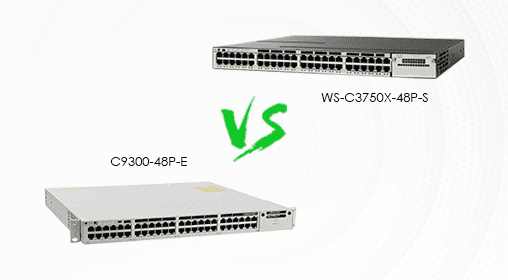
At the heart of the C9300-48P-E lies a modern x86 CPU with 8GB DRAM and 16GB flash memory, enabling it to run containers and third-party applications natively. Its switching capacity hits 256 Gbps with a stacking bandwidth of 480 Gbps using StackWise-480 technology. In contrast, the 3750X relies on 256MB DRAM and 64MB flash, with a 160 Gbps backplane and StackWise Plus offering 64 Gbps stacking throughput. The C9300’s packet buffer is 16MB, compared to the 3750X’s smaller buffer, which impacts performance under heavy traffic loads. The C9300 supports jumbo frames up to 9198 bytes, while the 3750X handles standard Ethernet frames. For PoE, the C9300 delivers up to 740W total power (with a 1100W PSU), whereas the 3750X maxes out at 435W–715W. If you need to power high-density Wi-Fi 6 APs or IoT devices, the C9300’s headroom is a clear advantage.
|
Parameter |
C9300-48P-E |
WS-C3750X-48P-S |
|---|---|---|
|
CPU/Memory |
x86, 8GB DRAM, 16GB flash |
256MB DRAM, 64MB flash |
|
Switching Capacity |
256 Gbps |
160 Gbps |
|
Stacking Bandwidth |
480 Gbps (StackWise-480) |
64 Gbps (StackWise Plus) |
|
PoE Budget |
Up to 740W |
Up to 715W (435W usable) |
|
Forwarding Rate |
154.76 Mpps |
101.2 Mpps |
|
Jumbo Frames |
9198 bytes |
Not supported |
Visually, the C9300 sports a sleeker, compact chassis (1.73×17.5×17.5 inches, 16.33 lbs) with integrated 1/10G SFP+ uplinks. The 3750X is bulkier (1.75×17.5×18 inches, 15.65 lbs) and uses modular uplink cards (e.g., C3KX-NM-1G). Both are 1U rack-mountable, but the C9300’s streamlined design aligns with modern data center aesthetics. A key difference is StackPower: the C9300 supports power redundancy across stacks, while the 3750X requires external modules for power sharing. The 3750X does offer dual redundant power supplies, but the C9300’s internal architecture is more energy-efficient.
The C9300 runs Cisco IOS XE, the same OS used in high-end Catalyst 9000 series switches, with support for SD-Access, DNA Center automation, and encrypted traffic analytics. It’s built for zero-trust security with features like TrustSec and MACsec. The 3750X runs traditional Cisco IOS with IP Base feature sets, lacking native SDN capabilities. While it supports ACLs, QoS, and basic routing (RIP, OSPF), it can’t handle modern threats or automation workflows. The C9300 also scales to 32,000 MAC addresses and 32,000 IPv4 routes, dwarfing the 3750X’s 4K MAC table and limited routing entries.
With a mean time between failures (MTBF) of 299,000 hours, the C9300 is engineered for mission-critical environments. Its StackPower technology allows power sharing between stacked units, minimizing downtime. The 3750X has a solid MTBF of 139,913 hours but lacks advanced redundancy mechanisms. For user experience, the C9300’s DNA Center provides a graphical interface for centralized management, while the 3750X relies on CLI or basic web tools. The C9300’s container support lets administrators deploy custom scripts directly on the switch, something the 3750X can’t achieve.
Choose the C9300-48P-E if:
You’re building a future-proof network with Wi-Fi 6, IoT, or cloud integrations.
Security and automation are priorities (e.g., DNA Center, encrypted traffic analysis).
You need higher PoE budgets for power-hungry devices like PTZ cameras or access points.
Your network handles high-volume data flows (e.g., video conferencing, large backups).
The WS-C3750X-48P-S might suffice if:
You operate a legacy network with basic routing and PoE needs.
Budget constraints are critical, and you don’t require SDN capabilities.
Your environment relies on traditional CLI management without automation.
While the 3750X remains a competent switch, the C9300 is a generational leap in performance, security, and scalability. For growing enterprises, investing in the C9300 ensures longevity against evolving demands.