
Intellectual Property
Hot selling product recommendations
View More




















Cisco C8500L-8S4X vs. C8300-2N2S-4T2X: Choosing Your Edge Warrior
Picking between the Cisco Catalyst C8500L-8S4X and the C8300-2N2S-4T2X feels a lot like choosing between a nimble special forces operative and a well-equipped infantry squad. Both are designed for the network edge, but they're built for different missions. One leans into raw performance and future-proofing for demanding roles, while the other offers incredible versatility for complex, mixed-media branch offices. Let's get into the specifics.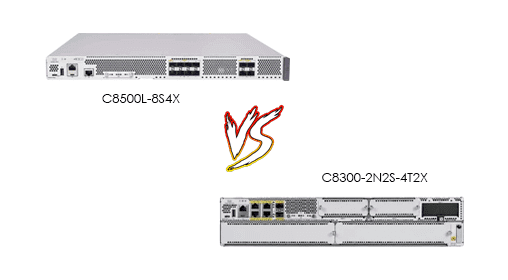
The Core of the Matter: A Hardware Showdown
First, the raw numbers. This table lays out their fundamental differences at a glance.
|
Feature |
Cisco Catalyst C8500L-8S4X |
Cisco Catalyst C8300-2N2S-4T2X |
|---|---|---|
|
Form Factor |
1 RU
|
2U Rack-mountable
|
|
Default Port Configuration |
8 x 1GE SFP ports + 4 x 1/10GE SFP+ ports
|
Information not fully detailed in search results, but part of the Catalyst 8300 series which is recognized as a router
|
|
Expansion Slots |
Fixed configuration (based on available search results) |
7 expansion slots
|
|
Power Supplies |
Dual, redundant 400W (AC/DC/HVAC/HVDC options)
|
Redundant power supply supported
|
|
Default Memory |
16 GB DRAM (upgradable to 64 GB)
|
Information not specified in available search results |
|
IPsec Throughput (SD-WAN) |
Up to 19 Gbps
|
Information not specified in available search results |
|
Key Architecture |
x86-based platform architecture
|
Part of the Catalyst 8300 series, which is 5G-ready and designed for cloud edge
|
Under the Hood: Performance and Design Philosophy
The numbers tell a clear story. The C8500L-8S4X is built on an x86 architecture, which gives it serious muscle for processing-intensive tasks. Think of it as a server-grade router. This is evident in its impressive IPsec throughput, making it a fantastic choice for securing multiple high-bandwidth connections, something you'd need at a small aggregation site or a large branch with significant internet break-out requirements. Its design is sleek and focused in a 1RU chassis, prioritizing density and pure data plane performance.
In contrast, the C8300-2N2S-4T2X plays a different game. Its standout feature is its immense flexibility, thanks to those seven expansion slots. This isn't just a router; it's a platform. You can tailor it with modules for specific needs—adding more T1/E1 ports for legacy WAN connections, extra Ethernet interfaces, or even on-board compute for hosting services. It's a 2U workhorse designed to be the all-in-one heart of a sophisticated branch office, consolidating multiple functions into a single box.
Living with Each Box: The User Experience
When you unbox and deploy these, the experience diverges. The C8500L feels like a precision instrument. Its fixed port layout means setup is straightforward if its built-in interfaces match your needs. You're getting a high-performance engine that's ready to pump data securely at remarkable speeds. It's for environments where the requirements are clear and performance is non-negotiable.
The C8300, however (however), is all about customization. The initial setup might involve more planning as you decide which modules to populate. But this flexibility is its superpower. It can grow and adapt with your branch office. Need to add a new type of connection a year from now? You likely just slot in a new module instead than replacing the entire device. This makes it a long-term partner for dynamic environments.
Weighing Value and Stability
Talking about stability, both platforms benefit from Cisco's IOS XE operating system, which provides a robust and familiar foundation. The C8500L series is designed with high-efficiency dual power supplies by default for power supply redundancy. The C8300 series also supports redundant power supplies, contributing to overall system reliability.Value is in the eye of the beholder (eye of the beholder). If your primary need is to move a massive amount of encrypted data as efficiently as possible, the C8500L-8S4X delivers tremendous value for its performance class. You're paying for power and speed.
If you need a versatile network Swiss Army knife (knife) that can handle a little bit of everything and adapt to an uncertain future, the C8300-2N2S-4T2X and its expansion slots present a different kind of value. It's an investment in flexibility and longevity, potentially saving you (you) from a hardware refresh down the line.
The Bottom Line: Which Warrior for Your Battle?
Making the right call comes down to the mission profile of your network edge.
Lean towards the Cisco Catalyst C8500L-8S4X if... your site is a performance-critical node, perhaps aggregating smaller branches or serving as a dedicated internet gateway. Its high-speed ports and powerful encryption capabilities are ideal for bandwidth-intensive and security-heavy applications where the configuration is relatively stable.
The Cisco Catalyst C8300-2N2S-4T2X is likely your better fit if... you're managing a complex branch office that needs to support a variety of connection types, both old and new. Its expandability makes it perfect for sites where requirements might change or where you need to consolidate services onto a single, reliable platform.
There's no universally correct answer, only the best tool for your specific network landscape.