
Intellectual Property
Hot selling product recommendations
View More




















Cisco C8300-2N2S-6T: The Backbone of Modern Enterprise Branch Networking
When you unbox the Cisco C8300-2N2S-6T, the first thing you notice is its rugged, modular design tailored for heavy-duty use. Built with a sturdy metal chassis, it fits seamlessly into standard server racks, occupying either 1U or 2U spaces depending on configuration. The front panel is clean but purposeful, featuring four RJ45 ports and two SFP+ embedded ports that support up to 1G WAN connections. These aren’t just for show—they’re the gateways to reliable, high-speed data flow, whether you’re linking a remote office to the cloud or securing critical transactions. The device’s modularity is a standout; it includes slots for pluggable interface modules (PIMs), network interface modules (NIMs), and service modules (SMs), allowing businesses to customize I/O capabilities as needs evolve. Dual power supplies ensure redundancy, minimizing downtime risks, while subtle LED indicators provide at-a-glance status checks without overwhelming the senses. This isn’t a flashy gadget; it’s a workhorse designed for 24/7 operation in environments where reliability trumps aesthetics.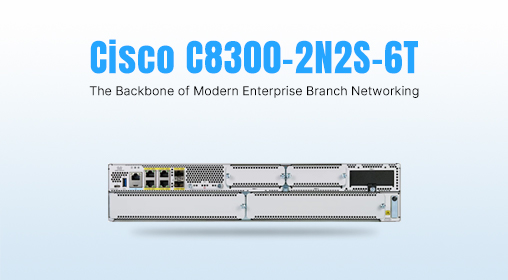
Under the hood, the C8300-2N2S-6T packs a serious punch. At its core lies an 8-core Intel processor, which handles complex networking tasks without breaking a sweat. It delivers up to 10G IP throughput and 2G SD-WAN throughput, making it ideal for bandwidth-intensive applications like video conferencing, large-scale data backups, or real-time analytics. The router runs on Cisco’s IOS XR operating system, which offers granular control over network management and security protocols. But what does this mean in practice? Imagine a financial institution processing thousands of transactions per second: the C8300 ensures data packets are prioritized, encrypted, and delivered without lag. Its integrated security acceleration hardware enables high-performance packet filtering and encryption, while support for IPsec VPNs and SSL VPNs creates a fortress-like environment for remote access. For IT teams, the learning curve is minimal—Cisco’s vAnalytics and ThousandEyes integration provide deep visibility into network performance, flagging issues before they escalate into full-blown outages.
Users often highlight the router’s balance of power and simplicity. One admin noted, “It just runs. We’ve had zero unplanned downtime since deployment, even during peak traffic hours.”The modular design earns praise for scalability; adding a 5G/LTE module or expanding storage feels plug-and-play. However, some point out that the base model’s memory could be limiting for hyper-scale deployments, though it’s upgradeable to 32GB. Others wish for more granular SD-WAN analytics out-of-the-box, but third-party integrations fill the gap. Where the C8300 truly shines is in demanding scenarios: think emergency response teams relying on seamless connectivity or manufacturing plants using IoT sensors. Here, its multi-layered security and low latency turn potential vulnerabilities into strengths.
Is the C8300-2N2S-6T worth the investment? For mid-sized to large enterprises, absolutely. While not the cheapest option on the market, its durability and modularity reduce long-term TCO. The ability to start with a basic configuration and expand as needed—whether adding PoE switches, voice gateways, or wireless WAN cards—means it grows with your business. Compared to older ISR models, the performance leap is tangible: faster data processing, better security, and cloud-native agility. It’s not for a small office with minimal needs, but for organizations where network reliability is non-negotiable, every dollar spent translates into reduced risk and enhanced productivity.
|
Parameter |
Specification |
|---|---|
|
Processor |
8-core Intel |
|
WAN Interfaces |
4x RJ45 + 2x SFP+ (up to 1G) |
|
IP Throughput |
10G |
|
SD-WAN Throughput |
2G |
|
Modular Slots |
1 PIM, 1 NIM, 1 SM |
|
Power Supply |
Dual redundant |
|
Security |
IPsec/SSL VPN, integrated hardware acceleration |
No device is perfect, and the C8300-2N2S-6T has its trade-offs. On the plus side, its future-proof design and robust performance make it a standout for evolving enterprise needs. The cons? Base configurations might require upgrades for memory-intensive tasks, and initial setup can be complex for teams new to Cisco’s ecosystem. But for those who need a resilient, scalable backbone for branch operations, it’s hard to beat. This router doesn’t just connect points A to B—it weaves a fabric of reliability that modern businesses can count on.