
Intellectual Property
Hot selling product recommendations
View More




















Cisco C8300-1N1S-4T2X: The Branch Network Powerhouse Built for Tomorrow
When you first unbox the C8300-1N1S-4T2X, what strikes you is its solid, purposeful design. This isn't a flashy piece of gear; it's a workhorse. Housed in a compact 1-rack-unit (1RU) chassis, it's built for standard server racks, making it a tidy fit for crowded wiring closets. The front panel is clean and logical: you get four Gigabit Ethernet RJ45 ports and two 10 Gigabit SFP+ ports for high-speed fiber or copper uplinks, giving you immediate flexibility for your existing and future connectivity needs . The inclusion of both a Service Module (SM) slot and a Network Interface Module (NIM) slot on the side is a clear signal of this router's expandable nature, allowing you to add specialized functions like enhanced switching or additional WAN interfaces down the line . Weighing in at about 9.1 kg, it has a substantial feel, reinforced by the default dual, hot-swappable power supplies at the back that promise the kind of reliability branch offices desperately need .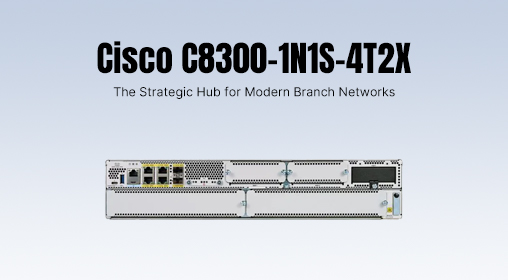
This router finds its home as the core networking device for medium to large branch offices. It's designed to be the central nervous system for locations that demand more than just basic internet connectivity. Think of a financial institution processing high-volume transactions, a healthcare provider transmitting large medical images, or a retail chain managing real-time inventory and customer data across all its points of sale . Its core mission is to handle sophisticated tasks like SD-WAN, provide multi-layered security, and ensure application performance, all while being 5G-ready for future network evolution . It's the evolution of the proven ISR 4400 series, packing more power, higher port density, and advanced capabilities into a modern platform .
Under the hood, it's powered by an 8-core Intel x86 processor, which acts as the brain for its operations. It comes standard with 8 GB of DRAM, which is a solid starting point, but the real beauty is that this can be expanded all the way up to 32 GB to handle more routes, more sessions, and more services as your branch grows . The built-in 16 GB M.2 SSD storage provides space for logging and applications. Where this router truly shines is in its performance metrics. It can forward data at speeds up to 19.7 Gbps and handle encrypted SD-WAN traffic at up to 17 Gbps, ensuring that even bandwidth-intensive applications and security protocols don't create a bottleneck .
|
Parameter |
Specification |
|---|---|
|
Fixed Ports |
4 x 1G RJ45 + 2 x 10G SFP+ |
|
Expansion Slots |
1 x SM, 1 x NIM, 1 x PIM |
|
Default DRAM |
8 GB (Upgradable to 32 GB) |
|
Default Storage |
16 GB M.2 SSD |
|
IPv4 Forwarding Throughput |
Up to 19.7 Gbps |
|
SD-WAN IPsec Throughput |
Up to 17 Gbps |
|
Max IPsec Tunnels |
4000 |
|
Max IPv4 Routes |
1.6 million (default), up to 4 million (with 32GB DRAM) |
|
Form Factor |
1 Rack Unit (1RU) |
The feature set is where the C8300-1N1S-4T2X moves from being a simple router to a strategic platform. Running on Cisco's robust IOS XE operating system, it's fully programmable, enabling automation at scale through APIs and Zero-Touch Provisioning (ZTP) . This means rolling out a new branch can be as simple as plugging the device in; the configuration is delivered automatically from a central manager like Cisco Catalyst SD-WAN Manager. Security is deeply integrated, not an afterthought. It includes hardware-anchored secure boot, a built-in firewall, intrusion prevention systems (IPS/IDS), and advanced malware protection, creating a strong security perimeter right at the branch edge . For application performance, features like AppQoE (Application Quality of Experience) and TCP optimization ensure critical applications like video conferencing and cloud software run smoothly .
From an operational standpoint, the experience is centered on control and simplification. The modularity means you aren't locked into a fixed configuration. If a new site needs a 5G wireless backup link, you can pop in a PIM module without changing the entire router . Centralized management via cloud-based controllers drastically reduces the complexity of managing a distributed network, allowing a small IT team to efficiently oversee dozens of remote locations. The dual power supplies and robust construction, with a Mean Time Between Failures (MTBF) of over 536,000 hours, provide immense peace of mind, minimizing the risk of costly downtime .
When evaluating its value, the C8300-1N1S-4T2X sits in a sweet spot. It's not the entry-level option, but its modular design and performance headroom make it a smarter long-term investment. The ability to start with what you need and expand later protects your investment against future obsolescence. The integrated security and SD-WAN capabilities can also lead to cost savings by reducing reliance on expensive MPLS circuits and consolidating multiple security appliances into a single platform .
Of course, no technology is perfect for every scenario. The router's primary strength is also the source of its main considerations. The wealth of features and the IOS XE operating system have a learning curve, and maximizing its potential often requires investing in Cisco's licensing ecosystem for advanced security and analytics, which adds to the total cost of ownership over time . However, for organizations that need a robust, secure, and scalable foundation for their branch networks, the advantages are compelling. The combination of high performance, advanced security, and hardware flexibility in a 1RU form factor is a powerful package for businesses looking to build a modern WAN .