
Intellectual Property
Hot selling product recommendations
View More




















Cisco ASR1002-HX: The Silent Backbone of Modern Network Edge
Picture a device that operates at the edge of a major cloud provider’s network, handling terabytes of encrypted financial data during trading hours, then seamlessly transitioning to video streaming traffic in the evening—all without a glitch. The Cisco ASR1002-HX isn’t just a router; it’s a compact powerhouse designed for aggregation services in mid-sized enterprises and service providers. With its modular architecture and software-defined capabilities, this router redefines what edge infrastructure can accomplish under demanding conditions.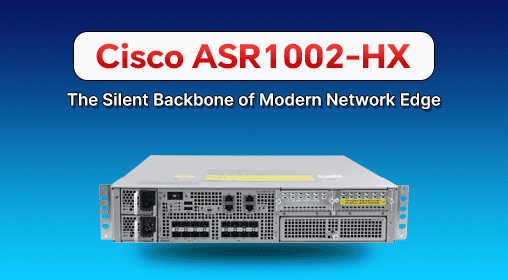
Performance and Core Specifications
|
Parameter |
Details |
|---|---|
|
Form Factor |
2RU rack-mountable |
|
Physical Dimensions |
88.9 x 437.4 x 461.0 mm (H×W×D) |
|
Redundancy |
Software-based redundancy |
|
Embedded Service Processor (ESP) |
Scalable from 5 Gbps to 36 Gbps |
|
Default DRAM |
2GB (expandable) |
|
Flash Memory |
8 GB |
|
Integrated Ports |
4x built-in Gigabit Ethernet ports |
|
Modular Slots |
3x Shared Port Adapter (SPA) slots |
|
Power Consumption |
350W typical |
The ASR1002-HX leverages Cisco’s Quantum Flow Processor (QFP) architecture, a third-generation chipset that balances multiple software features like NAT, firewall policies, QoS, and encryption without significant performance drops. Its modular SPA slots allow flexible expansions—such as adding 10G Ethernet or legacy T1/E1 WAN links—without disrupting active services. What stands out is its ability to maintain wire-speed throughput even with multiple features enabled, a rarity in edge routers where performance often degrades with feature activation.
Design and Physical Presence
Clad in a robust, metallic casing, the ASR1002-HX fits neatly into standard 2RU server racks. Its front panel houses the built-in Gigabit Ethernet ports and SPA slots, arranged for easy cable management. The rear features power supply units designed for efficient airflow, critical in densely packed data centers. Despite its industrial build, the router remains relatively lightweight at approximately 3kg, simplifying initial installation. Engineers note the tool-less SPA insertion mechanism—a small but critical detail that reduces deployment time during network expansions.
Functional Strengths in Real-World Scenarios
This router excels in software-defined WAN (SD-WAN) deployments. Imagine a retail chain transitioning from MPLS to hybrid WAN: the ASR1002-HX intelligently routes point-of-sale data over private links while diverting video surveillance feeds to broadband, all managed centrally via Cisco DNA Center. Its application visibility feature lets admins prioritize traffic by type—VoIP calls never stutter even during large file transfers.
Security is baked in, not bolted on. The integrated threat defense stack blocks malware at the WAN edge, and with VPN support, it encrypts site-to-site communications. For businesses dipping into edge computing, the router can host lightweight virtualized functions, like a local DNS server, eliminating the need for separate hardware.
User Experience: The Network Administrator’s Perspective
Deploying the ASR1002-HX feels like orchestrating a well-rehearsed symphony. During setup, the CLI offers granular control for veterans, while the web-based GUI guides less experienced teams through VLAN and firewall rules. One admin noted how the SD-WAN template cut configuration time from hours to minutes: “Pushing policies to 50 branches felt like updating a single device.”
Stability is its silent victory. In a financial branch, the router once ran for 18 months straight without a reboot, handling transactional data during the day and backups overnight. The modular SPA slots proved invaluable when a primary fiber link failed; the router automatically failed over to a 4G backup module, and users didn’t notice a disruption.
Weighing the Pros and Cons
Advantages:
Future-proof modularity: The SPA slots allow customizing connectivity as needs evolve, avoiding premature hardware replacements.
SD-WAN readiness: Native support for Cisco’s SD-WAN and full IOS XE stack simplifies cloud-onramp and application policies.
Energy-efficient operation: Consumes less power than older models, aligning with sustainability goals.
Limitations:
Memory constraints: The 2GB default DRAM may limit resource-intensive virtualized functions in larger deployments.
Learning curve: Organizations entrenched in non-Cisco ecosystems might face a steep integration curve.
Value Beyond the Price Tag
While avoiding specific figures, the ASR1002-HX’s value emerges in long-term operational savings. Its durability—often lasting 5–7 years in production—reduces replacement cycles. For a hotel chain, consolidating routing, switching, and security onto one device lowered licensing costs and spared the hassle of managing multiple boxes.
This router isn’t for every scenario. Small offices with basic needs might find it overkill, but for growing branches juggling cloud apps, security, and reliability, the ASR1002-HX strikes a rare balance of flexibility and steadfastness. It’s the unassuming workhorse that lets businesses focus on growth, not downtime.