The Router That Learned to Keep Up: Living with the Cisco ASR1001-X
There's a certain kind of silence you only find in a well-run data center. Not the absence of sound, but the absence of worry. The Cisco
ASR1001-X has given me that feeling more times than I can count. It sits in the rack, doing what edge routers are supposed to do, which is essentially nothing noticeable. When it works properly, nobody talks about it. When it fails, well, let's just say you'll have a very bad day. After spending the better part of three years deploying and managing these units across multiple sites, I've developed something close to respect for this piece of hardware.
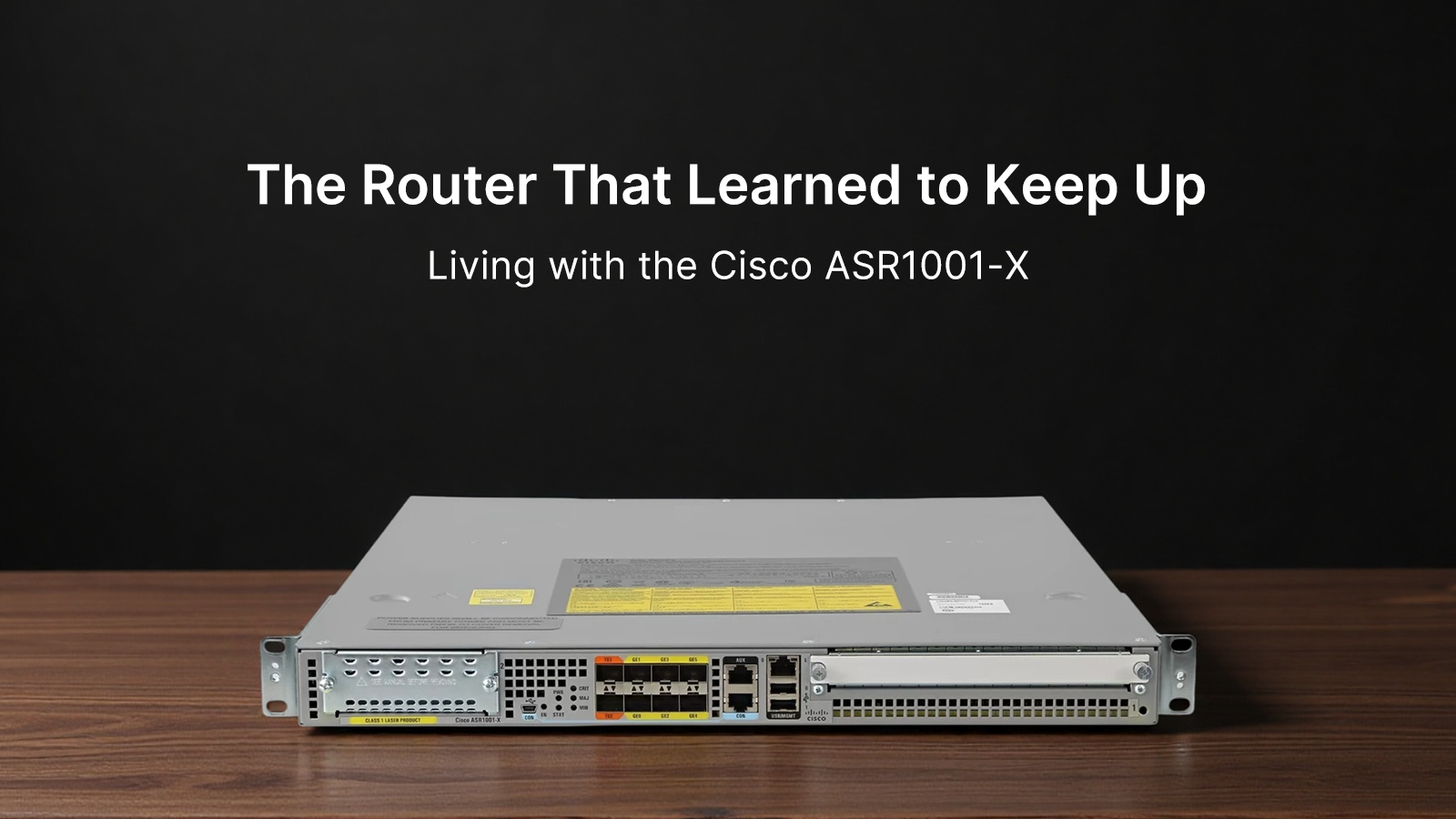
The first thing you notice when handling the
ASR1001-X is how different it feels from the ISR series. This is service provider grade equipment, and it shows. The chassis is 1U, but it's deeper and more substantial than your average branch router. The front bezel has that distinctive Cisco ASR look—dark gray with a prominent airflow vent and status LEDs that are actually useful rather than decorative. The modular bay on the right side is where you'll spend most of your time during initial setup, sliding in SIPs and ESPs like you're building a custom PC. The rear panel is clean and logical. Fixed ports are minimal because this box is designed around modular flexibility. You get management ports, console access, and then the real connectivity comes from whatever modules you decide to install. It feels like equipment that expects you to know what you're doing.
I deployed my first
ASR1001-X at a regional aggregation point where we needed to terminate hundreds of customer connections while maintaining strict QoS policies. The ISR series was choking on the load, and we needed something with more headroom. The ASR1001-X handled the transition without drama. What impressed me most wasn't the raw throughput numbers, but how the performance remained consistent under load. I've watched traffic spike during peak hours, seen encryption services running at full tilt, and the router never once suggested it was struggling. The ESP (Embedded Services Processor) architecture separates forwarding from services, which means your security policies don't murder your packet rates. That separation matters more than people realize until they're staring at a dashboard full of dropped packets.
| Parameter |
Specification |
| Model |
Cisco ASR 1001-X |
| Form Factor |
1 Rack Unit (1U) |
| ESP Throughput |
2.5 Gbps to 20 Gbps (license dependent) |
| Fixed Ports |
2 x 1GE RJ-45, 2 x 1GE SFP, 1 x 10GE SFP+ |
| Module Slots |
1 x SIP/SPA bay |
| Default Memory |
8 GB DRAM (upgradeable to 16 GB) |
| Bootflash |
8 GB (expandable) |
| Power Supplies |
Dual redundant AC/DC, hot-swappable |
| Operating System |
Cisco IOS XE |
| Console Ports |
RJ-45 and Mini-USB |
| USB Ports |
2 x USB 2.0 Type-A |
| MTBF |
Approximately 120,000 hours |
| Lifecycle |
Mature platform, active support |
The user experience with the
ASR1001-X is very much a tale of two phases. The initial configuration period requires patience and planning. This isn't a router you order on a whim and expect to have running by lunch. You need to think through your licensing strategy, decide which SIP and SPA modules match your connectivity needs, and plan your memory configuration based on expected routing table sizes. I made the mistake of underestimating memory requirements on my first deployment and had to schedule a maintenance window to upgrade DRAM. That was a lesson I didn't need to learn twice. Once everything is properly sized and configured, though, the router becomes remarkably hands-off. IOS XE on the ASR platform is stable, and the command structure will feel familiar to anyone who's worked with Cisco equipment before.
What really distinguishes this platform is how it handles services. I've run NetFlow export, IPsec VPN termination, NAT, and complex BGP policies simultaneously without seeing the kind of performance degradation that plagued older architectures. The ESP is the secret sauce here. It's a dedicated processor that handles all the heavy lifting for services, leaving the main CPU free for control plane functions. In practical terms, this means you can enable features that would tank performance on other routers without worrying about collateral damage. I've had customers enable deep packet inspection and encrypted traffic analytics on their
ASR1001-X deployments, and the impact on throughput was negligible. That kind of headroom is expensive, but it's also peace of mind.
The modularity is both a strength and a source of frustration. On one hand, being able to swap out interface modules means you can adapt to changing connectivity requirements without replacing the entire chassis. Need more 10GE ports? Change the SPA. Need legacy copper connections? There's a module for that. This flexibility extends the useful life of the platform significantly. On the other hand, the module ecosystem is complex, and not all combinations work together. I've spent hours on Cisco's compatibility matrices trying to verify that a specific SPA will work with a particular IOS XE version on my specific ESP configuration. The documentation exists, but it's scattered across multiple portals and sometimes contradictory. Once you figure it out, you're fine. Getting there can be tedious.
Power consumption is higher than you might expect for a 1U device. The
ASR1001-X isn't trying to win efficiency awards, and that shows in your electricity bill if you're running multiple units. The fans are also noticeable. This isn't ISR-level quiet. In a dedicated data center, nobody cares. In a small server room that doubles as a storage closet, your facilities team will have opinions. The heat output is substantial enough that you need to plan your rack airflow carefully. I've seen deployments where the
ASR1001-X raised the ambient temperature enough to affect neighboring equipment. Proper cooling isn't optional with this platform.
The licensing model deserves its own paragraph because it's complicated enough to warrant one. Base throughput comes licensed, but if you want to unlock the full potential of the ESP, you're buying performance licenses. Security features, application visibility, WAN optimization—they all have their own license SKUs. The costs add up, and the structure isn't always intuitive. I've had conversations with Cisco account teams where we spent more time discussing licensing than technical requirements. That said, the licensing does give you flexibility. You can start with a lower throughput license and upgrade later without hardware changes, which helps with budget planning. Just make sure you understand the full cost picture before you commit.
From a value perspective, the
ASR1001-X sits in an interesting position. It's no longer the newest platform in Cisco's portfolio, which means pricing has matured. For organizations that need service provider features without the expense of the ASR 1002-X or higher models, it represents solid value. The build quality means these units last, and the modular design means they can adapt as requirements change. I've seen ASR1001-X deployments from five years ago still running production traffic without hardware issues. That longevity matters when you're calculating total cost of ownership. The alternative is buying cheaper equipment that needs replacement in three years, which often costs more in the long run.
Troubleshooting on the
ASR1001-X is generally straightforward if you know Cisco's diagnostic tools. The logging is comprehensive, SNMP support is solid, and the show commands provide detailed visibility into system state. I've used the platform's built-in packet capture features to debug complex routing issues without needing external taps. The redundancy features work as advertised. I've pulled power supplies during traffic windows and watched the failover happen without a single dropped packet. Same with route processor switchover. For environments where uptime is measured in financial terms, that reliability justifies the investment.
Would I recommend the
ASR1001-X today? For the right use case, absolutely. If you're building a service edge, aggregating customer connections, or need a router that can handle serious services without compromising performance, this platform delivers. It's not the newest option available, and it's not the most power-efficient. But it's proven, flexible, and backed by a support infrastructure that will be around for years. The learning curve is real, the licensing is complex, and the initial investment is significant. But once it's running, the ASR1001-X fades into the background, doing its job without demanding attention. And for a network engineer, that's the highest compliment you can pay to any piece of infrastructure.