
Intellectual Property
Hot selling product recommendations
View More




















Cisco ASR1000-MIP100: The Compact Powerhouse for Network Edge Deployment
When you unbox the Cisco ASR1000-MIP100, the first thing that strikes you is its deliberate engineering. This isn’t just another modular interface processor—it’s the silent workhorse that keeps the ASR 1000 Series routers running smoothly at the network edge. Designed for service providers and large-scale enterprises, this component slots into the ASR 1000 chassis to handle critical tasks like traffic aggregation, security enforcement, and data forwarding. Its role is straightforward but vital: ensure that high-volume data flows remain stable, secure, and efficient, even during peak usage. For organizations managing distributed networks or cloud gateways, the MIP100 acts as a force multiplier, enabling seamless scalability without constant hardware upgrades.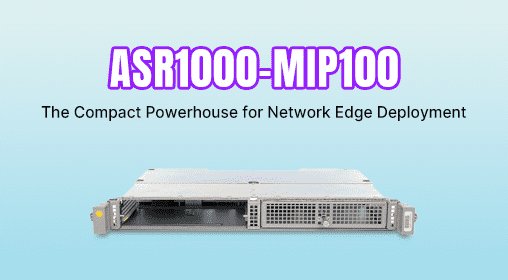
Performance-wise, the MIP100 is built to thrive under pressure. It supports bidirectional throughput scaling up to 20 Gbps, depending on the ESP (Embedded Services Processor) configuration, and integrates hardware-based encryption for secure data transmission. The processor’s architecture leverages Cisco’s Quantum Flow Processor for intelligent traffic management, allowing it to prioritize latency-sensitive applications like VoIP or real-time analytics. What stands out is its flexibility—it can be configured to operate in standalone mode for smaller deployments or stacked for high-availability scenarios. Below is a breakdown of its core specifications:
|
Parameter |
Specification |
|---|---|
|
Compatibility |
Cisco ASR 1000 Series routers |
|
Maximum Throughput |
Up to 20 Gbps (varies with ESP) |
|
Encryption Support |
Hardware-based, up to 8 Gbps |
|
Form Factor |
Modular interface processor |
|
Redundancy |
Hot-swappable with software failover |
|
Memory Allocation |
Shared with route processor (default 8 GB) |
Physically, the MIP100 mirrors the ASR 1000 Series’ no-nonsense aesthetic. The module features a brushed metal casing with reinforced edges, designed to dissipate heat efficiently under continuous operation. Its ports are neatly aligned for straightforward cable management, and the status LEDs are clearly visible from front-facing angles—a practical touch for technicians working in dimly lit server rooms. Despite its compact size, the build feels substantial, with connectors that withstand frequent plugging and unplugging. The cooling system operates quietly, relying on passive heat sinks rather than noisy fans, making it suitable for office-adjacent deployments.
Functionally, the MIP100 excels in environments where reliability is non-negotiable. It supports advanced features like granular QoS policies, which let administrators prioritize critical traffic, and integrated security protocols for threat detection. However, it’s worth noting that the module’s capabilities are tightly coupled with the ESP and route processor; for example, encryption performance depends on the ESP version installed. This interdependence is a double-edged sword: it simplifies initial setup but can complicate upgrades if the chassis lacks compatible components. Still, for teams already invested in Cisco’s ecosystem, this integration reduces compatibility headaches.
Users of the MIP100 often highlight its plug-and-play simplicity. One network engineer noted that installation took minutes, with the chassis recognizing the module instantly. The learning curve is minimal for those familiar with Cisco’s IOS-XR, though newcomers might need time to master the CLI for advanced configurations like dynamic routing policies. In daily operation, the module runs quietly and consistently, with few unexpected issues. However, some users mention that troubleshooting can be opaque—when problems arise, logging and diagnostics require deep diving into system logs. On balance, though, the MIP100 is praised for its "set it and forget it" reliability.
When evaluating its pros and cons, the advantages include robust build quality, seamless integration with the ASR 1000 platform, and scalable performance. The drawbacks revolve around its dependency on other components—for instance, older ESPs might bottleneck throughput. Yet, for organizations prioritizing long-term stability over cutting-edge specs, the MIP100 delivers exceptional value. It avoids the premium cost of newer modules while handling modern workloads effectively, making it a smart choice for budget-conscious upgrades or edge deployments.
In summary, the ASR1000-MIP100 embodies Cisco’s emphasis on practicality. It might not be the flashiest component in the rack, but for those who need dependable performance at the network edge, it’s a steadfast partner that rarely lets you down.