
Intellectual Property
Hot selling product recommendations
View More




















Cisco ASR 9904: The Compact Powerhouse for Next-Generation Networks
When you first lay eyes on the Cisco ASR 9904, its rugged, streamlined chassis immediately signals serious capability. This isn't just a router; it's a dense, high-capacity platform engineered for service providers and large enterprises who need to handle massive traffic flows without compromising on reliability or features. Housed in a 14 RU footprint, the chassis is designed for efficiency, with a modular layout that supports up to 4 line cards, 2 Route Switch Processors (RSPs), and 5 fabric cards. The physical build emphasizes both durability and thermal management, with reinforced mounting points and optimized airflow channels to keep critical components cool under sustained loads. Front-facing ports and clearly labeled indicators make initial setup straightforward, while the robust steel construction ensures it can withstand the demands of a data center or network operations center environment.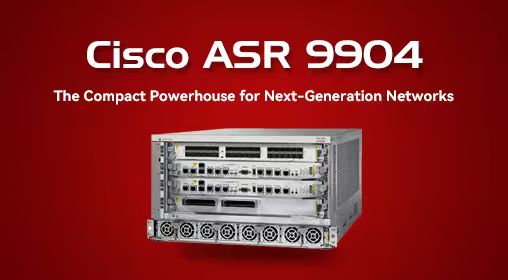
Under the hood, the ASR 9904 is built to deliver. It leverages Cisco's custom NPU (Network Processing Unit) architecture, which handles packet forwarding and advanced services with impressive efficiency. The router supports a remarkable maximum system capacity of 16 Tbps, ensuring it can comfortably manage the bandwidth demands of modern applications, from 4K video streaming to large-scale cloud migrations. A key design strength is its VoQ (Virtual Output Queue) fabric, which prevents head-of-line blocking and maintains consistent performance even during traffic spikes. This is further enhanced by deep buffers and a large FIB (Forwarding Information Base) capacity, allowing the router to handle intensive workloads without dropping packets.
Core Technical Specifications at a Glance
|
Parameter |
Specification |
|---|---|
|
Max System Capacity |
16 Tbps
|
|
Chassis Size |
14 Rack Units (RU)
|
|
Line Card Slots |
4
|
|
Fabric Architecture |
Centralized, with VoQ support
|
|
Software |
Cisco IOS XR
|
|
Key Interfaces |
10GE, 40GE, 100GE, 1TE
|
The functional scope of the ASR 9904 extends far beyond basic routing. It serves as a foundational element for software-defined networking (SDN) deployments, offering full programmability through APIs and integration with controllers like Cisco's Network Services Platform. This makes it possible to automate provisioning, implement granular traffic engineering policies, and adapt network behavior in real-time based on application needs. Security is deeply embedded, with features like MACsec encryption on interfaces, integrated threat intelligence, and the ability to segment traffic for different customers or services. The platform also supports sophisticated quality of service (QoS) mechanisms, allowing network operators to guarantee performance for latency-sensitive applications like voice and video.
From an operational perspective, the ASR 9904 is designed to minimize complexity. Engineers familiar with Cisco's IOS XR will find the management interface logical and powerful, though the sheer depth of features means there is a learning curve for newcomers. The system's stability is a major plus; once configured, it runs for extended periods with minimal intervention. Troubleshooting is aided by comprehensive logging and detailed telemetry data, which can be streamed to external monitoring tools for analysis. The modularity of the design also pays off during maintenance or upgrades. Being able to hot-swap a line card or power supply without taking the entire system offline is a significant advantage for maintaining service availability.
Evaluating its value proposition, the ASR 9904's primary strength lies in its density and scalability. By consolidating multiple functions into a single platform, it reduces the number of physical devices needed in a network rack, saving on space, power, and cooling costs. The investment in its advanced fabric and NPU technology future-proofs the network, ensuring it can handle not just today's traffic but also the anticipated growth from 5G, IoT, and expanded cloud services. For organizations where network uptime and performance directly impact revenue, the reliability of this platform offers compelling long-term value, helping to avoid costly outages and performance degradation.
Of course, no platform is without its trade-offs. The advanced capabilities and custom silicon of the ASR 9904 come with a steeper initial financial outlay compared to more entry-level routers. Furthermore, fully leveraging its potential, especially in automated or SDN environments, often requires a team with specialized skills or investment in additional training. The initial configuration for complex service provider scenarios can be time-consuming, demanding careful planning to ensure all features interact as intended.
In essence, the Cisco ASR 9904 is a premium, high-density router engineered for the core of demanding networks. It excels in environments where bandwidth, reliability, and advanced feature sets are non-negotiable. While its complexity and cost warrant careful consideration, its ability to consolidate services, scale efficiently, and operate with carrier-grade stability makes it a strategic asset for organizations building the network infrastructure of the future.