
Intellectual Property
Hot selling product recommendations
View More




















Cisco ASR-9006-AC vs. Juniper MX960: The Heavyweight Battle for Network Dominance
Picking between the Cisco ASR-9006-AC and the Juniper MX960 is like choosing between two elite athletes; both are top performers, but they're built for slightly different games. This isn't just a spec-sheet comparison—it's about philosophy. Cisco's ASR-9006-AC is a compact, high-density powerhouse designed for efficiency and modern software-defined networking. Juniper's MX960 is a sprawling, massively scalable platform built for raw throughput and long-term expansion in the core of the network. Let's get into the nitty-gritty of how they stack up.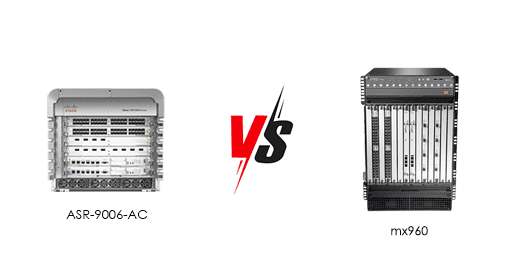
First, the numbers never lie. A side-by-side look at their core specs reveals their DNA immediately.
|
Core Parameter |
Cisco ASR-9006-AC |
Juniper MX960 |
|---|---|---|
|
Chassis Height |
10 RU
|
16 RU
|
|
Line Card Slots |
4
|
Up to 11
|
|
System Capacity |
Up to 7 Tbps
|
Up to 12 Tbps
|
|
Fabric/Per-Slot Capacity |
Varies by RSP (e.g., 440G/slot with RSP440)
|
Up to 1.5 Tbps per slot
|
|
Power Supply Options |
AC or DC (cannot be mixed)
|
AC or DC
|
|
Typical Power Input |
200-240V AC; 50-60 Hz; 16A Max
|
100-240V AC or -40 to -72V DC
|
|
Weight (Fully Loaded) |
~150 lbs (68 kg) (chassis with common components)
|
Up to ~334 lbs (151.6 kg)
|
|
Cooling |
Two fan trays, side-to-side or front-to-back airflow
|
Multiple high-capacity fan trays
|
|
Software OS |
Cisco IOS XR
|
Juniper Junos OS |
Just from the table, the MX960 is the larger beast, both physically and in terms of potential scale. It's built for environments where slot count and total bandwidth are the king. The ASR-9006-AC offers a more condensed form factor, packing serious capability into a smaller footprint, which is a huge plus in space-constrained data centers.
When you see these boxes in person, the difference is striking. The ASR-9006-AC has a clean, dense, and manageable profile. It's a 10RU chassis that feels purpose-built and efficient. The MX960, at 16RU, is a commanding presence in the rack. It's taller, deeper, and when fully loaded, can weigh over 330 pounds, demanding serious real estate and structural support. The Juniper chassis also supports extended cable management arms that add to its depth, so you'd better have a deep rack. The Cisco's design is more straightforward, often with front-to-back or side-to-back airflow that can be easier to manage in standard hot/cold aisle configurations.Feature-wise, both are incredibly capable, but they shine in different areas. The ASR-9006-AC, running on Cisco's IOS XR, is a dream for service providers deep into the Cisco ecosystem, especially those leveraging segment routing and deep system redundancy. Its architecture is built for carrier-class reliability from the ground up. The MX960, powered by Juniper's Penta silicon, brings some incredible capabilities to the table, like embedded MACsec and IPsec encryption without sacrificing performance, which is a massive advantage for securing traffic at scale. Its support for the Contrail Cloud Platform also makes it a natural fit for SDN-driven, automated environments.
The user experience is where the vendor philosophy really comes through. Managing the ASR-9006-AC means working with the powerful but sometimes complex Cisco IOS XR CLI. It's incredibly granular and robust, but there's a learning curve. If your team are Cisco command-line veterans, they'll feel right at home. Juniper's Junos OS, on the MX960, is renowned for its consistency and logical structure. Many engineers find it more intuitive, and its commitment to automation is first-class. It often feels like you can script and automate tasks more easily on Junos.
In terms of value, the conversation starts with the initial investment. The MX960, being the larger platform with a higher theoretical ceiling, likely commands a higher initial price. However, its immense scalability means it could host more services per chassis, potentially offering a better long-term value for networks that are expected to grow exponentially. The ASR-9006-AC, as a more compact system, might have a lower entry point and is ideal for achieving high density in a smaller space, giving you excellent value for specific use cases like WAN aggregation. Both platforms are investments in stability—they are not designed to be replaced often.
And that stability is legendary for both. The ASR-9006-AC is built with no single point of failure in mind, featuring redundant RSPs, fabric, power, and fans. The MX960 is engineered to similar carrier-grade standards. These are not boxes that fall over; they are the foundations upon which entire networks are built.
So, who wins? It's all about the application.
Choose the Cisco ASR-9006-AC if: Your priority is maximizing port density and performance in a compact, 10RU form factor. You're operating in a space-constrained data center or are heavily invested in the Cisco ecosystem and its software-defined capabilities. It's a precision instrument for high-density aggregation.
Choose the Juniper MX960 if: You need absolute maximum scalability and future-proofing. Your network core requires the highest possible throughput (up to 12 Tbps) and you need the flexibility of up to 11 slots for future line cards. It's the platform for building the next decade's network core.
You can't really make a bad choice here; you're just picking the tool that's perfectly shaped for the job you need to do today and the growth you expect tomorrow.