When the Fan Alarm Won't Quit: Living with the Cisco ASR 1013
It started with a fan alarm at 2 AM on a Tuesday. The kind of alert that makes your stomach drop because you know it's either a simple sensor glitch or the beginning of a very long night. That was my first real introduction to the Cisco
ASR 1013, and honestly, it set the tone for everything that followed. This chassis doesn't forgive carelessness, but it rewards preparation. After three years of running two of these beasts in our core aggregation layer, I've learned that the 1013 is less of a router and more of a commitment. You don't just deploy it. You build around it.
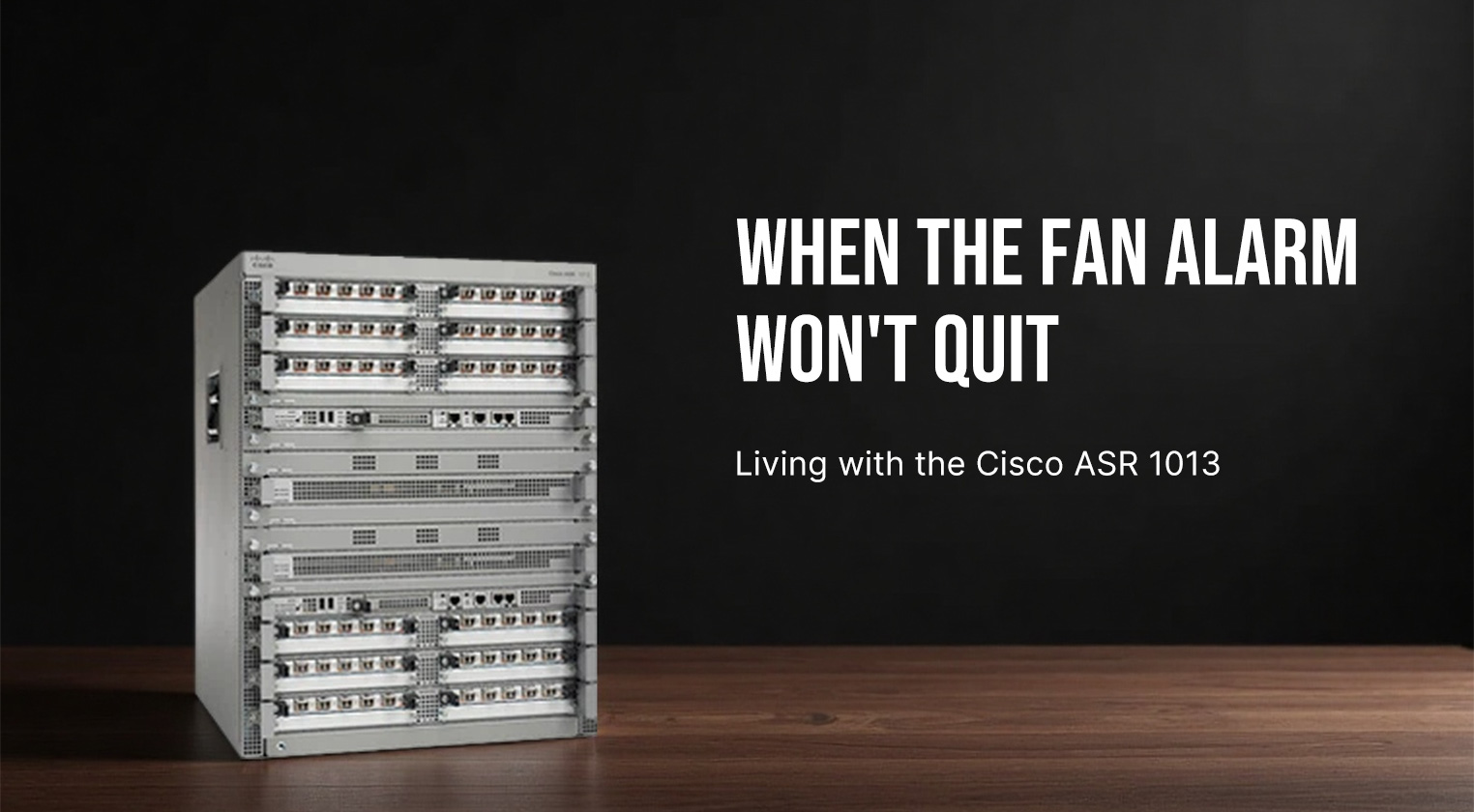
The
ASR 1013 sits at the top of the ASR 1000 family food chain. While everyone talks about the flashier 1006 or the compact 1004, the 1013 is what you get when you need serious slot density without jumping to the carrier-grade CRS or NCS platforms. Thirteen slots sounds like overkill until you're the person responsible for consolidating three legacy routers into one chassis. Then it becomes real estate. The chassis itself is a 13RU monster that demands a full 4-post rack and proper airflow planning. Front-to-back cooling sounds standard until you realize the exhaust heat can warm a small office. We learned that the hard way during summer when the data center containment wasn't quite dialed in.
What makes the 1013 interesting isn't just the slot count. It's the architecture. The separation of control and data planes means you can have an RP failover without dropping a single packet, provided you've configured everything correctly. The Embedded Services Processors handle the heavy lifting—encryption, NAT, QoS—while the Route Processors focus on keeping the routing tables happy. I've watched an ESP100 chew through 100 Gbps of encrypted traffic without breaking a sweat, and that kind of performance headroom is why this box ends up in service provider edges and large enterprise cores. But here's the thing nobody tells you in the datasheets: the licensing model can turn a straightforward upgrade into a budgetary nightmare. You buy the ESP, but then you need to license the throughput. It's like buying a car and then paying extra to unlock the horsepower you already paid for.
| Specification |
Detail |
| Chassis Model |
Cisco ASR 1013 |
| Rack Units |
13 RU |
| Total Slots |
13 (flexible slot allocation) |
| Route Processor Slots |
2 (RP1, RP2, or RP3 support) |
| ESP Slots |
2 (supports ESP40, ESP100, ESP200) |
| SIP Slots |
Up to 13 (depending on RP/ESP configuration) |
| Max System Throughput |
Up to 200 Gbps (with dual ESP200) |
| Power Supply |
Up to 4 AC/DC inputs (N+N redundancy) |
| Fan Trays |
Dual redundant, field-replaceable |
| Management |
Gigabit Ethernet, Console (RJ-45/Mini-USB), AUX |
| Operating System |
Cisco IOS XE |
| Memory |
Scalable DRAM on RP (8GB-16GB typical) |
| Storage |
USB, CompactFlash, eUSB options |
| MTBF |
Approximately 100,000+ hours |
The user experience with the 1013 is a mixed bag, and I say that as someone who's spent more hours than I'd like to admit in the CLI. On the good side, IOS XE is mature and well-documented. If you've worked with Cisco gear before, the learning curve isn't brutal. The modularity is fantastic—every component is hot-swappable, and I've replaced power supplies, fans, and even RPs during maintenance windows without taking the box offline. That kind of redundancy turns potential disasters into minor inconveniences. The SPA ecosystem is still robust, though Cisco has been pushing toward newer interface modules. You can find adapters for everything from legacy TDM to 100GE, which makes the 1013 incredibly flexible for brownfield deployments where you're dealing with inherited infrastructure.
But there are frustrations. The fan noise is significant. This isn't a chassis you put in an office closet. Even in a properly cooled data center, the acoustic footprint is noticeable during routine maintenance. Power consumption is another consideration. A fully loaded 1013 with dual ESP200s and populated SIP slots can draw serious wattage, and that shows up on both the electricity bill and the cooling requirements. I've seen facilities teams raise eyebrows when we proposed adding a second unit. The physical depth of the chassis also means cable management requires planning. Rear clearance isn't optional—it's mandatory. We had to re-rack adjacent equipment just to get proper airflow and service access.
Then there are the quirks that you only learn through experience. The RP switchover, while seamless in theory, requires careful configuration. I've seen cases where a misconfigured standby RP caused a full reboot instead of a graceful failover. The ESP throughput licensing is another pain point. You might have the hardware capacity, but if your license doesn't match, you're artificially throttled. It's a protection mechanism for Cisco, but it feels like a tax on capacity planning. And let's talk about the fan alarms. Sometimes they're real. Sometimes they're sensor drift. Distinguishing between the two requires either experience or a very patient TAC engineer. We eventually learned to keep spare fan trays on-site because waiting for next-day shipping during a thermal event isn't a strategy—it's a gamble.
The strengths and weaknesses are clear once you've lived with the platform. On the positive side, the 1013 offers carrier-class reliability in a form factor that doesn't require a dedicated data hall. The slot density means you can consolidate multiple devices, reducing both rack space and management overhead. The IOS XE feature set is comprehensive, supporting everything from basic routing to advanced services like CUBE for voice border control. The hardware redundancy options are thorough—dual RPs, dual ESPs, multiple power feeds, redundant fans. It's built for environments where downtime is measured in dollars per minute. The longevity is also worth noting. These chassis have a long support lifecycle, and the modular design means you can upgrade interfaces without replacing the entire box.
On the downside, the cost structure is complex. Between the chassis, RPs, ESPs, SIPs, SPAs, and licenses, the total investment adds up quickly. The power and cooling requirements are non-trivial. The learning curve for optimal configuration is steeper than it appears—there's a difference between making it work and making it work well. The fan noise and heat output limit deployment options. And while Cisco's support is generally solid, TAC engagement for complex issues can be time-consuming. There's also the reality that newer platforms like the NCS series are getting more attention from Cisco, which raises questions about long-term investment protection. The 1013 isn't end-of-life, but it's not the strategic focus it once was.
From a value perspective, the
ASR 1013 occupies an interesting position. It's more expensive than stacking multiple smaller routers, but when you factor in the reduced management overhead, lower failure points, and consolidation benefits, the total cost of ownership often favors the 1013 for mid-to-large deployments. It's not the right choice for every scenario. A branch office doesn't need this kind of capacity. But for a regional aggregation point, a data center edge, or a service provider POP, the 1013 delivers reliability and flexibility that justifies the investment. The key is understanding what you're buying. This isn't a router you grow into. It's a router you plan for.
Three years in, I still get that slight tension when a fan alarm pops up. But I've also learned to trust the platform. The
ASR 1013 has carried our core traffic through upgrades, failures, and growth without major incidents. It's not perfect, but it's dependable. And in network engineering, dependable is often more valuable than perfect. The 1013 won't win beauty contests or silence complaints about data center noise. But when the rest of the network is having a bad day, this chassis keeps forwarding packets. That's ultimately what matters. It's the kind of infrastructure you install, configure carefully, and then rely on to do its job quietly in the background. Well, quietly might be the wrong word. Reliably, definitely.