The Nine Slot Sweet Spot: My Year Inside the Cisco ASR 1009-X
There is a specific sound that a data center makes when you slide a new chassis into the rack. It is the sound of rails locking, cables tightening, and the initial spin-up of fans that sounds like a jet engine preparing for takeoff. My first encounter with the Cisco
ASR 1009-X was exactly like that, except I was also holding my breath because this box was supposed to replace three aging edge routers that had been held together by duct tape and hope. The
1009-X is not just hardware. It is a statement. It says you have outgrown the 1004 but you are not quite ready to commit to the massive footprint of the 1013. It lives in that uncomfortable middle ground where capacity meets reality, and after living with it for a year, I have some thoughts that you will not find in the official datasheet.
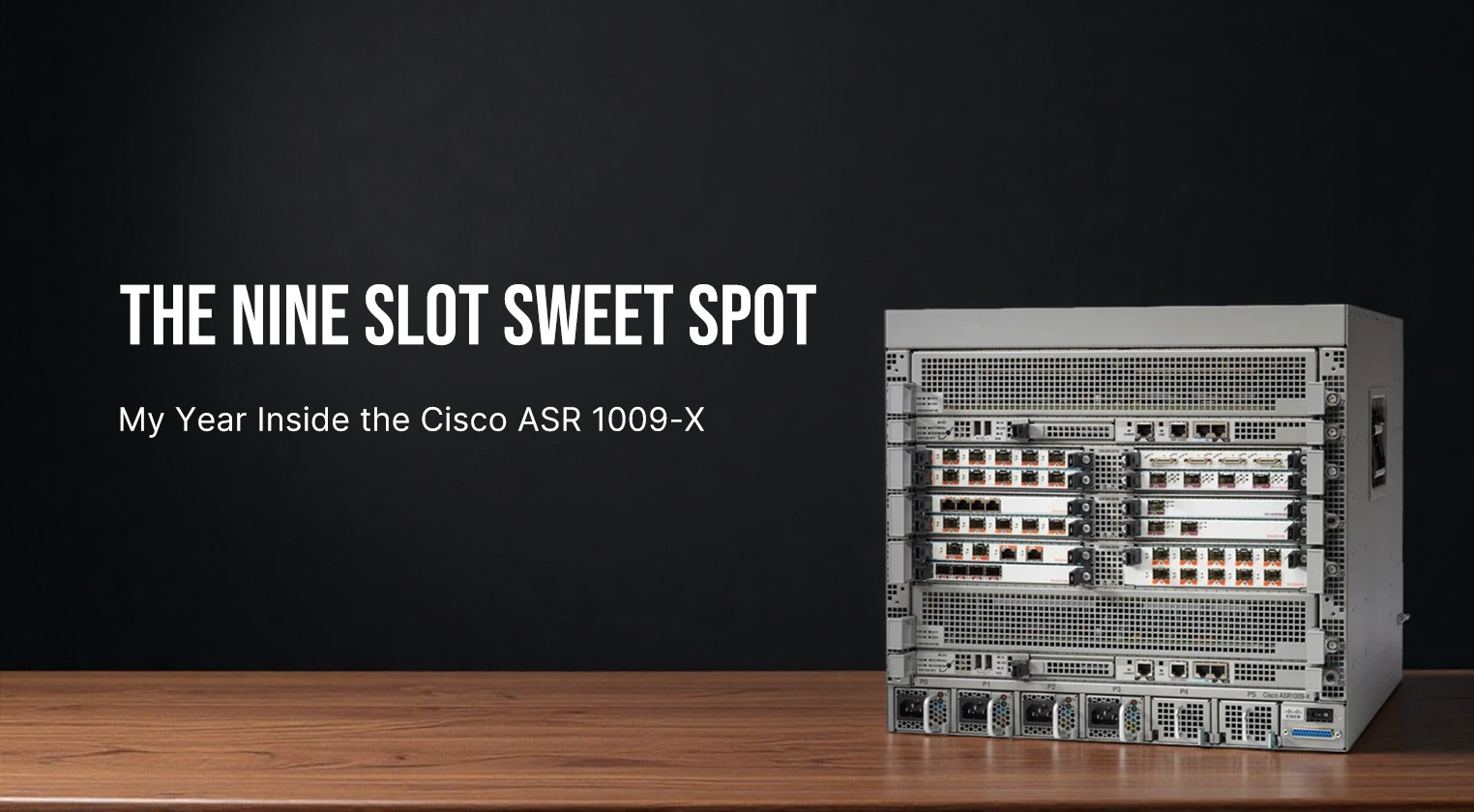
Physically, the thing is a beast. It occupies nine rack units, which sounds specific but feels substantial when you are trying to find space in a crowded cabinet. The front panel is a grid of slots that looks intimidating until you realize the flexibility it offers. Unlike older fixed chassis, the
1009-X lets you mix and match service modules in a way that feels almost like building a PC, provided you have the budget for the parts. The airflow is front-to-back, which is standard, but the volume of air moved is not. We had to adjust the cold aisle containment because the exhaust heat was warmer than we anticipated. It is not loud enough to trigger safety alarms in a proper data center, but if you ever have to lean in to read a serial number while it is running, you will feel the heat on your face. That physical presence sets the expectation. This is not a quiet appliance. It is industrial infrastructure.
The real experience begins when you power it on and start poking around IOS XE. The boot time is reasonable, but the real test is how the system handles load. We pushed this box to handle about 80 percent of its rated throughput during a peak migration window, and the CPU stayed surprisingly calm. That is the benefit of the separated plane architecture. The Route Processor handles the control logic while the Embedded Services Processor takes the hit for the actual packet forwarding. I remember watching the show process cpu command during a BGP flap storm and feeling a level of relief that is hard to describe. The control plane did not spike. The data plane kept moving. That separation is the core of why you buy this over a cheaper integrated router. You are paying for stability when things go wrong, not just speed when things go right.
| Specification |
Detail |
| Chassis Model |
Cisco ASR 1009-X |
| Rack Units |
9 RU |
| Slot Count |
9 General Purpose Slots |
| Route Processor |
Single slot (RP1, RP2, or RP3) |
| Embedded Services Processor |
Single slot (ESP40, ESP100, ESP200) |
| Max Throughput |
Up to 200 Gbps (dependent on ESP) |
| Power Supply |
Up to 4 AC/DC inputs (N+N redundancy) |
| Fan Trays |
Dual redundant, field-replaceable |
| Management Ports |
Gigabit Ethernet, Console (RJ-45/Mini-USB) |
| Operating System |
Cisco IOS XE |
| DRAM |
Scalable (typically 8GB to 16GB on RP) |
| Boot Storage |
USB, CompactFlash, eUSB |
| MTBF |
Approx. 100,000+ hours |
However, living with the
1009-X is not without its frustrations. The licensing model is the first hurdle. You buy the hardware, but the throughput is locked behind a software license. It feels like buying a car with a governor on the engine and paying extra to remove it. We once had a scenario where we upgraded the ESP hardware but forgot to upgrade the throughput license, and the box throttled itself exactly at the limit. It was a humbling lesson in reading the fine print. The CLI is familiar to anyone who knows Cisco, but the sheer number of options in IOS XE can be overwhelming. It is powerful, yes, but sometimes I miss the simplicity of older IOS versions. The complexity here is a double-edged sword. You can do almost anything, but configuring advanced features like flexible NetFlow or complex QoS policies requires a deep dive into documentation that assumes you already know what you are doing.
From a maintenance perspective, the modularity is a lifesaver. I have swapped out a fan tray on a live system without so much as a packet loss, which is the kind of magic that keeps you employed. The components are accessible, and the labeling is clear. But cable management on a nine-slot chassis requires discipline. If you do not plan your fiber runs and power cables carefully, the front of the rack becomes a spider web that blocks airflow. We learned to use vertical cable managers religiously. Another quirk is the power consumption. It is not inefficient, but a fully loaded chassis draws enough power that you need to verify your PDU capacity before plugging it in. We nearly tripped a breaker during initial testing because we assumed the idle power draw would be lower. It is not a device you can just drop into any available slot without checking the infrastructure first.
The value proposition is where the
1009-X really makes sense. It is not cheap. Nothing in the ASR family is. But when you compare it to buying multiple smaller routers to achieve the same density and redundancy, the total cost of ownership often leans in favor of the 1009-X. You save on rack space, power distribution, and management overhead. You have one device to monitor instead of four. For a mid-sized service provider or a large enterprise campus core, this consolidation is worth the upfront investment. It is not the right choice for a small branch office. That would be overkill. But for an aggregation point where downtime costs money, the reliability justifies the price tag. It sits in a sweet spot where performance meets practicality.
There are downsides you need to accept. The single RP slot can be a concern for some, though the system is stable enough that it rarely matters. If you want dual Route Processors for absolute control plane redundancy, you need to look at the 1013, which costs more and takes more space. The 1009-X assumes you trust the hardware reliability of the single RP, and in my experience, that trust has been well-placed. The fan noise is another factor. It is not office-friendly. This is a data center device, and it sounds like one. Also, the learning curve for the newer IOS XE features can be steep if your team is used to legacy IOS. There are subtle differences in how commands are structured and how packages are managed. It requires training, not just plugging and playing.
After a year of operation, the ASR
1009-X has become the backbone of our edge network. It handles the traffic spikes without complaining. It survives the firmware upgrades with minimal drama. The initial anxiety of deploying such a critical piece of hardware has faded into a routine confidence. When I look at the monitoring dashboard and see the green lights on the 1009-X, I feel a sense of security that is hard to quantify. It is not perfect. The licensing is annoying, the heat is real, and the configuration depth is daunting. But it works. In this industry, that is the highest compliment you can pay a piece of equipment. It does the job quietly, or as quietly as a nine-unit chassis can, and it lets me sleep at night knowing the edge is holding. That reliability is what you are actually buying, far more than the throughput numbers or the slot count.