The Six-Rack-Unit Elephant in the Room: Real Talk on the Cisco ASR 1006-X
It usually starts with the alarm. You're sitting in a NOC or a data center, and suddenly the ambient noise level spikes, or you get a syslog message about throughput throttling that you didn't expect. The Cisco
ASR 1006-X has a reputation for being a beast, but like any powerful engine, it has quirks that only show up after you've lived with it for a while. One of the most common frustrations I've seen with this chassis isn't a hardware failure, but a licensing mismatch. Engineers order the box expecting 100 Gbps of raw power, plug it in, and then realize the Embedded Services Processor (ESP) is capped at a fraction of that speed until the right performance license is applied. It's a harsh lesson in the modern Cisco licensing model that catches even seasoned veterans off guard. Then there's the heat. This thing breathes fire, metaphorically speaking. If your cold aisle containment isn't perfect, the
ASR 1006-X will let you know with fan speeds that sound like a jet engine preparing for takeoff. These aren't dealbreakers, but they are the reality checks that define the user experience before you even type your first command.
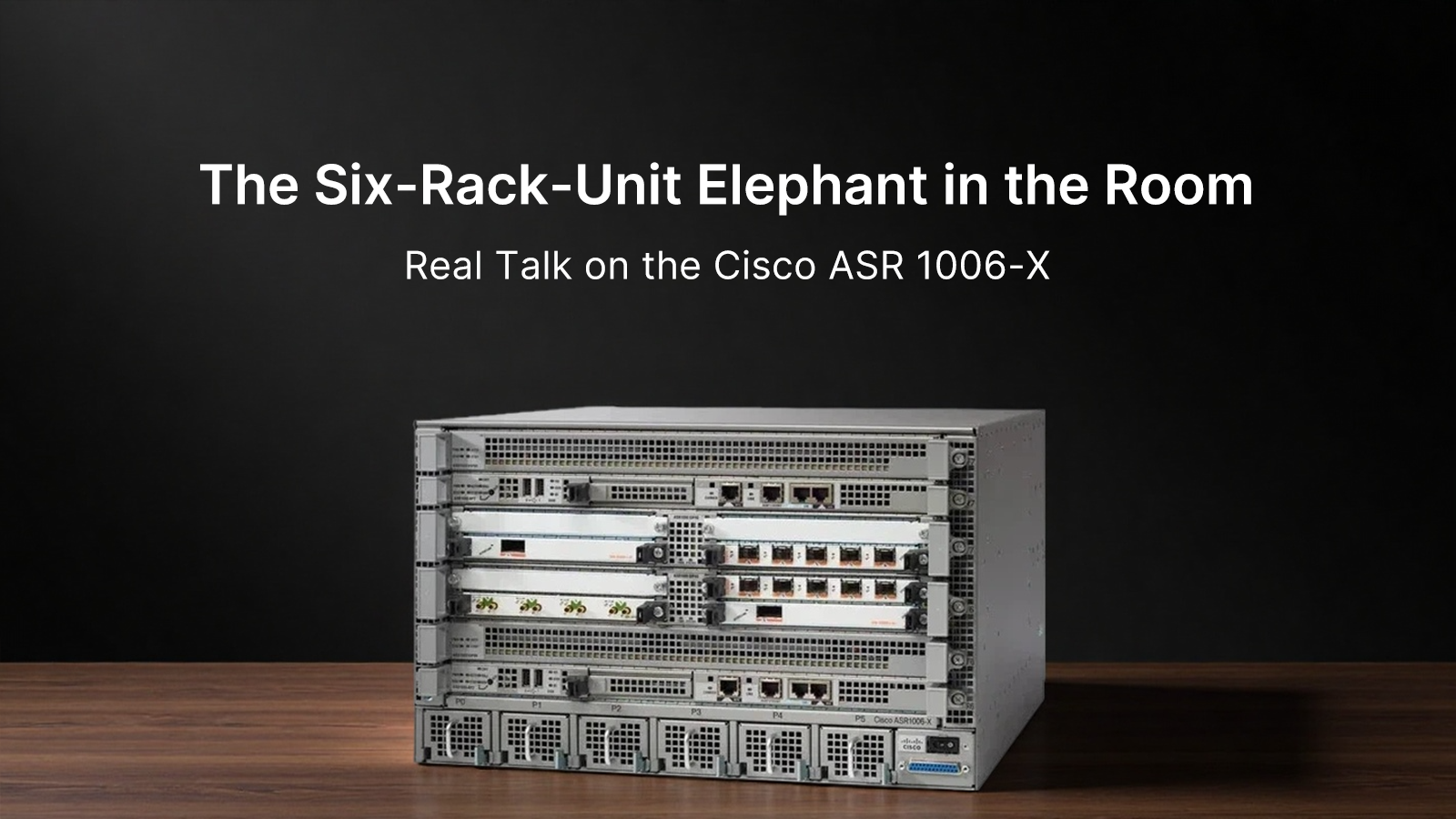
Once you get past the initial setup hurdles and licensing paperwork, the physical presence of the
ASR 1006-X is undeniable. It's a 6-rack-unit chassis, which means it dominates the vertical space in a standard cabinet. Unlike the sleeker 1U branch routers, this is aggregation gear, and it looks the part. The front panel is a grid of modular slots, dominated by the Route Processor (RP) and the ESP slots that sit centrally. The SIP (SPA Interface Processor) slots line up ready to accept whatever connectivity modules you need. It's not pretty in a consumer sense; it's industrial. The bezel is functional metal, the LEDs are bright and status-focused, and the airflow design is strictly front-to-back. When you slide it into the rack, you need to ensure you have the depth clearance because the cabling at the rear can get heavy, especially if you're populating all the SIP slots with high-density SPAs. It feels dense, heavy, and built to stay in one place for a decade.
Under the hood, the architecture is what justifies the rack space and the power draw. The separation of the control plane (RP) and the data plane (ESP) is the core design philosophy here. This means your routing protocols and management traffic don't fight with your actual packet forwarding. It's a design that prioritizes stability over raw clock speed, and in a core or aggregation role, that stability is currency. The system bandwidth can scale significantly depending on the ESP installed, reaching up to 100 Gbps in ideal configurations, but the real magic is in how it handles services. Encryption, NAT, firewalling—these are offloaded to the ESP, so enabling IPSec tunnels doesn't tank your CPU utilization on the Route Processor. This architecture allows the box to wear many hats without collapsing under the weight of its own features.
| Parameter |
Specification |
| Model |
Cisco ASR 1006-X |
| Form Factor |
6 Rack Units (6RU) |
| System Bandwidth |
Up to 100 Gbps (ESP dependent) |
| RP Slots |
2 (Active/Standby Redundancy) |
| ESP Slots |
2 (Embedded Services Processor) |
| SIP Slots |
6 (SPA Interface Processor) |
| Memory |
Scalable DRAM (typically 8GB-16GB base) |
| Power Supplies |
Up to 6 AC/DC (N+1 Redundancy) |
| Fan Trays |
2 Field-Replaceable Trays |
| Operating System |
Cisco IOS XE |
| Throughput Licensing |
Tiered (2.5G to 100G) |
| Management |
Console, Aux, Gigabit Ethernet Mgmt |
| USB |
Type-A ports for storage/boot |
Living with the
ASR 1006-X day-to-day is a mix of power and complexity. The user experience is heavily tied to IOS XE, which is generally robust but can be verbose. If you're coming from a JUNOS or NX-OS background, the CLI will feel familiar but with Cisco's unique quirks. Configuration management is straightforward if you use tools like Ansible or Cisco DNA Center, but doing it manually on a box with this many slots requires discipline. I've seen configurations become messy simply because there are so many interface types possible. One day you're configuring a TenGig interface, the next you're dealing with a legacy T3 SPA. The flexibility is a double-edged sword; it allows you to adapt to any network requirement, but it also means the configuration can become a sprawling document that's hard to audit. On the positive side, the redundancy features work flawlessly. I've performed RP failovers during maintenance windows without dropping a single session, and the power supply redundancy gives you the confidence to swap units live. That operational peace of mind is hard to quantify but invaluable.
In terms of use cases, this router lives in the aggregation layer. It's not for the branch office, and it's not quite a core backbone router for a massive ISP, but it sits perfectly in the middle. I've deployed them as Internet edge devices for large enterprises, terminating BGP sessions and handling DDoS mitigation scrubbing. They also excel as WAN aggregation points, pulling in traffic from hundreds of remote sites via MPLS or DMVPN. The ability to run Cisco CUBE (Unified Border Element) on the same box means you can consolidate your voice and data edge, reducing the physical footprint in the data center. For service providers, it's a popular choice for L2/L3 VPN services where QoS is critical. The granularity of the QoS policies you can apply here is deep, allowing for complex traffic shaping that cheaper edge routers simply can't handle. It's a consolidation tool, designed to take three or four specialized appliances and merge them into one chassis.
However, we need to talk about the downsides, because they are significant. The power consumption is high. Running dual RPs, dual ESPs, and a full load of SPAs means you need to budget for watts, not just rack units. The heat output follows suit, requiring robust cooling. If you put this in a closet that wasn't designed for carrier-grade gear, you'll have problems. The licensing model, as mentioned earlier, is another pain point. Unlocking the full throughput potential requires additional investment, and the tiers can be confusing. There's also the issue of obsolescence. While the ASR 1000 series is mature and stable, newer platforms like the Catalyst 8000V or NCS series are pushing higher densities with lower power. The ASR 1006-X is no longer the bleeding edge, so you're buying into a technology that is in the latter half of its lifecycle. This affects long-term planning, as support contracts and software updates will eventually phase out.
Despite these drawbacks, the value proposition remains strong for certain scenarios. If you can acquire the hardware at a mature market rate, the cost per gigabit of managed throughput is competitive. The real value isn't just in the bandwidth, but in the feature density. Being able to run advanced security, deep packet inspection, and high-availability routing in a single box reduces operational overhead. You manage one OS, one power system, one set of logs. That simplification saves engineering hours, which often costs more than the hardware itself. The modularity also protects your investment. If your network evolves from copper to fiber, or from 1GE to 10GE, you swap the SPA, not the router. This adaptability extends the useful life of the chassis, allowing it to outlast several generations of fixed-configuration competitors.
The pros and cons really depend on your specific environment. On the pro side, you get carrier-class redundancy, massive I/O flexibility, and a proven IOS XE codebase that most engineers already know. The separation of control and data planes ensures that a spike in traffic doesn't lock you out of management. On the con side, the physical size limits where you can deploy it, the power and cooling requirements are non-negotiable, and the licensing complexity can lead to unexpected costs. It's not a device for the faint of heart or the budget-constrained small business. It's for organizations that need a central aggregation point that won't fail when the traffic spikes.
In the end, the
ASR 1006-X is a workhorse that demands respect. It doesn't try to be friendly; it tries to be reliable. If you treat it right—give it clean power, adequate cooling, and the correct licenses—it will form the backbone of your network for years. If you try to cut corners on the environment or the software entitlements, it will let you know loudly and expensively. For the right deployment, it's one of the most capable aggregation routers ever built, balancing flexibility and performance in a way that few competitors have matched. It's the kind of gear you install, configure, and then trust to handle the heavy lifting while you focus on the rest of the network. Just make sure you check your license levels before you turn it on.