
Intellectual Property
Hot selling product recommendations
View More




















Cisco AIR-CAP2702I-H-K9: The Unseen Engine of Modern Business Connectivity
Walk into any modern office, school, or hospital where reliable Wi-Fi is not a luxury but a necessity, and you might just find a sleek, unassuming white disc on the ceiling quietly powering the entire digital ecosystem. This is often the Cisco AIR-CAP2702I-H-K9, an indoor wireless access point that has become a staple in enterprise networks. It’s the kind of hardware that goes unnoticed until something breaks, which, for this device, is a rare occurrence. Designed for demanding indoor environments, it delivers the robust and consistent connectivity that today's data-heavy applications demand.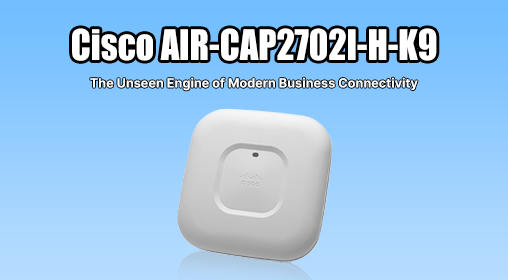
You can recognize it by its circular, low-profile design measuring 221 millimeters in diameter and 51 millimeters in height, finished in a clean white casing that blends discreetly into most ceiling tiles. Weighing between 1 to 2.2 kilograms, it feels substantial without being bulky, hinting at the solid components inside. The front is minimalist, with only a few subtle indicator LEDs, while the base houses its connectivity options: two self-sensing 10/100/1000BASE-T Gigabit Ethernet ports and a separate RJ-45 console port for management. This dual-port setup is a thoughtful touch, allowing for flexible network backhaul connections. It's designed for easy installation via PoE (Power over Ethernet), which means a single cable run to the ceiling provides both power and data, significantly simplifying deployment.
Beneath its simple exterior lies performance that has kept it relevant for years. As a dual-band 802.11ac access point, it offers theoretical connection speeds of up to 1.3 Gbps (1300 Mbps), a significant step up from older wireless standards. This speed is crucial for handling multiple high-bandwidth activities simultaneously, like video conferencing and large file transfers, without creating a bottleneck. The radio design uses integrated antennas with a gain of 4 dBi in the 2.4 GHz band and 5-6 dBi in the 5 GHz band, providing a balanced coverage pattern suitable for open office plans. Here’s a quick look at its core technical heart:
|
Feature |
Specification |
|---|---|
|
Network Standards |
IEEE 802.11a/b/g/n/ac
|
|
Maximum Speed |
1300 Mbps
|
|
Frequency Bands |
Simultaneous Dual-Band (2.4 GHz & 5 GHz)
|
|
Interface |
2 x Gigabit Ethernet Ports, 1 x Console Port
|
|
Antenna |
Internal Integrated Antennas
|
|
Power Supply |
PoE (802.3af/at) or Local DC Power
|
|
Operating Temperature |
-30 °C to 70 °C
|
One of its most appreciated features in IT departments is its dual-mode, or "fat and thin" flexibility. Out of the box, it can operate as a standalone "fat" AP, managing all its settings independently—perfect for smaller sites. However, when dropped into a larger network, it can seamlessly convert into a "thin" AP, handing over control to a central Cisco wireless controller. This allows for centralized management, automatic updates, and coordinated radio frequency tuning across hundreds of access points, a godsend for administrators managing a vast campus. On the security front, it goes beyond basic password protection, supporting enterprise-grade protocols like WPA2, WPA3, and AES encryption, and includes capabilities to detect rogue access points and mitigate denial-of-service attacks, creating a more secure wireless environment.
From a user's perspective, the experience is defined by stability. In spaces equipped with these access points, the Wi-Fi connection tends to be steadfast, with minimal drop-offs as you move around. The robust build quality allows it to operate reliably in a wide range of conditions, from a chilly server room to a warm manufacturing floor, with an operating temperature range of -30°C to 70°C. For the network administrator, the initial setup via the controller is straightforward, and once configured, the device just works. The 15W power consumption is reasonable for its performance class, contributing to lower long-term operating costs. While it may not have the absolute fastest speeds of the latest Wi-Fi 6/6E models, its performance remains more than adequate for the vast majority of business applications today, from cloud-based software to VoIP calls.
Assessing its value proposition reveals why it remains a common sight. The real strength of the 2702i lies in its legendary Cisco build quality and that enterprise-grade reliability. It's built to last for many years, offering a total cost of ownership that is attractive when weighed against frequent replacements of less durable equipment. The extensive features for network management and security provide significant value for organizations that need a professional, controllable wireless infrastructure rather than a consumer-grade solution. Its durability and sustained performance in the secondary market are a testament to its inherent quality, making it a smart long-term investment for businesses prioritizing stability over cutting-edge speed.
Of course, no technology is without its compromises. The most evident drawback is the lack of support for the latest Wi-Fi 6 and Wi-Fi 6E standards, which means it misses out on features like higher efficiency in dense device environments and lower latency. For a company planning a new deployment with a focus on future-proofing for the next five to seven years, this could be a limitation. Some might also find the initial acquisition cost to be a consideration compared to some less feature-rich alternatives, though this is balanced against the brand's reputation and comprehensive feature set. Ultimately, the Cisco AIR-CAP2702I-H-K9 may not be the flashiest or newest player on the field, but it continues to be a profoundly competent and trusted one, delivering the solid, manageable, and dependable wireless foundation that businesses rely on every day.