
Intellectual Property
Hot selling product recommendations
View More




















Cisco A9K-RSP880-TR: The Heart of High-Performance Networking
When you slide the Cisco A9K-RSP880-TR into an ASR 9000 chassis, you are not just inserting a component—you are activating the core intelligence of the network. This Route Switch Processor is designed for service providers and large enterprises that demand relentless performance and scalability. It serves as the central nervous system for the router, handling critical tasks like packet forwarding, route processing, and system management. In environments where every millisecond counts, such as data centers or telecommunications hubs, the RSP880 ensures traffic flows smoothly even under extreme loads. Its role extends beyond mere switching; it integrates advanced routing protocols and quality-of-service policies to maintain order in complex network ecosystems.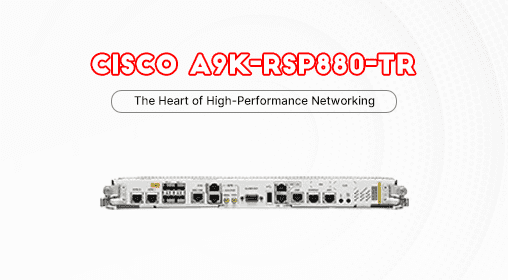
The processor’s architecture is built for heavy lifting. With a quad-core 2.4 GHz CPU and 16 GB of DDR3 memory, it tackles massive routing tables and concurrent operations without breaking a sweat. The inclusion of dual 128 GB SSDs provides ample storage for logging and system diagnostics, while the 64 GB flash memory ensures swift boot times and reliable software updates. For connectivity, it features two RJ-45 ports supporting 10/100/1000Base-T, along with SFP+ slots for fiber optics, enabling seamless integration into existing infrastructure. Here is a breakdown of its core specifications:
|
Parameter |
Specification |
|---|---|
|
Processor |
Quad-core 2.4 GHz |
|
Memory |
16 GB DRAM |
|
Storage |
64 GB SSD, 128 GB (dual SSDs) |
|
Ports |
2 x RJ-45 (Gigabit Ethernet), SFP+ slots |
|
Maximum Data Transfer Rate |
10 Gbit/s |
|
Redundancy Support |
Hot-swappable components, redundant power |
|
Compatibility |
Cisco ASR 9000 Series routers |
Physically, the module embodies Cisco’s commitment to robustness. The metal chassis is designed to dissipate heat efficiently, with reinforced edges to withstand frequent handling during maintenance. The port arrangement is logical and labeled clearly, reducing the chance of errors during cable connections. Despite its powerful internals, the board maintains a streamlined profile to avoid obstructing airflow in densely packed chassis. The cooling system operates with a low hum, making it suitable for deployment in noise-sensitive environments like office server rooms.
Functionally, the RSP880 excels in versatility. It supports multi-layer routing protocols including BGP and OSPF, allowing network architects to design resilient topologies. The embedded QoS mechanisms prioritize latency-sensitive traffic such as VoIP or video streaming, while security features like ACLs safeguard against unauthorized access. However, it is worth noting that as a specialized component, its capabilities are tightly coupled with the ASR 9000 ecosystem. This means upgrades often require chassis compatibility checks, and interoperability with non-Cisco gear can be limited. For IT teams deeply invested in Cisco’s environment, this integration is a strength; for heterogeneous networks, it might pose challenges.
Users of the RSP880 often highlight its reliability. One network engineer noted that after deployment, the system ran for years without unscheduled downtime—a testament to its solid construction. The learning curve is minimal for those familiar with Cisco’s IOS-XR, though newcomers might need time to master the CLI for advanced features like dynamic load balancing. On the downside, the processor’s power consumption is higher compared to newer models, which could impact operational costs in large-scale deployments. Additionally, the lack of support for 25G or 40G interfaces might limit its appeal in networks transitioning to higher speeds.
When evaluating its pros and cons, the advantages include proven stability, high throughput, and seamless integration with the ASR 9000 platform. The drawbacks revolve around its aging architecture—energy inefficiency and limited support for modern interfaces. Yet, for organizations prioritizing reliability over cutting-edge specs, the RSP880 remains a cost-effective workhorse. Its value lies in delivering consistent performance without the premium price tag of newer processors, making it a sensible choice for core routing duties in legacy upgrades or budget-conscious expansions.
In summary, this processor exemplifies Cisco’s focus on endurance and practicality. It might not have the buzz of latest-generation hardware, but it gets the job done with minimal fuss—a quality that resonates deeply with those who keep networks running day in and day out.