
Intellectual Property
Hot selling product recommendations
View More




















Cisco A9K-36X10GE-SE: High-Density Networking for Modern Infrastructure
The Cisco A9K-36X10GE-SE is a line card built for the ASR 9000 Series routers, focusing on packing 36 ports of 10 Gigabit Ethernet into a single module to tackle the bandwidth crunch in modern networks. It’s not just about adding ports—it’s about doing so efficiently, whether you’re a service provider scaling 5G backhaul or an enterprise linking distant data centers. Let’s walk through what makes this piece of gear tick, from its real-world uses to how it feels to actually run it.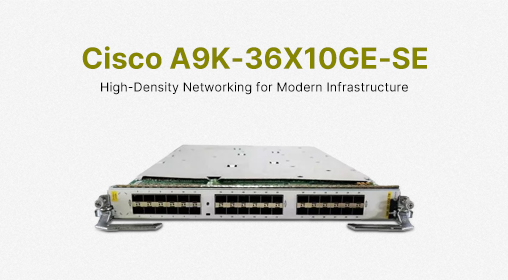
For specific purposes, this card shines in scenarios where density matters most. Mobile carriers use it to aggregate traffic from cell towers, handling thousands of concurrent 10GE streams without breaking a sweat. Enterprises deploy it in WAN aggregation points to connect branch offices to headquarters, ensuring low-latency access to cloud apps. Data centers rely on it for inter-server communication or storage area network (SAN) links, where every microsecond counts for application performance. It handles both Layer 2 switching and Layer 3 routing, so you can consolidate tasks that once needed separate hardware, cutting down on rack space and management headaches.
When it comes to performance, the numbers speak for themselves. The card delivers line-rate forwarding across all 36 ports, meaning no bottlenecks even when every port is maxed out. Aggregate bandwidth hits up to 3.6 Tbps, which translates to smooth handling of massive data flows—think 4K video streams, bulk file transfers, or real-time analytics workloads. Latency stays below 1 microsecond thanks to hardware-accelerated packet processing, critical for time-sensitive apps like financial trading or VoIP. Here’s a quick look at its core specs in a structured format:
|
Parameter |
Specification |
|---|---|
|
Ports |
36 x 10GE SFP+ |
|
Aggregate Throughput |
Up to 3.6 Tbps |
|
Forwarding Latency |
<1 μs (packet-to-packet) |
|
Power Consumption |
150W (typical) |
|
Redundancy |
Hot-swappable power supplies |
Physically, the module has a no-nonsense design focused on practicality. It’s compact enough to fit in crowded ASR 9000 chassis, with ports arranged in four neat rows of nine to keep cables tidy. The casing uses heat-resistant alloys and reinforced connectors, so it holds up in data centers with strict cooling or outdoor telecom cabinets exposed to temperature swings. Hot-swappable installation means you can swap it without shutting down the whole router—handy for upgrades or repairs. You’ll notice the lack of flashy branding; instead, there’s a subtle Cisco logo and port labels that are easy to read even when the card’s partially installed.
Functionality-wise, it’s packed with features that matter day-to-day. Traffic management lets you prioritize critical apps—say, giving video conferencing packets precedence over routine backups—using granular QoS policies. Network virtualization support (VXLAN, EVPN) helps build overlay networks for multi-tenant clouds, letting different departments share infrastructure securely. Automation hooks into Cisco DNA Center, so you can push configs across multiple cards with scripts, cutting manual errors. Redundant power supplies and failover mechanisms mean if one power input fails, the other takes over without dropping connections—something a hospital’s network team told me was a lifesaver during a recent outage.
From a user perspective, network admins who’ve used it highlight two things: stability and ease of integration. One engineer managing a regional ISP said, “We pushed 30 ports to full 10GE load during a 5G launch, and the card didn’t flinch—logs stayed clean, and troubleshooting was straightforward with Cisco’s tools.” The CLI feels familiar if you’ve used other Cisco gear, so training time is minimal. That said, the high port count demands planning: in smaller chassis, you’ll need to check airflow to avoid overheating, and mapping out cable runs early prevents messy racks later.
On value, the upfront cost is higher than lower-density cards, but the long-term savings are compelling. Consolidating 36 ports into one card cuts hardware expenses, and energy efficiency lowers utility bills—one enterprise reported saving 20% on power after swapping older cards for this. Less hardware also means fewer spares to stock and simpler firmware updates. For growing networks, it scales better than buying multiple smaller cards, avoiding the “chassis sprawl” that complicates management.
Its strengths are clear: unmatched 10GE density in a single slot, rock-solid performance under load, and deep Cisco ecosystem integration. The ability to upgrade software for new protocols (like future EVPN enhancements) keeps it relevant longer. But it’s not perfect. The initial price tag stings for smaller setups, and it’s tied to ASR 9000 chassis—if you’re using another vendor’s router, this card won’t work. Thermal management can be tricky in poorly cooled racks, too.
In short, the A9K-36X10GE-SE is a specialist tool for networks where 10GE density is non-negotiable. It’s not for everyone, but for those needing to move massive amounts of data reliably, it’s a workhorse that balances performance, scalability, and ease of use. If you’re already in the Cisco ecosystem and planning for growth, this card could be the backbone of your next network upgrade.