
Intellectual Property
Hot selling product recommendations
View More




















Cisco’s Catalyst Showdown: C9500-40X-A vs. C9500-48Y4C-A — Which Powerhouse Fits Your Network?
Hey there! If you’re weighing options between Cisco’s Catalyst 9500 series switches, you’ve probably noticed the C9500-40X-A and C9500-48Y4C-A popping up as top contenders. Both are beasts in their own right, but they cater to slightly different needs. Let’s break ’em down without the jargon overload.
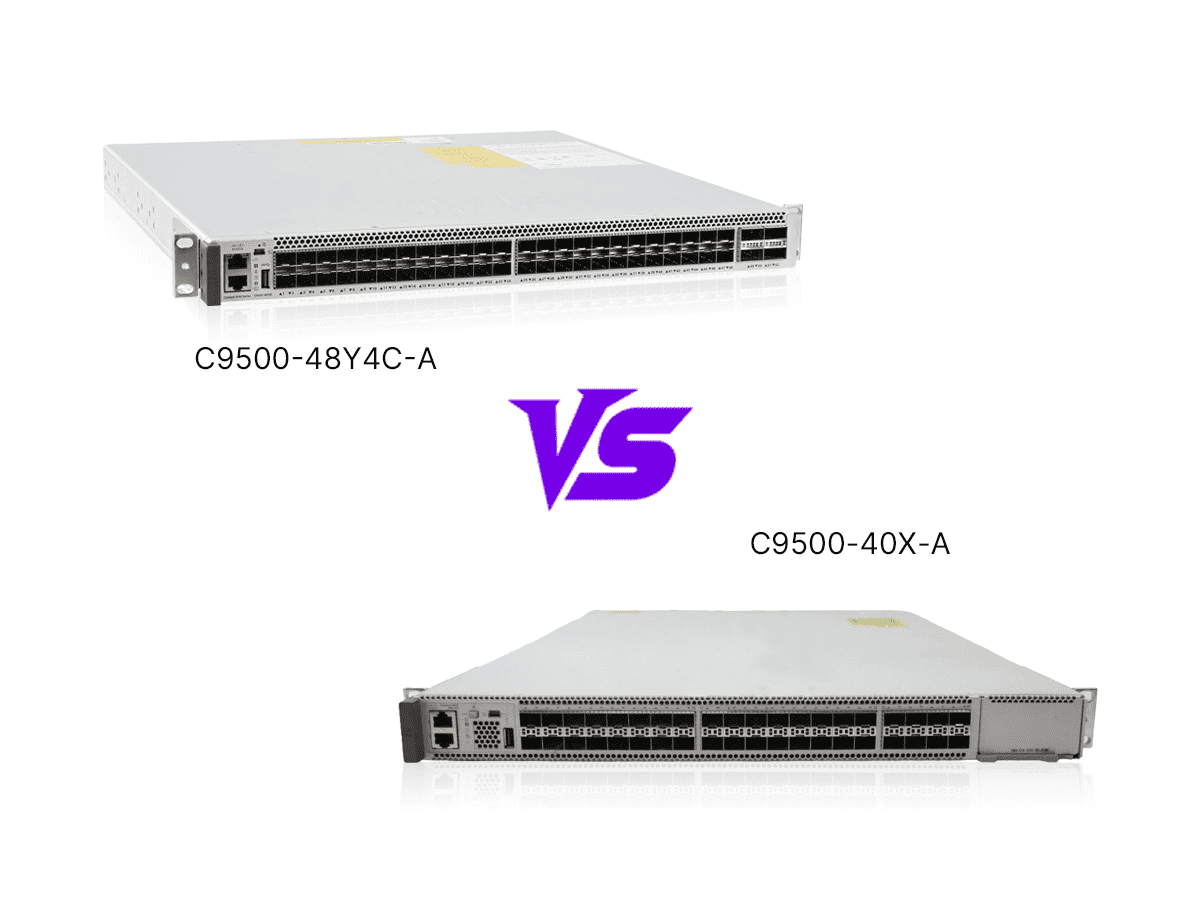
Here’s a quick table to visualize the key differences:
|
Feature |
C9500-40X-A |
C9500-48Y4C-A |
|---|---|---|
|
Port Configuration |
40x 10G SFP+ ports |
48x 1/10/25G downlink + 4x 40/100G uplink ports |
|
Backplane Bandwidth |
960 Gbps |
960 Gbps |
|
Packet Forwarding Rate |
720 Mpps |
720 Mpps |
|
Power Supply |
AC 115–230V (typical consumption ~950W) |
Dual AC inputs for redundancy |
|
Layer 3 Capabilities |
Full routing protocols, VLANs, QoS |
Advanced QoS, IPv4/IPv6 multicast, stacking |
|
Typical Price Range |
~6,600
|
~13,000
|
Both switches rock a sleek 1RU form factor, so they won’t hog space in your rack. The C9500-40X-A measures about 44 × 445 × 567 mm and weighs 11.68 kg, while the C9500-48Y4C-A has a similar footprint but includes enhanced cooling to handle the heat from those high-speed 25G/100G ports.
Fun detail: The 48Y4C model’s chassis is optimized for better airflow, which matters when you’re pushing data at 100G speeds. Both feel solid—typical Cisco quality.
C9500-40X-A is your go-to for pure 10G environments. It’s straightforward, with 40 dedicated SFP+ ports ideal for aggregation or data centers where simplicity rules. It supports up to 4,094 VLANs and boasts a QoS ACL capacity of 18,000 entries. Think of it as a reliable workhorse—no surprises.
C9500-48Y4C-A is the flexible futurist. Its mixed-speed ports (1G/10G/25G downlinks + 40/100G uplinks) let you connect legacy gear alongside modern equipment. It also steps up with higher multicast routing tables (up to 32,000 IPv4 routes) and shines in software-defined networking (SDN) setups. Perfect if you’re planning a spine-leaf architecture.
For the 40X-A: Setup is a breeze if you’re familiar with Cisco’s IOS-XE. It’s ideal for admins who want a “set it and forget it” switch—especially in networks where 10G uniformity simplifies troubleshooting. DNA Center integration adds centralized management, but you won’t need constant tinkering.
For the 48Y4C-A: Expect a steeper learning curve due to port-speed diversity. But! The payoff is scalability. It’s a dream for growing businesses or campuses that mix old and new gear. The 100G uplinks also make it a beast for core distribution roles.
Let’s be real: the 40X-A wins on upfront cost (~6.6K). It’s a value pick for budgets that demand reliable 10G performance without frills.The 48Y4C-A costs more (~13K), but you’re investing in long-term flexibility. If your network evolves often, those multi-speed ports and 100G uplinks will save you from future hardware swaps.
Both switches are built like tanks. They share an MTBF (Mean Time Between Failures) of ~230,000 hours (about 26 years!) and operate smoothly in temps from 0°C to 40°C. Redundant power supplies and hot-swappable fans are optional but recommended for mission-critical setups.
Translation: whether you choose the 40X-A or 48Y4C, you’re getting Cisco-grade reliability.
Pick the C9500-40X-A if you need a cost-effective, high-density 10G switch for a stable, predictable network. It’s the steady eddy.
Go for the C9500-48Y4C-A if your network is evolving, multi-speed, and ready for the next leap. It’s the forward-thinking powerhouse.
At the end of the day, both deliver Cisco’s trademark performance and security. Your choice boils down to budget, current needs, and where you see your network in five years. Happy networking!