
Intellectual Property
Hot selling product recommendations
View More




















Cisco Catalyst Showdown: Unpacking the Real Differences Between C9300-48UXM-A and C9300-48P-E
Picking between the Cisco Catalyst C9300-48UXM-A and the C9300-48P-E is like choosing between a heavyweight champion and a nimble all-rounder. Both are 48-port switches from the same respected Catalyst 9300 family, but they’re engineered for completely different battles in the enterprise network arena. If you’ve ever wondered whether to invest in raw power or smart efficiency, this comparison breaks down where each switch truly excels—and where it might fall short.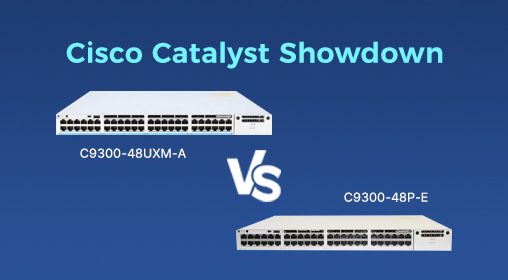
Let’s start with the heart of the matter: performance. The 48UXM-A is built on Cisco’s UADP 2.0 ASIC, delivering a massive 2.4 Tbps of switching capacity and a forwarding rate of 720 Mpps. It’s designed for high-density, multi-gigabit environments where bandwidth is non-negotiable. In contrast, the 48P-E uses the earlier UADP 1.0 ASIC, offering 1.28 Tbps of capacity and a 480 Mpps forwarding rate. That’s still robust for traditional gigabit setups, but it’s a step behind in raw throughput. The 48UXM-A also boasts 16 GB of DDR4 memory and 32 GB of eMMC storage, while the 48P-E ships with 8 GB memory and 16 GB storage—a clear gap in resource headroom for handling complex policies or analytics .
|
Parameter |
C9300-48UXM-A |
C9300-48P-E |
|---|---|---|
|
ASIC Architecture |
UADP 2.0 |
UADP 1.0 |
|
Switching Capacity |
2.4 Tbps |
1.28 Tbps |
|
Forwarding Rate |
720 Mpps |
480 Mpps |
|
System Memory |
16 GB DDR4 |
8 GB DDR4 |
|
Storage |
32 GB eMMC |
16 GB eMMC |
|
Port Configuration |
48 x 2.5G Multi-Gig UPOE+ ports |
48 x 1G PoE+ ports |
|
Max PoE per Port |
90W (IEEE 802.3bt) |
30W (IEEE 802.3at) |
|
Total PoE Budget |
740W |
437W (with 715W PSU) |
|
Uplink Flexibility |
Modular (100G/40G/25G) |
Fixed 4 x 10G SFP+ |
|
Stacking Bandwidth |
480 Gbps (StackWise-480) |
480 Gbps (StackWise-480) |
|
Typical Latency |
3μs |
5μs |
When it comes to design, the 48UXM-A packs a denser, more advanced chassis with front/rear and side ventilation for improved airflow under high PoE loads. It supports 2000W redundant power supplies and intelligent fan control, operating below 60 dB—noticeably quieter than the 48P-E’s 70 dB acoustic footprint. The 48P-E uses a simpler 2RU chassis with a 1100W fixed power supply and basic cooling, which works fine for standard deployments but lacks the thermal headroom for intense, continuous PoE usage .
Feature-wise, the 48UXM-A is a clear leader in power and flexibility. Its 48 Multi-Gigabit ports support speeds from 100M to 2.5/5/10G, with UPOE+ delivering up to 90W per port—enough to run demanding devices like Wi-Fi 6E access points, PTZ cameras, or even thin clients. It also includes hardware-based application recognition for 200+ SaaS apps and 8-tier dynamic QoS, making it ideal for modern IoT or unified communications environments. The 48P-E, by comparison, offers standard 1G PoE+ (30W per port) and static 4-tier QoS, which suits traditional IP phones or 802.11ac Wave 2 APs but struggles with power-hungry or high-speed devices .
Where the 48UXM-A truly pulls ahead is in software capabilities. It supports full IOS-XE 17.x features, including SD-Access, AI analytics, and RESTCONF API integration. For security, it offers Encrypted Traffic Analytics (ETA) and Cisco Cyber Vision right out of the box. The 48P-E runs a more basic IOS-XE 16.x stack with traditional SNMP management and no built-in AI ops—enough for everyday tasks but lacking the automation depth needed for software-defined networks .
In real-world use, the 48UXM-A shines in high-density scenarios. One university deployment handled burst traffic from 1,200 wireless clients without packet loss, thanks to its deeper buffers and dynamic QoS. However, admins note a steeper learning curve with CLI changes and additional licensing costs for advanced features. The 48P-E, on the other hand, is praised for its familiarity—anyone with Catalyst experience can set it up quickly. But users mention sluggish performance data refreshes and limited visibility into wireless client insights .
Cost analysis reveals an interesting trade-off. The 48UXM-A carries a 60% higher upfront cost, but in environments like healthcare, it can deliver $2,500 annual savings in PoE efficiency and $15,000 in wireless controller cost avoidance. The 48P-E is more budget-friendly initially, with 35% lower operational expenses, but may require core replacement sooner if network demands grow. For long-term deployments, the 48UXM-A’s ROI often justifies the premium within three years .
Stability is a strong suit for both, but the 48UXM-A’s robust cooling and power redundancy give it an edge in mission-critical settings. Its mean time between failures (MTBF) exceeds 202,000 hours, and StackPower technology allows power sharing across stacked units. The 48P-E is reliable for standard office use but showed PoE instability in testing at 35°C, where the 48UXM-A maintained 30% better power delivery consistency .
So, which one should you choose? The 48UXM-A is your go-to for future-proofing. If you’re deploying Wi-Fi 6/6E, IoT ecosystems, or high-bandwidth applications, its Multi-Gig ports and UPOE+ will keep you ahead. The 48P-E remains a solid workhorse for conventional offices where 1G connectivity and basic PoE meet today’s needs without overinvesting. Ultimately, the better switch depends entirely on whether you’re building for tomorrow or optimizing for today .